
A Boise State University research team has printed miniature supercapacitors using a new two-metal, atomically thin ink. The material combines niobium, tantalum and sulfur into layered crystals that can be deposited in patterns only 50 micrometers wide. The study appeared in Communications Materials on November 4, 2026; the university publicized the work on November 16.
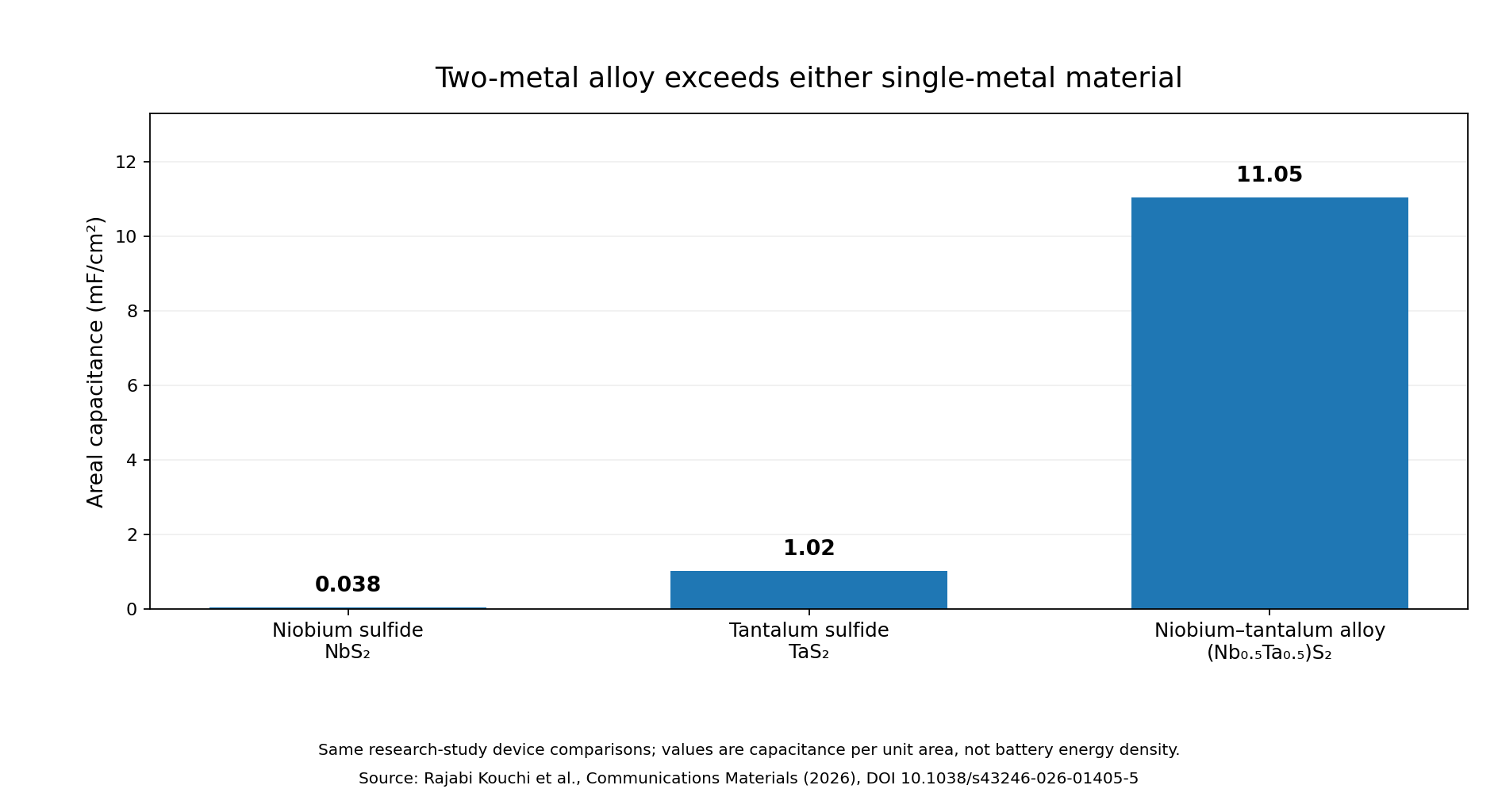
The most revealing result is not simply that the ink can be printed. Under the study’s comparative electrochemical tests, the alloy device delivered 11.05 millifarads per square centimeter of areal capacitance, compared with 1.02 mF/cm² for tantalum sulfide and 0.038 mF/cm² for niobium sulfide. The mixture measured about 10.8 times the tantalum sulfide value, with both devices tested under the reported experimental conditions.
Original 2025 Micron School of Materials Science and Engineering interview with Professor David Estrada, who supervises the alloy-ink research. The interview predates the November 2026 paper and provides laboratory background rather than showing the new device.
Why the alloy is better than either metal alone
The new material is written chemically as (Nb₀.₅Ta₀.₅)S₂. It is a ternary transition-metal dichalcogenide, meaning two different metals share atomic positions inside a layered sulfide crystal. That arrangement is different from stirring two finished powders together. Researchers led by Fereshteh Rajabi Kouchi and supervised by David Estrada engineered the material as printable nanosheets.
According to the university’s research announcement, the team developed a binder-free formulation with suitable viscosity and drying behavior. An aerosol jet printer converted the liquid into a fine spray and deposited it on surfaces including polyimide, paper and sapphire. The tiny features could eventually fit energy-storage components onto flexible electronics.
A supercapacitor differs from a conventional battery. Its electrodes typically store and release electrical charge quickly, rather than depending primarily on slow bulk chemical reactions. Such devices can deliver intense pulses, help buffer brief power interruptions and survive many charge-discharge cycles, although commercial batteries generally store substantially more energy per unit mass.
Capacitance is not battery energy density
Areal capacitance expresses charge-storage response relative to electrode area. It is not battery capacity in milliamp-hours or energy density in watt-hours per kilogram. The paper separately reports a volumetric capacitance of 184.2 farads per cubic centimeter for the alloy’s 600-nanometer-thick electrode at a 5-millivolt-per-second scan rate. The quantities must not be combined or compared as though they shared units.
Boise State University’s official 2025 alumni video profiles research supervisor David Estrada and his work in nanomaterials and manufacturing. It is not footage of the November 2026 experiments.
The researchers also tested a wider operating voltage range. In the expanded window reaching 1.6 volts, areal capacitance rose to roughly 30 mF/cm², but the authors warned that higher voltages could introduce parasitic reactions and faster degradation. The published three-material chart therefore uses the conservative, matched values rather than the larger figure obtained under different conditions.
The hard part is turning a crystal into a manufacturable ink
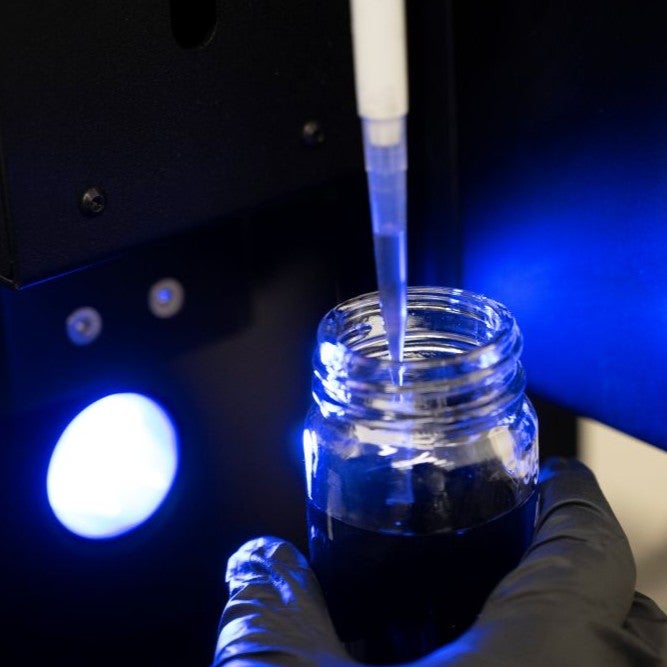
Engineering a new ink is difficult because nanosheets must remain dispersed, resist oxidation and dry without leaving concentrated rings or broken traces. The successful printing demonstrates a complete sequence from crystal synthesis to electrochemical characterization, not simply a promising ingredient described in theory.
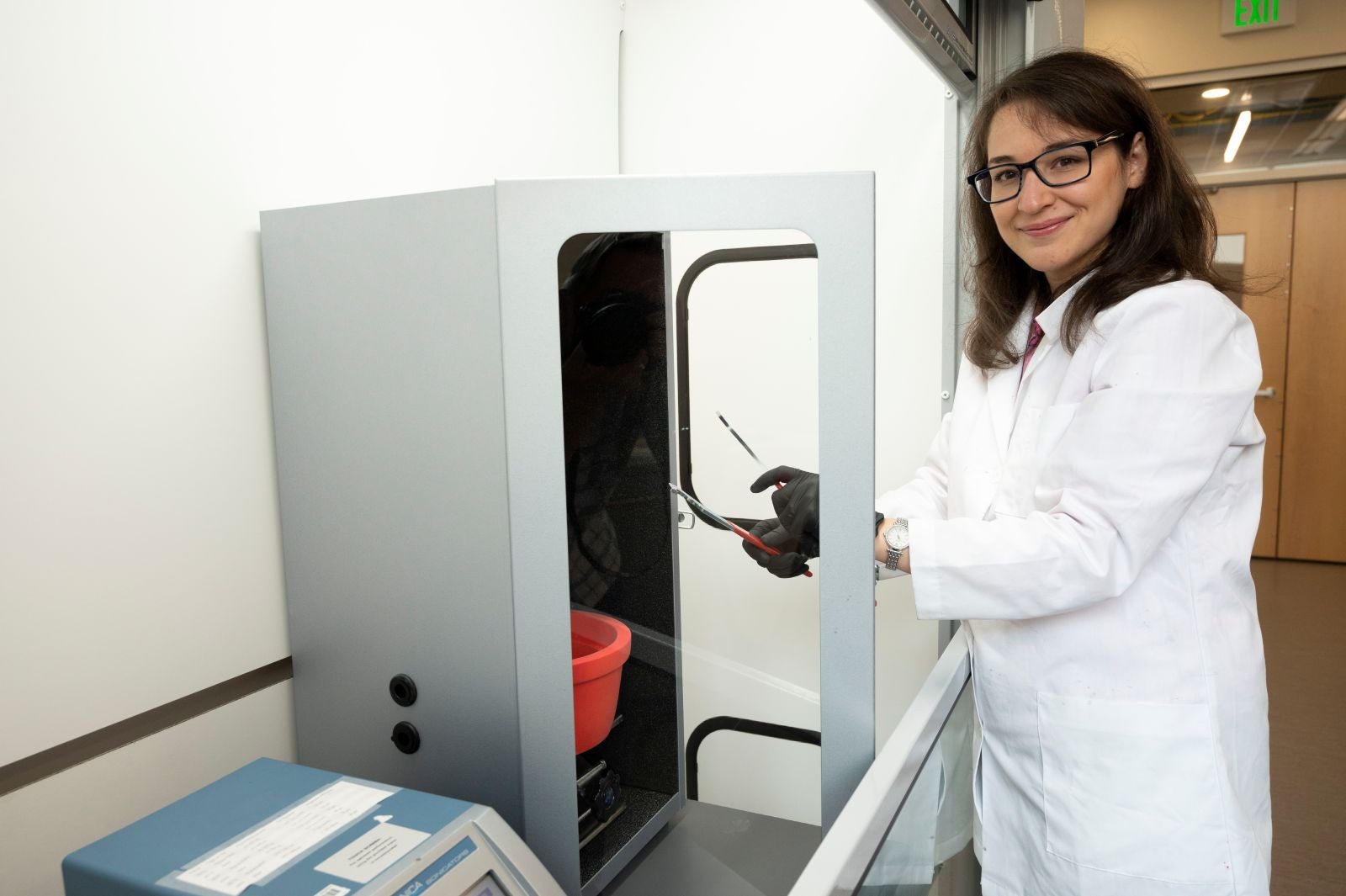
The work is a laboratory proof of concept, not a commercial power source. Its electrode dimensions are tiny; a useful wearable device would still need suitable packaging, a stable electrolyte, scalable interconnections, long-term durability and evidence of economical production. The researchers have not demonstrated that a printed patch can power a phone, electric vehicle or data center.
Where printed energy storage could matter
Related materials research emphasizes why measurement context matters. BitcoinVersus.Tech has previously examined faster printing of intricate battery-compatible structures, a curved battery integrated into a drone leg, supercapacitors for brief AI power spikes and a hand-powered lock that uses capacitive storage. Those systems use different chemistries, sizes and performance metrics.
The importance of the Boise State work lies in expanding the set of materials that manufacturers might print directly onto electronics. A carefully engineered two-metal crystal outperformed either single-metal counterpart in a controlled experiment; whether the advantage survives mass manufacturing and years of operation remains to be established.
Primary research and original media
- Rajabi Kouchi et al., Communications Materials, November 4, 2026, first reported alloy SC tests
- Boise State University original announcement and research photographs, November 16, 2026
- Research authors’ explanatory article, November 19, 2026
- Micron School of Materials Science and Engineering: David Estrada interview, October 14, 2025
- Boise State Alumni and Friends: David Estrada, Distinguished Alumni, October 10, 2025
Editor’s Note: We volunteer daily to ensure the credibility of the information on this platform is Verifiably True. If you would like to support to help further secure the integrity of our research initiatives, please scan the QR code below

For mobile scanning, open the article on another display and scan the QR code with a Bitcoin wallet. Verify the receiving address 3C9o19EH5HSiwEPyCTmEKzxhNCbo2X6TTb before sending.
BitcoinVersus.Tech covers engineering and energy research for information, not investment or purchasing advice. Prototype-level performance should not be interpreted as commercial product certification.


Leave a Reply