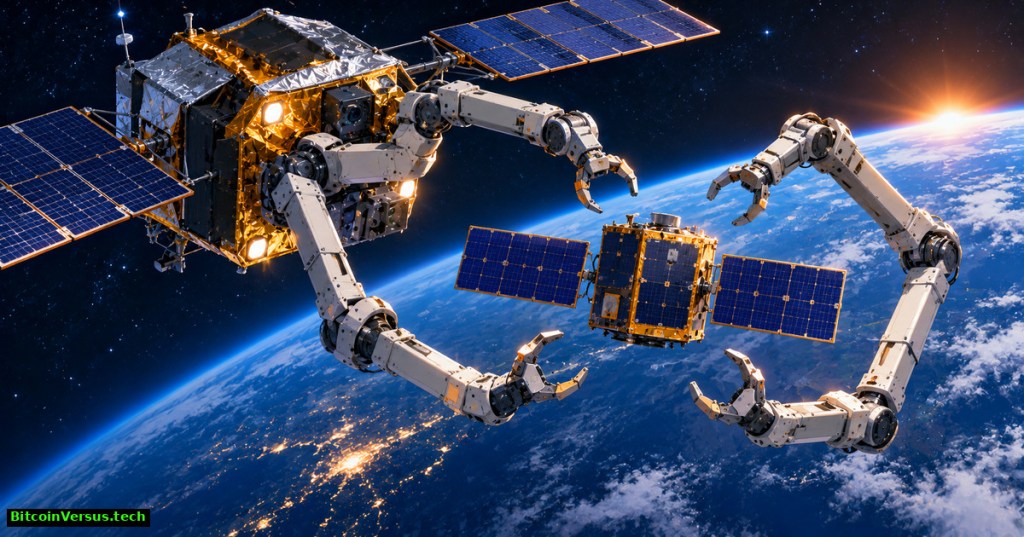
The European Space Agency has signed a contract worth more than €102 million to build a spacecraft that grabs a retired satellite and helps remove it from orbit. Germany’s OHB System became prime contractor for ClearSpace-1 at Space Tech Expo Europe in Bremen on November 17, 2026. The mission is planned for launch in 2030, not already operating above Earth.
ClearSpace-1 will chase ESA’s Proba-1, a roughly 95-kilogram satellite launched in 2001. The spacecraft was built for technology demonstrations, not for a robot to seize it decades later. An inactive object cannot cooperate by aligning itself or providing a dedicated docking fixture, making the encounter more difficult than routine spacecraft docking.
Official ClearSpace channel, February 5, 2025: concept animation of the revised mission capturing Proba-1. Simulated footage, not an orbital test or footage from the 2026 contract signing.
Four arms must catch a satellite without breaking it
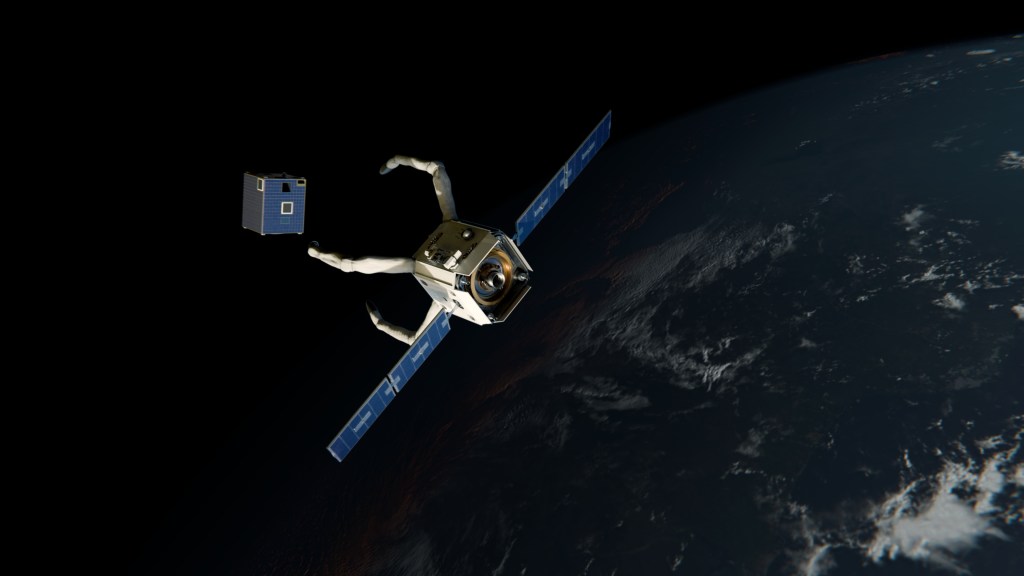
ESA describes a capture spacecraft with four robotic arms. Optical and radio-frequency sensors will estimate Proba-1’s relative position, attitude and rotation before the servicing vehicle moves close enough to form a cage around the satellite. The arms must close carefully to avoid striking appendages or producing more fragments.
The target measures about 0.6 by 0.6 by 0.8 metres. Capturing a freely tumbling object requires spacecraft guidance, navigation, control and collision-avoidance logic to work together. The servicer must first match the target’s motion, then use propulsion to reduce the combined orbit until atmospheric reentry disposes of the pair. A successful demonstration would validate a difficult sequence, not automatically create an affordable commercial cleanup industry.
Why the target and launch date changed
The original plan targeted a VESPA rocket payload adapter. ESA changed targets after the adapter was damaged in an orbital debris collision in 2023. The replacement, Proba-1, offers a real unprepared satellite for testing. OHB’s November agreement follows a redesign and a preparatory phase completed in March 2025.
Some older ESA pages still show a planned 2029 launch and earlier media refer to VESPA. The agency’s November 17, 2026 construction update explicitly gives 2030. Earlier animations and schedules are therefore historical references, not current flight commitments.
ESA Extras, April 1, 2025: official documentary explaining orbital debris and collision risks. Background reporting, not a ClearSpace-1 flight demonstration.
Orbital servicing is becoming an industry
Active debris removal has a practical business case because every failed satellite occupies orbital space and introduces collision risk. NASA’s Starfish Otter inspection mission explores the first step of approaching failed objects, while the agency’s small-satellite demonstrations test complementary navigation and propulsion systems. Inspection alone is not removal.
Disposal is another distinct challenge. NASA’s Swift telescope reentry shows the consequences of an aging satellite eventually descending, whereas Varda’s return spacecraft are designed around repeatable reentry operations. Capturing an uncontrolled object before descent adds another layer of risk.
The next milestones
OHB leads the industrial consortium, with ClearSpace responsible for close-proximity and capture capabilities and other partners contributing spacecraft systems. The contract value is a new construction award, not a verified final lifetime cost or evidence that removing each future satellite will cost €102 million.
Engineering teams must build, integrate and test the spacecraft, demonstrate safe autonomous approach behavior and launch it before any cleanup outcome can be confirmed. If ClearSpace-1 captures Proba-1 and lowers their shared orbit as intended, the mission would move Europe closer to a practical method of clearing large stranded spacecraft. Until then, the achievement is a signed contract and a demanding test still ahead.
Sources and documentation
- European Space Agency, ClearSpace-1 ready to be built, November 17, 2026
- OHB System, €102 million ClearSpace-1 contract, November 17, 2026
- ClearSpace, consortium progress, November 18, 2026
- ESA, ClearSpace-1 mission profile and target specifications
- ESA, April 2025 official Proba-1 mission rendering
- ClearSpace official Proba-1 concept animation, February 2025
- ESA Extras, Space Debris: Is It a Crisis?, April 2025
Editor’s Note: We volunteer daily to ensure the credibility of the information on this platform is Verifiably True. If you would like to support to help further secure the integrity of our research initiative, please scan the QR code below

For mobile scanning, open the article on another display and scan the QR code with a Bitcoin wallet. The voluntary donation amount is 5,000 sats. Verify the receiving address 3C9o19EH5HSiwEPyCTmEKzxhNCbo2X6TTb before sending.
BitcoinVersus.Tech publishes technology and financial journalism for informational purposes and does not provide financial, investment, or legal advice.


Leave a Reply