
At Supercomputing 2026 in Chicago, networking manufacturer AurCore showed a compact way to move traffic between increasingly powerful GPU racks: 64 ports of 800-gigabit Ethernet in a 2U switch. Its November 18 announcement describes an AES9000 sample built on Marvell’s Teralynx 10 switching chip, using SONiC-based open networking instead of proprietary per-port activation licenses. A sample displayed at a trade show is an engineering milestone, not proof of mass production, a customer deployment or measured end-to-end AI performance.
ServeTheHome opens a different 64-port 800GbE switch built on Marvell Teralynx 10. The 2024 tour was sponsored by Marvell and does not depict AurCore’s SC26 sample. Watch directly on YouTube.
64 optical ports, 51.2 terabits of switching
The arithmetic is straightforward: 64 × 800 Gb/s = 51,200 Gb/s, or 51.2 Tb/s of nominal aggregate one-way port bandwidth. Marvell’s Teralynx 10 product brief confirms a 51.2 Tb/s silicon option with 512 high-speed SerDes lanes and support for 64 × 800GbE. The figure is the configured port-rate sum, not a guarantee of equivalent useful application throughput. Framing overhead, congestion, flow patterns and optics impose additional limits.
Each front-panel OSFP connection can be broken into two 400G, four 200G or eight 100G connections when matched with suitable optics and breakout cabling. Fully breaking out 64 ports into 100G links yields 512 logical connections, but does not increase the underlying 51.2 Tb/s switching budget. A network engineer still needs correct transceivers, lane mappings, firmware and a topology that avoids uplink oversubscription.
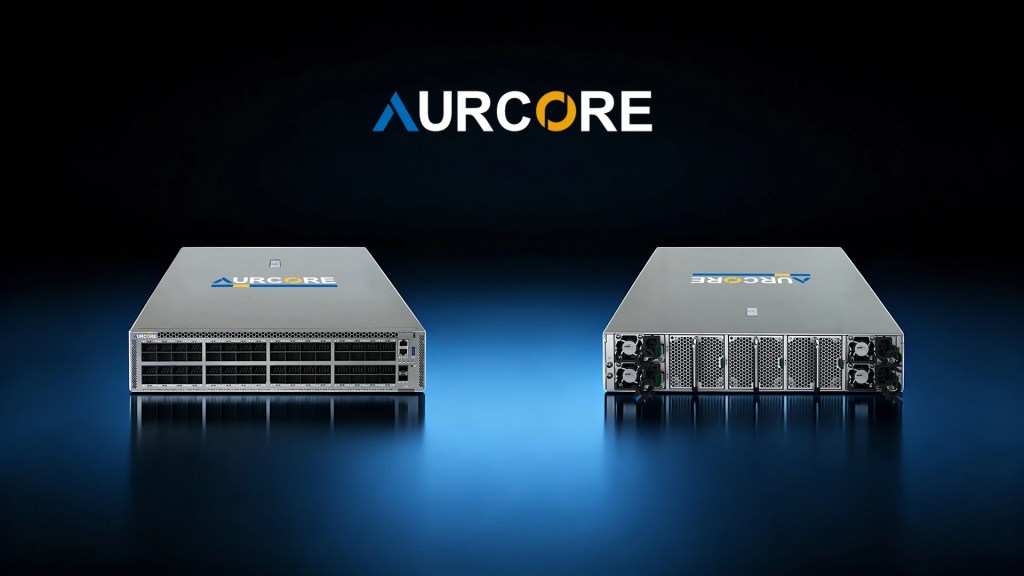
Open switching software is part of the hardware story
AurCore says SONiC support will extend from its existing 25G–400G products to the AES9000. SONiC separates network software from a single proprietary hardware vendor and supports operations through open interfaces and automation tools. AurCore advertises all ports enabled at purchase, a perpetual software license, a three-year warranty and optional support services. Software support planned for a product is not equivalent to publicly demonstrated release maturity or a completed interoperability matrix.
For AI clusters using RDMA over Converged Ethernet version 2 (RoCEv2), network tuning is critical. AurCore cites Priority Flow Control (PFC), Explicit Congestion Notification (ECN) and telemetry in its SONiC portfolio. Those mechanisms can manage bursts and congestion, but improper pause policies, buffer tuning or packet loss can still disrupt tightly synchronized GPU jobs. Production operators would want link-failure, congestion, software-update and optical error-rate tests before accepting the design.
Marvell and Keysight explain laboratory testing of AI Ethernet fabrics, including the Teralynx 10 chip family. The April 2026 demonstration is not an AurCore product certification. Watch directly on YouTube.
Where a 2U switch fits inside an AI fabric
The AES9000 is intended for high-density leaf-spine Ethernet fabrics linking GPU servers, storage and other switches. Redundant hot-swappable power supplies and fan modules and front-to-back airflow make physical service possible without replacing an entire chassis. However, AurCore has not disclosed a measured AES9000 power draw, independent latency results, optics temperature envelope, list price or volume shipping timetable in the SC26 announcement. Claims of superior cost per bit therefore remain commercial positioning rather than independently established totals.
Bitcoin mining facilities normally need relatively little network throughput per ASIC because their mining controllers exchange compact job and share messages. GPU training clusters can instead transfer enormous volumes of gradients and model data between servers. That contrast explains why faster optical switches matter to mining operators pursuing AI projects, as explored in our Bitcoin-versus-cloud infrastructure comparison.
A competitive generation, not the final bandwidth ceiling
The launch joins a crowded switch-silicon market. BitcoinVersus.Tech has covered Cisco’s 51.2 Tb/s G302 silicon, Marvell’s newer 102.4 Tb/s Teralynx T100, and 1.6T Ethernet link-testing technology. The relevance of AurCore’s 51.2T product lies in packaging, open software, operability and price rather than claiming the highest possible chip bandwidth.
The next verifiable milestones are a publicly available datasheet, power and latency measurements under realistic traffic, published SONiC interoperability tests, a volume availability date and documented customer installation. Until then, AurCore has shown a promising 64-port hardware sample, not established a fully benchmarked AI production fabric.
Primary sources: AurCore SC26 announcement, November 18, 2026; Marvell Teralynx 10 product brief; Marvell switch portfolio.
We volunteer daily to ensure the credibility of the information on this platform is Verifiably True. If you would like to support to help further secure the integrity of our research initiative, please scan the QR code below.



Leave a Reply