
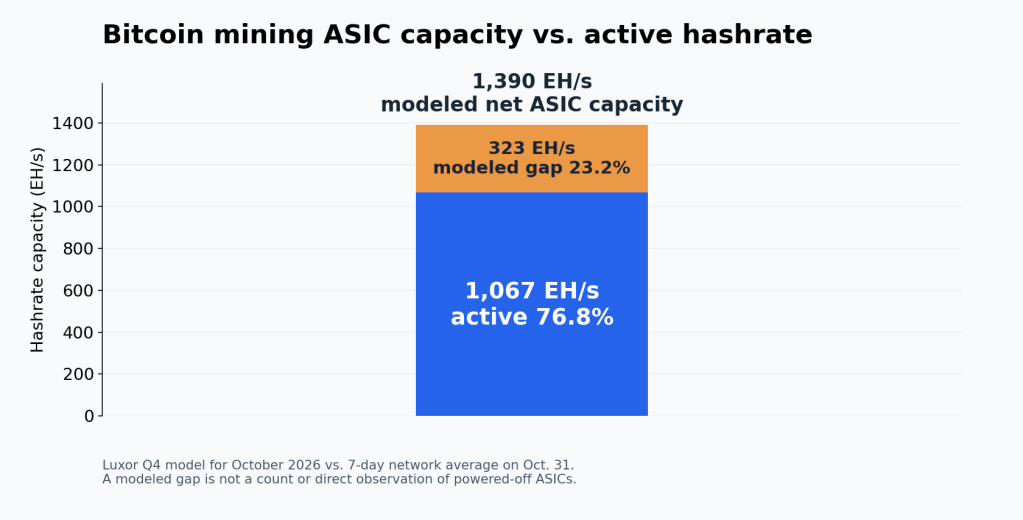
Bitcoin miners may have much more installed computing potential than the network actually uses. In its November 5 mining market report, Luxor estimated 1,390 exahashes per second (EH/s) of net ASIC capacity for October 2026. The network’s seven-day-average active hashrate was 1,067 EH/s on October 31. The difference is 323 EH/s, or 23.2% of modeled capacity. The gap is a model result, not a verified count of switched-off ASIC machines.
Official June 2026 Luxor Technology explanation of hashrate, network difficulty and mining revenue. Educational context, not direct evidence of the October estimated inactive fleet. Watch on YouTube.
Nearly one-quarter of modeled capacity is missing from active hashrate
Luxor’s estimated capacity divides into approximately 76.8% active and 23.2% difference. Its three least-efficient ASIC classes, running at roughly 32 joules per terahash (J/TH) or worse, together represent an estimated 314 EH/s. That figure resembles the inactive-capacity gap, but cannot prove that specific machines were offline. Units may be retired, temporarily curtailed, awaiting power or unavailable for other operational reasons.
For scale, operating 323 EH/s at an illustrative 32 J/TH would consume approximately 10.3 gigawatts of miner input power. The equation is 323 EH/s multiplied by 32 MW per EH/s. Actual ASIC efficiency varies, while cooling and power distribution add overhead. The calculation is hypothetical and does not establish electricity savings associated with the modeled gap.
October mining revenue fell even as competition increased
Luxor measured dollar hashprice falling 17.9%, from $40.15 to $32.98 per petahash per second per day. Bitcoin’s price fell 8.0% from October open to close, while network difficulty rose 11.76%. With more competing hashrate chasing the same block subsidy, expected revenue per machine weakened. Transaction fees averaged only 0.57% of block rewards, offering little buffer against pressure on the subsidy.
Electricity costs explain the older-machine squeeze
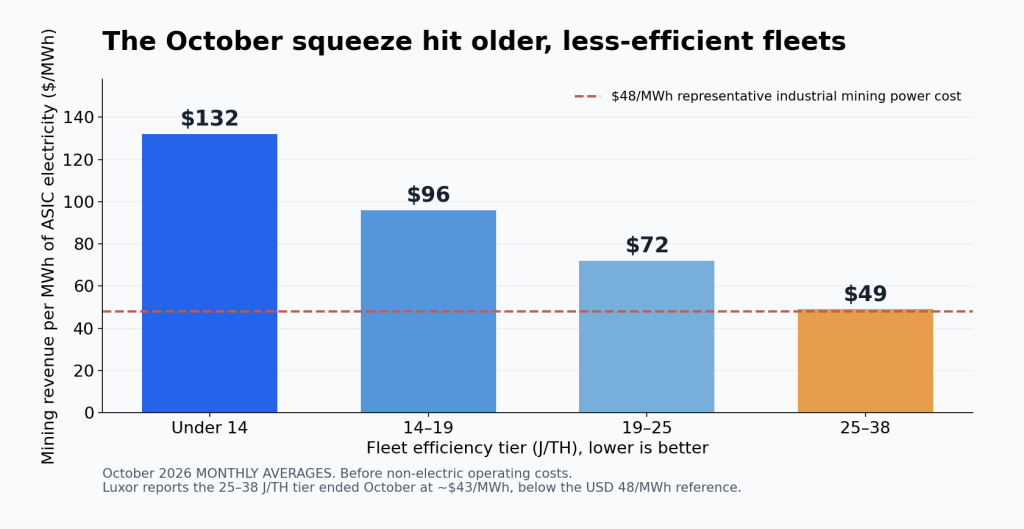
October’s energy-linked mining revenue averaged approximately $132/MWh for fleets more efficient than 14 J/TH, $96/MWh for 14-19 J/TH, $72/MWh for 19-25 J/TH and $49/MWh for 25-38 J/TH. Against Luxor’s cited $48/MWh representative electricity price, the last group averaged only $1/MWh before non-electric costs. It ended October around $43/MWh, below that benchmark. Cheaper site electricity, different equipment and operational revenue can change the outcome for individual miners.
VoskCoin’s July 2026 sponsored Texas mining-farm tour shows ASIC operations, electrical systems and curtailment in practice. The tour does not verify Luxor’s global modeled capacity. Watch original facility footage.
November’s difficulty drop changes the next comparison
A later Luxor weekly report dated November 16 recorded a 9.1% difficulty reduction on November 14 to 134.82 trillion, and a seven-day hashrate average of 967 EH/s. Those later observations cannot be inserted into October’s installed-capacity calculation without rebuilding the model. Lower difficulty improves expected bitcoin rewards per unit of hashrate, but falling Bitcoin prices may still reduce dollar revenue.
BitcoinVersus.Tech has also covered ASIC electricity break-even prices, November’s retarget, Texas power-market conditions, and the definition of hashprice. Comparing equipment efficiency, actual electricity contracts and measured uptime is essential before calling every unutilized exahash permanently retired.
The next statistics to watch
Higher hashprice or falling electricity costs could bring dormant mining capacity online. Extended operating losses could instead accelerate ASIC retirement or fleet replacement. A credible follow-up should distinguish network-estimated active hashrate, modeled nameplate capacity, observed site uptime and physical machine inventories, while showing dates and error ranges.
Sources and methodology: Luxor October 2026 Lookback, released November 5 and Luxor November 16 Roundup. Share percentages and the 10.3 GW illustrative load were calculated independently from Luxor’s rounded estimates.
We volunteer daily to ensure the credibility of the information on this platform is Verifiably True. If you would like to support to help further secure the integrity of our research initiative, please scan the QR code below.



Leave a Reply