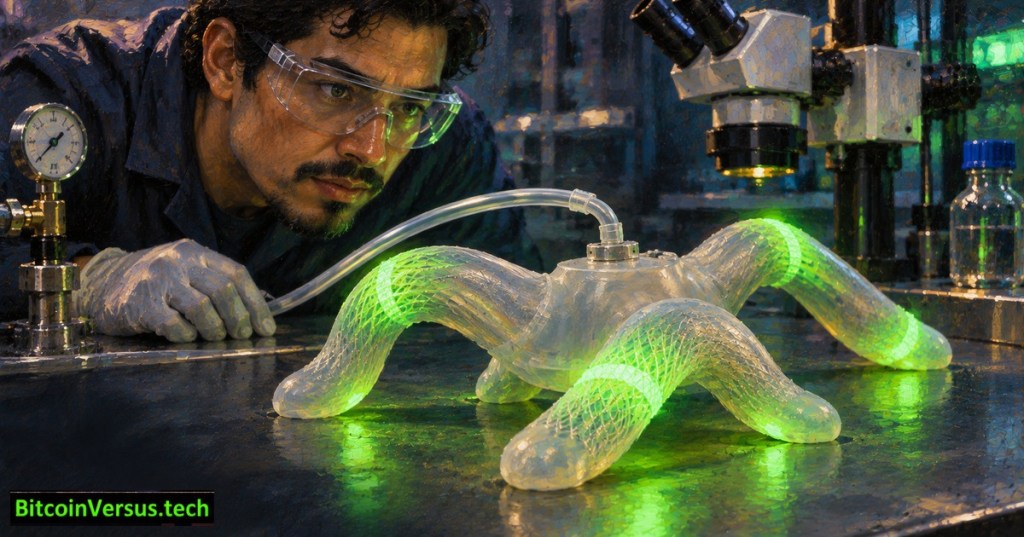
A four-limbed soft robot developed in South Korea can reveal where its body bends by glowing green. Researchers at the Daegu Gyeongbuk Institute of Science and Technology (DGIST) covered a flexible, air-driven robot with light-emitting fibers that activate under stretching and compression. A November 16, 2026 institutional announcement brought renewed attention to the peer-reviewed research, originally published in September. The striking demonstration needs no battery or electrical wiring for its optical sensing layer, although the robot still requires pneumatic actuation to move.
The actual glowing soft-robot demonstration linked by Popular Science in November 2026. Laboratory footage, not a consumer product. Watch directly on YouTube.
Why stretching silicone can generate light
The team mixed copper-doped zinc sulfide (ZnS:Cu) luminescent particles into a flexible polydimethylsiloxane, or PDMS, polymer matrix. The composite was injected into elastic silicone tubes. Mechanical deformation creates electrical interactions inside the material that stimulate green emission, a phenomenon called mechanoluminescence. The energy comes from movement rather than a connected power supply; the device is not making light without an energy source.
Using tubes instead of flat coatings matters. Soft pneumatic actuators undergo substantial shape changes, and a stiff sensor patch can impede motion or peel away. An elastic sheath holds the glowing material together while distributing strain. In laboratory tests, the most flexible fiber sustained more than 200% tensile strain and continued producing light during 1,000 stretch–release cycles. The numbers describe material tests, not a guaranteed service lifetime for a finished robot.
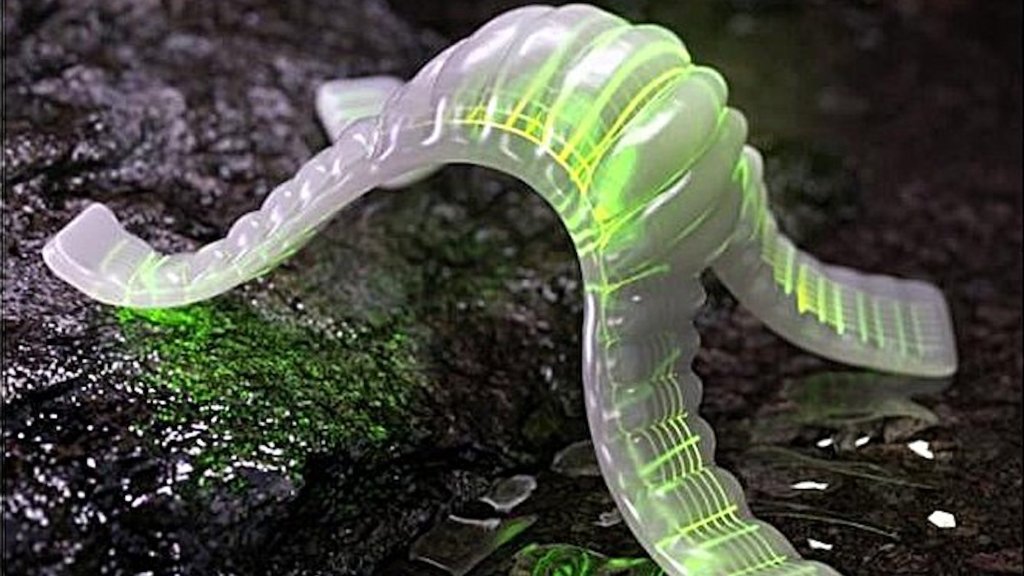
The robot moves by air, but its skin shows the strain
The prototype uses pneumatic chambers and an elastomer body. Researchers manually injected and withdrew air with syringes, causing its legs to bend and recover. A woven network of glowing fibers followed the movements, lighting up selectively where deformation occurred. The paper reports approximately 1.6 centimeters of forward displacement in one demonstrated actuation cycle, but no standardized speed, continuous autonomy or payload benchmark.
Importantly, adding even thin fibers affected the mechanics. In a test with 30 mL of injected air, a control leg expanded to 1.82 times its original length, compared with 1.51 times for the leg carrying the thinnest sensing fiber. Thicker sensing tubes restricted the leg further. The study therefore demonstrates a workable compromise between visible feedback and flexibility, not perfectly zero-impact instrumentation.
What a glowing indicator can—and cannot—measure
The green emission makes deformation locations immediately visible to a person or external camera. It is qualitative optical feedback, not an already calibrated joint-angle sensor providing digital positions to a controller. Turning the light into machine-readable proprioception would require an optical receiver, calibration and software, with their own energy consumption. Bright ambient light, contamination, aging and repeatability also need evaluation outside controlled laboratory conditions.
Earlier mechanoluminescence research presentation linked on DGIST professor Soon Moon Jeong’s official laboratory website. Background technology, not footage of the September 2026 robot experiment. Watch directly on YouTube.
A different path to robotic awareness
Existing approaches solve related problems differently. BitcoinVersus.Tech recently covered a 400 Hz robotic fingertip sensor that electronically reads contact forces and a wearable teaching device for robot hands. DGIST instead makes deformation visible directly through the material, potentially reducing embedded wiring at the sensing surface.
For context, an air-powered runner highlights the mechanical side of soft robotics, while a shape-changing origami robot shows another approach to deformation. DGIST’s research focuses instead on passive visual reporting. Future applications may include artificial skin, wearables and inspection systems, but none was validated as a commercial device by the published experiment.
The next credible milestones would be quantified optical sensitivity, reliable readout under different lighting, longer durability testing and autonomous robot trials. For now, a moving soft robot that visibly marks its own bends is a useful materials demonstration with a clearly defined engineering limitation: the sensing may be battery-free, but locomotion and machine vision are not.
Sources: Lee and colleagues, Small Structures, September 15, 2026; DGIST research record; DGIST institutional release, November 16, 2026; lead research laboratory.
We volunteer daily to ensure the credibility of the information on this platform is Verifiably True. If you would like to support to help further secure the integrity of our research initiative, please scan the QR code below.



Leave a Reply