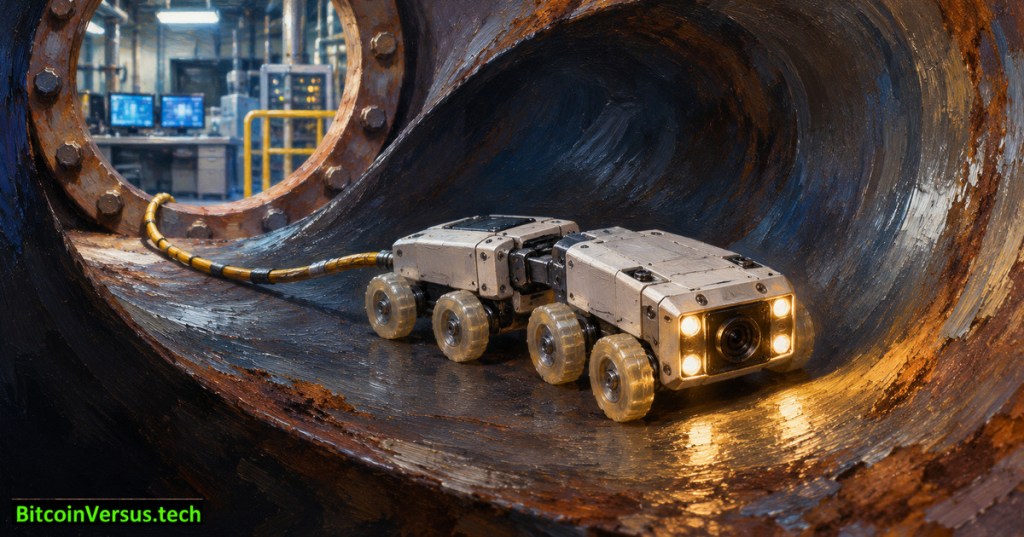
A robot compact enough to enter a two-inch pipe has tackled an overlooked problem in nuclear cleanup: inspecting decades-old waste-transfer lines without digging them out of the ground. On November 19, 2026, Sandia National Laboratories introduced SPIINE, a tethered, six-wheeled inspection robot developed for the U.S. Department of Energy’s Hanford Site in Washington.
Its published laboratory results are remarkably practical. SPIINE negotiated tight 90-degree elbows, traveled more than 60 meters through mixed horizontal and vertical piping and produced 16.5 newtons of pulling force in straight steel pipe, more than eight times its own weight. A peer-reviewed paper published October 22 reports operating power of approximately 2–3.5 watts over representative test segments.
Why the nuclear site needs a crawling machine
Hanford’s underground tanks and transfer piping are part of a long-running cleanup of radioactive material from plutonium production. Some double-walled pipes are only about two inches across, run hundreds of feet and contain sharp turns. Conventional push cameras reportedly traveled only around ten feet before encountering geometry they could not navigate. External visual checks cannot reliably identify corrosion or cracks on hidden internal surfaces.
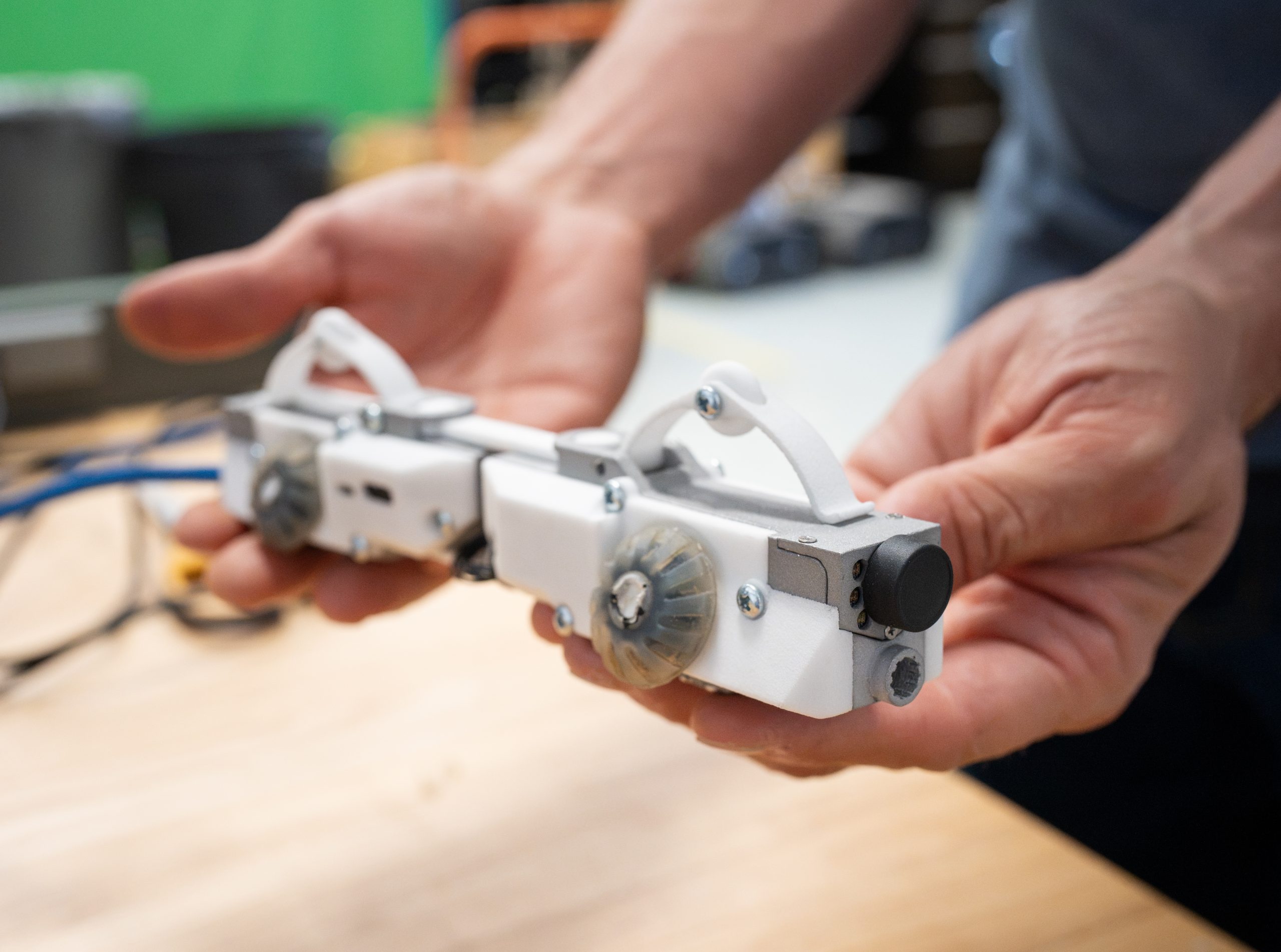
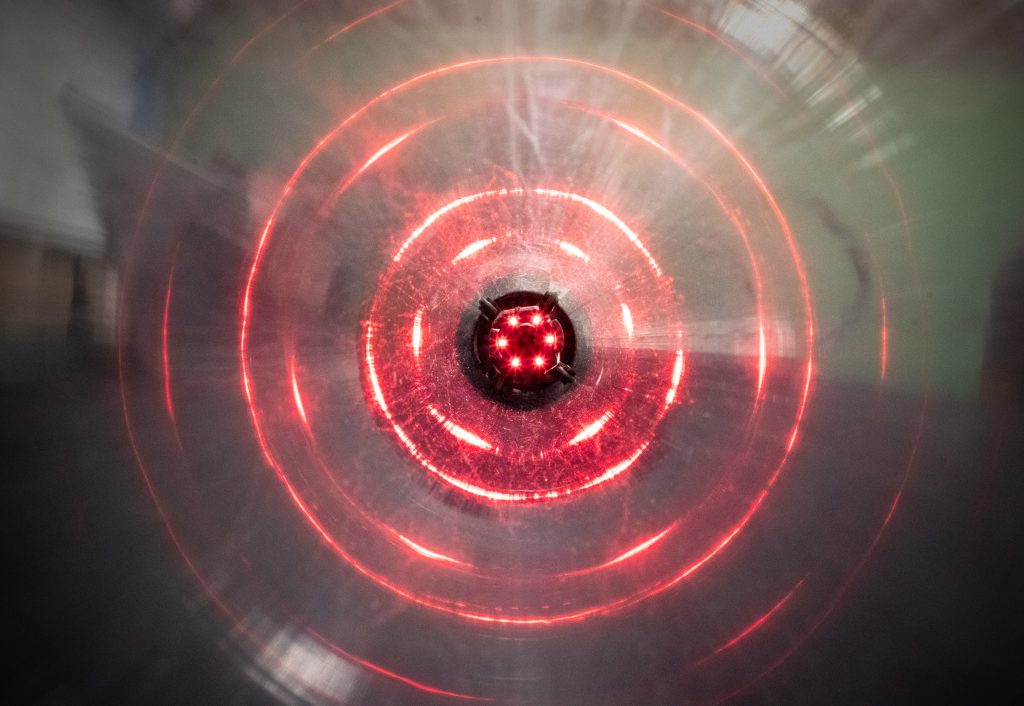
The Sandia robot uses an articulated body, compliant wheels and adjustable LED lighting around an onboard camera. A game controller provides operator input, while a tether delivers power and returns live video. Engineers are also exploring how to tow ultrasonic or electromagnetic probes for wall-thickness measurements. The published capability is camera-based inspection and laboratory mobility, not a completed certified pipeline inspection at Hanford.
The hardest problem is pulling a cable around bends
A tether is reliable for power and communications but becomes a mechanical burden as bends accumulate. Engineers call the underlying problem the capstan effect: friction increases the pull force needed to drag a cable around a curved surface. The simplified capstan relationship is T₂/T₁ = e^(μθ), where μ is friction coefficient and θ is total wrap angle in radians. For illustration only, four 90-degree bends at an assumed μ of 0.2 yield a tension multiplier of about 3.51×. Real pipe routing differs, and the number is not a Sandia measurement.
Sandia designed SPIINE so additional powered modules can help move the cable through long, bend-filled runs rather than forcing a single robot to drag all of it. The paper documents high-resolution video and power delivery through a tether tested to 110 meters, and successful passage through 53-millimeter-inner-diameter elbows with curves as tight as 76 millimeters.
What the numbers do—and do not—prove
The reported 16.5 N traction corresponds to approximately 3.7 pounds-force, a substantial pull for a small machine. Pull force and wattage, however, are measured properties under specified test conditions; neither establishes corrosion-detection accuracy, endurance inside contaminated piping or reliability over years of work. Sandia says field trials at Hanford remain a next step. The laboratory is working on cleaning the camera lens, emergency retrieval if a module jams and smaller thickness-measuring sensors.
The engineering theme extends beyond nuclear facilities. Related BitcoinVersus.Tech reporting covers robotic monitoring of aging infrastructure, robots built for extreme ocean depths, soft robots navigating confined anatomy and rising demand for inspection robots. Across fields, confined-space navigation is valuable when humans cannot safely or economically enter.
For Hanford, the near-term milestone is not an autonomous cleanup machine. It is a tested method for getting a live camera, controlled traction and potentially diagnostic probes through places ordinary inspection equipment cannot reach.
Sources, evidence and media
- Sandia National Laboratories, November 19, 2026: original announcement, photo downloads and video
- Sandia Lab News, November 19, 2026: engineering and deployment limitations
- McArthur et al., Robotics 15(11), 210, October 22, 2026: peer-reviewed 25-page study
- Sandia original extended b-roll video (large file; external link only)
Media disclosure: The featured 1200 × 630 oil painting is editorial illustration, not a photograph of SPIINE operating inside Hanford’s real pipe network. The approved preexisting BitcoinVersus.tech neon-green-on-black watermark was copied once to the bottom-left without re-typesetting. The two photographs and 20-second video in the body show the authentic Sandia laboratory prototype and carry original-source credits.
We volunteer daily to ensure the credibility of the information on this platform is Verifiably True. If you would like to support to help further secure the integrity of our research initiative, please scan the QR code below.



Leave a Reply