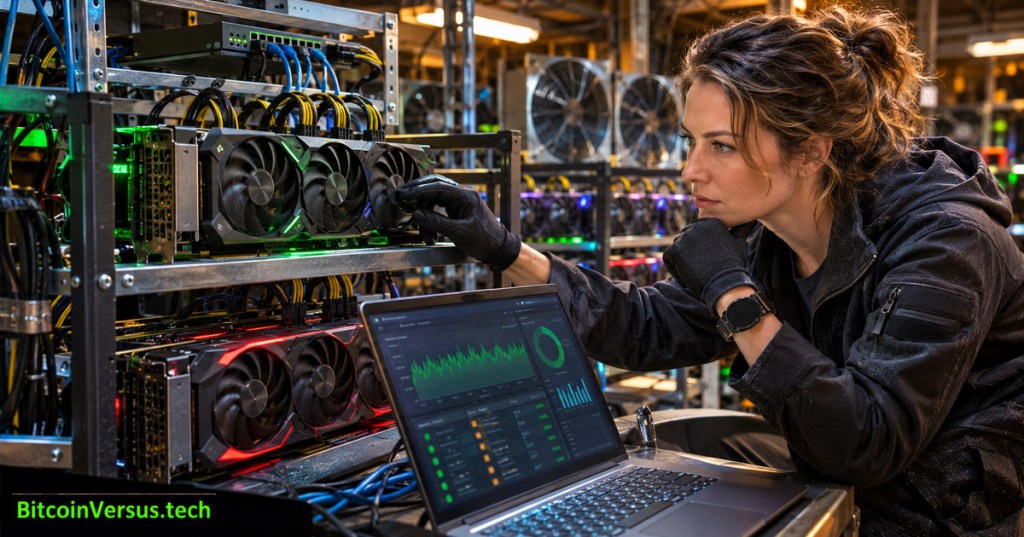
A graphics-card mining rig can look healthy while doing no useful work. After a GPU driver fault or failed kernel launch, fans may continue spinning even though the miner stops submitting shares. Suprminer 1.9.52, released November 21, 2026, tackles the problem with automatic process recovery, a familiar monitoring interface and a correction to its GPU-memory optimization for the NEB cryptocurrency network.
The release is significant for operators running NVIDIA or AMD rigs unattended, but its changes are specific to supported errors and mining algorithms. Suprminer does not turn ordinary GPUs into competitive Bitcoin SHA-256 ASICs, and restarting software is not proof that mining income resumed. The developer’s versioned release notes are the primary record.
Red Panda Mining, June 26, 2026: archival footage of GPU-rig assembly, HiveOS troubleshooting and card recovery. The video predates Suprminer 1.9.52 and does not test its new features. Watch directly on YouTube.
A restart is useful only if accepted shares return
The new recovery path addresses GPU errors that leave a card unusable by the existing process, including illegal memory access and launch failures. Previously, a miner could keep retrying with idle cards. Version 1.9.52 relaunches with the original arguments after certain faults, according to its maintainer.
That distinction matters in fleet operations. A watchdog should record the crash time, restart time, accepted-share count and elapsed downtime. A clean startup banner does not establish whether the pool credited additional work. BitcoinVersus.Tech previously covered ForgeMiner’s separate GPU recovery changes and SRBMiner’s AMD tuning fixes. The common engineering priority is reducing failed work, not simply raising a benchmark counter.
A monitoring API with a network-security boundary
The new -b or --api-bind argument provides ccminer-style status queries. With -b 4068, the monitoring service listens locally. Binding to 0.0.0.0:4068 instead exposes the listener on every network interface. Supported text requests include summary, threads and pool, alongside HTTP JSON used by HiveOS, mmpOS and SMOS.
Local binding is the safer default. If remote monitoring is necessary, restrict access with firewall rules and an authenticated management network rather than exposing a mining-control interface to the public internet. The API reports operational state; it is not a wallet or pool payout endpoint.
Red Panda Mining’s April 2021 archival GPU-rig walkthrough covers hardware wiring, HiveOS setup and troubleshooting. Its Ethereum-mining examples are historical and no longer reflect Ethereum proof-of-stake operation. Watch directly on YouTube.
Why one startup fix changes measured GPU speed
NEB uses deterministic integer training steps on model data derived from Kepler and TESS astronomy signals. Suprminer stores exact intermediate results in GPU memory to avoid repeatedly performing expensive work. A bug in version 1.9.51 allocated a first-model result table roughly 10% smaller than intended on cards with up to 32 GB of memory; version 1.9.52 corrects the initial allocation.
For the developer’s RTX 5090 TESS example, the startup-window rate rose from 4.33 to 4.60 GH/s, approximately 6.2%. The release explicitly says speed after the next model change was unchanged. Its broader GPU table mixes measurements from versions 1.9.51 and 1.9.52. Published speeds are model-specific tests, not independent pool-payout evidence, guaranteed sustained hashrate or measured revenue.
For context, BitcoinVersus.Tech previously explained NEB’s astronomy-data mining mechanism, Keryx’s multi-GPU scheduling and memory expansion experiments on NVIDIA’s CMP 170HX. A GPU performing model training is still an energy-consuming machine; researchers must separately establish whether its output delivers useful scientific results.
What operators should verify
The miner advertises a 0% developer fee, while pool fees, electricity and hardware costs remain separate. Packages exist for Linux, Windows and several mining operating systems, but the author has not qualified physical Windows GPU execution across the advertised hardware. Operators should verify downloaded files, test with limited exposure, watch junction temperatures and compare accepted shares and energy use over equal time windows.
More reliable recovery could help small GPU operators avoid hours of silent inactivity. The evidence currently supports a software improvement, not a universal performance multiplier, improved profitability or any change to Bitcoin’s ASIC mining economics.
Primary references
Suprminer 1.9.52 official release, November 21; developer documentation and model benchmarks; NEB protocol and source; NEB pool setup guidance. Performance figures are developer reported, not independently reproduced by BitcoinVersus.Tech. The featured art is a conceptual editorial illustration, not developer test photography.
We volunteer daily to ensure the credibility of the information on this platform is Verifiably True. If you would like to support to help further secure the integrity of our research initiative, please scan the QR code below.



Leave a Reply