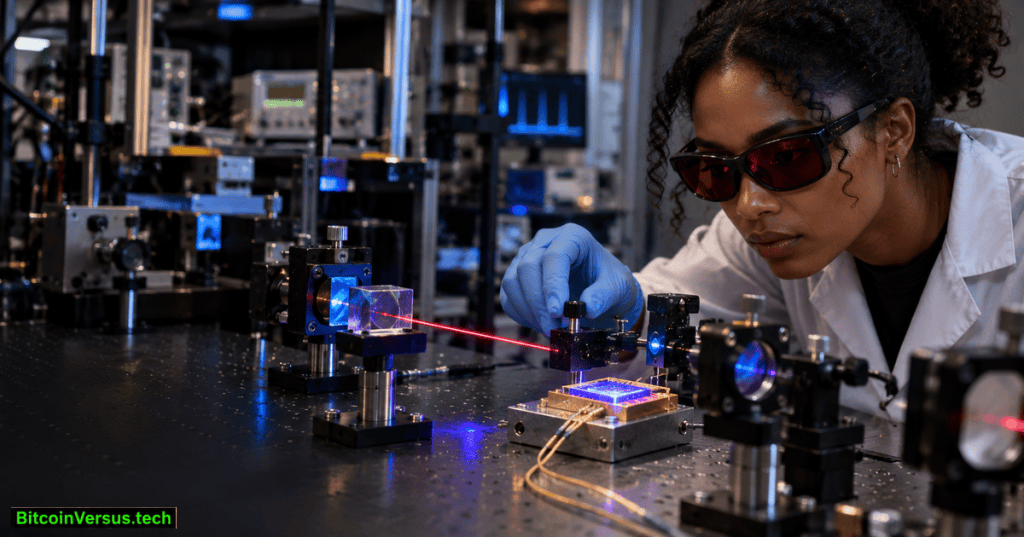
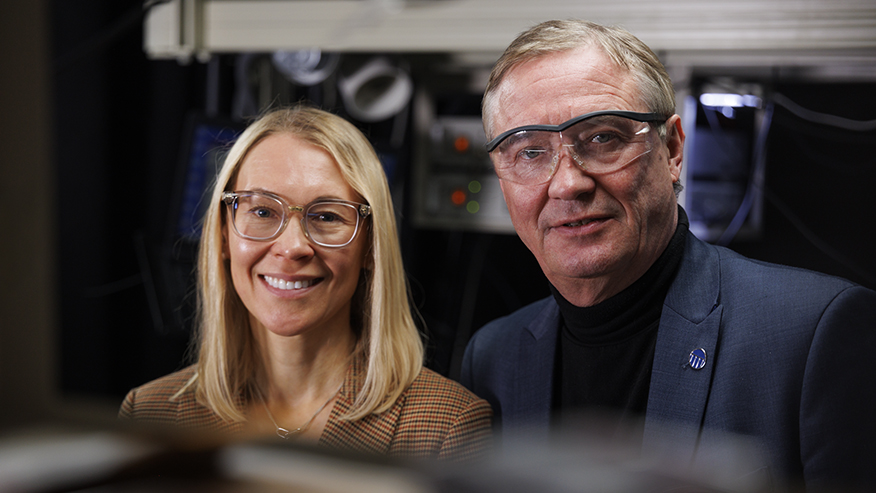
What if one particle of light could flip a much stronger beam on or off, and a computer could predict when quantum light would drift out of tune? Purdue University researchers have worked on both problems, two obstacles to building quantum computers around photons rather than electronic circuits. A November 12, 2026 university report brings together experimental milestones from 2021 and 2025 with a newer predictive quantum-noise study.
The work is promising but remains a collection of research components, not a complete light-powered quantum processor. The reported reduction in optical frequency drift is a modeled benefit of future feedback control, not a measured improvement from a commercial machine.
First, make reliable single photons
Quantum photonic circuitry uses individual packets of light as carriers of information. Producing them when and where a circuit needs them is difficult. In a 2021 Science Advances study, Purdue researchers described light-emitting defects in silicon nitride, a material already used for integrated optical waveguides. The microscopic defects acted as localized emitters triggered by laser light at room temperature. Later work explored controlling defect locations with nanostructures to make future arrays more repeatable.
Reliable photon generation matters because sending a random number of photons into an optical gate can spoil a computation. However, source brightness, indistinguishability and integration remain separate challenges. BitcoinVersus.Tech’s quantum-computing guide explains why a qubit is not simply a very fast conventional bit.
Second, switch a beam with one photon
In a Nature Nanotechnology paper first published November 17, 2025, a Purdue team demonstrated an optical switch responding to a control beam at single-photon intensities. An incoming photon produced an electron in silicon; avalanche multiplication amplified that electrical event, changing the material’s optical response and modulating a separate, stronger probe beam.
The trick bridges a microscopic light event to a measurable response. It does not prove an all-optical universal quantum logic gate: a semiconductor electron avalanche is involved, and the team still faces substantial packaging, speed, loss and integration work.
Third, predict quantum noise before correction
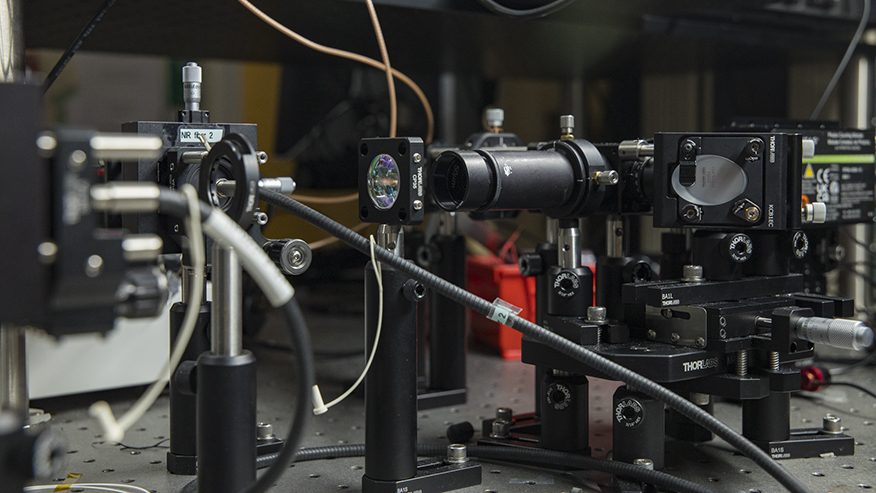
A 2026 Nature Communications paper addresses spectral diffusion: the frequency of light emitted from a quantum defect shifts as its local environment fluctuates. Such shifts make photons less alike and can undermine interference between remote quantum nodes. The researchers found temporal patterns in emitter behavior and used machine learning to forecast future changes.
The paper estimates that an implemented anticipatory-control system could reduce step-by-step spectral shifts by average factors around 2 to 19, depending on emitter stability. Those figures describe prospective compensation, not a directly observed 19-fold improvement in a functioning chip. Predictions would still need hardware able to tune and stabilize emitters quickly enough.
Comparable optical-engineering challenges appear in Xanadu’s low-loss photonic switching work, while Paderborn’s photon-counting research addresses detection rather than the same Purdue device. NIST’s entangled-photon experiment illustrates a further application of precise quantum-light control.
Why a photonic computer is still difficult
Photons can propagate over optical links with relatively low environmental disturbance, and some sources operate at room temperature. Neither property establishes that an entire quantum computer would require no cooling or achieve lower total energy use. Routing loss, detector efficiency, measurement, error correction and scaling to hundreds or thousands of useful qubits remain open engineering problems. Purdue’s latest report is therefore best read as progress on three essential building blocks, not proof of an imminent replacement for conventional processors.
Sources: Purdue University research report, November 12, 2026; Nature Nanotechnology, DOI 10.1038/s41565-025-02056-2 (2025 publication); Nature Communications, DOI 10.1038/s41467-026-72829-3 (2026 paper).
We volunteer daily to ensure the credibility of the information on this platform is Verifiably True. If you would like to support to help further secure the integrity of our research initiative, please scan the QR code below.

BitcoinVersus.tech is not a financial advisor. This media platform reports on financial subjects purely for informational purposes.


Leave a Reply