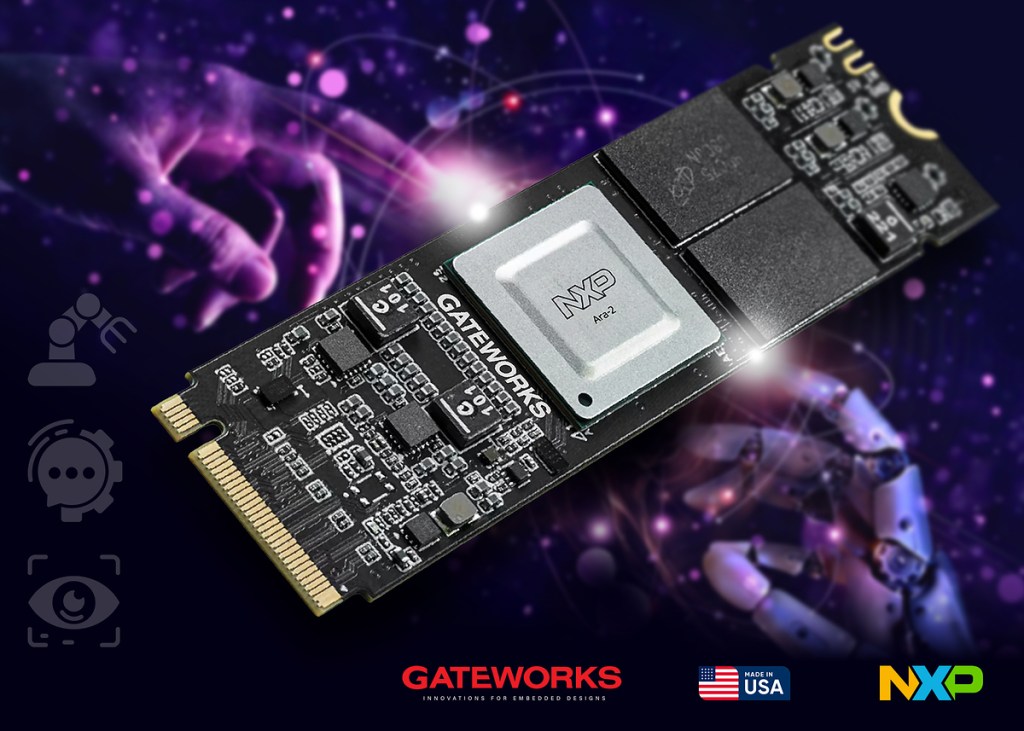
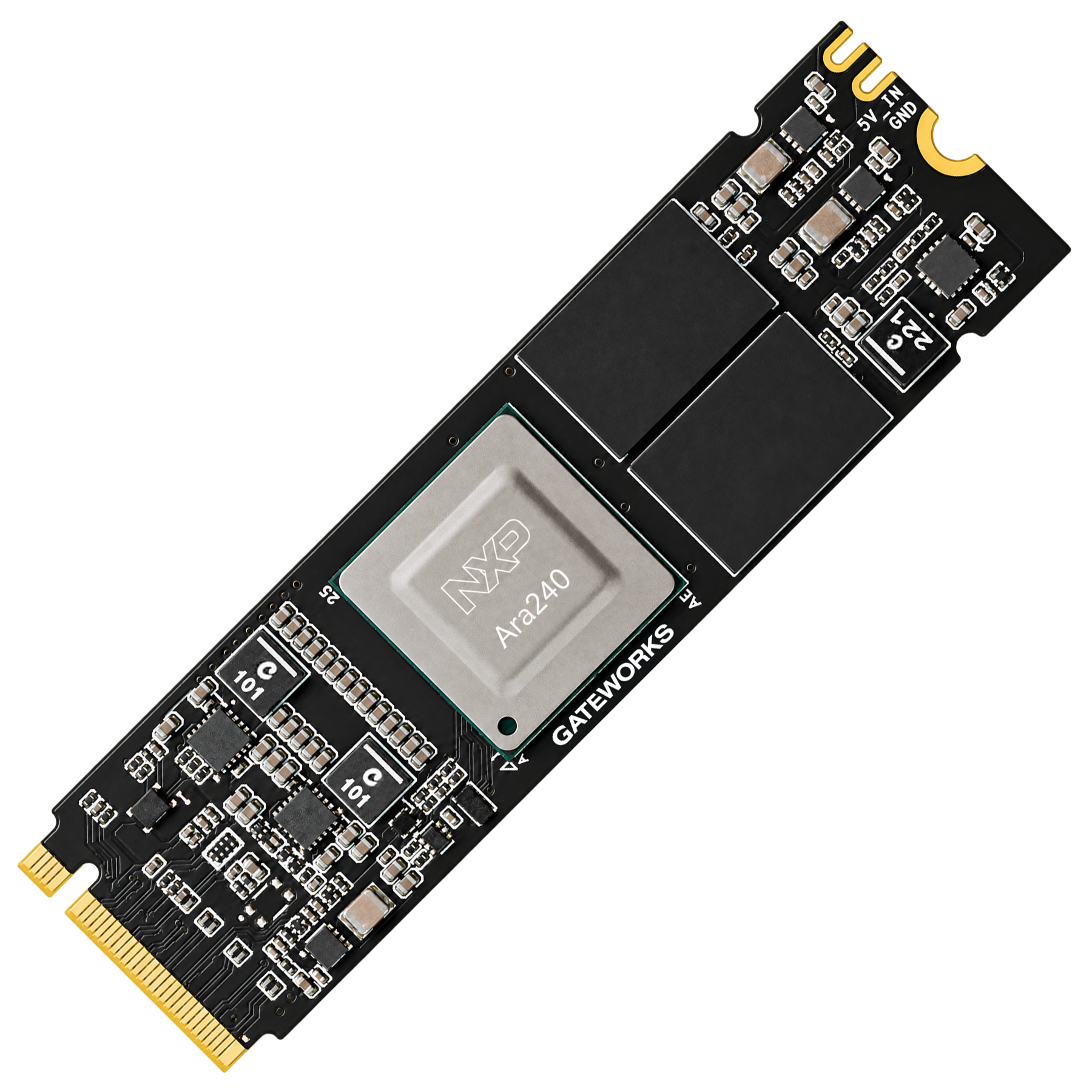
An industrial computer can gain dedicated artificial intelligence processing through a connector commonly associated with solid-state storage. On November 19, 2026, Ohio-based Ezurio announced availability of its GW16168 accelerator, a compact expansion card incorporating NXP’s Ara240 neural processor. Originally developed within the Gateworks portfolio, the module represents the commercialization of an existing accelerator architecture rather than the debut of an entirely new chip.
The manufacturer’s rating reaches 40 equivalent trillion operations per second, or eTOPS. Engineers can select versions with 8 or 16 GB of dedicated LPDDR4 memory. The intended workloads include industrial inspection, robotics and local language-model inference.
Ezurio’s November 5 demonstration presents image recognition and language-model execution on the module. The demonstration predates the availability announcement and does not establish performance across every supported model.
A separate processor for neural networks
Instead of asking the host CPU to execute every neural-network operation, the system can transfer compatible workloads to a specialized accelerator. The host remains responsible for operating-system services, application logic and coordination. Dedicated memory helps retain model data near the accelerator, reducing repeated transfers across the host interface. NXP’s processor documentation identifies an architecture combining local storage and external memory bandwidth with dedicated neural computation.
What the power and memory specifications mean
According to Ezurio’s part specifications, the card measures 22 by 80 by 3.5 millimeters and has a typical operating current of 2 amperes at 3.3 volts. Multiplication gives an indicative 6.6 watts of module power. Continuous operation at that illustrative load would consume about 158.4 watt-hours per day, excluding the host computer and its peripherals. Typical current is not a maximum-power guarantee or a workload-specific benchmark.
A seven-billion-parameter model encoded at four bits per parameter would require approximately 3.5 GB for raw weights alone. Additional space is necessary for quantization metadata, intermediate activations and context-dependent caches. The Gateworks technical guide lists compiled examples for language, vision-language and object-detection workloads. Model compatibility depends on the runtime and compiler as well as memory capacity.
Why equivalent TOPS is not token throughput
Arithmetic throughput ratings depend on numerical precision and the method used to count operations. Equivalent TOPS should not be treated as a directly comparable measurement of dense integer arithmetic across every accelerator. Language-model generation also depends on memory bandwidth, model architecture, context length and software efficiency. Tokens per second, latency and energy per completed inference are more informative when comparing identical workloads.
Developers must also check the host’s electrical power budget, Linux driver compatibility and heat dissipation. An M.2 connector alone does not establish compatibility. Local processing can reduce dependence on remote services, but it does not eliminate requirements for secure updates and application validation.
A growing market for specialized processors
Related reporting includes Neuronova’s low-power speech detector, Axelera’s server accelerator, MemryX’s multi-chip architecture and robot-controller vision integration. The GW16168 occupies a distinct niche: adding local AI capability without replacing the entire embedded computer. Independent measurements across realistic industrial workloads would help establish its practical value.
Featured image: Gateworks and NXP’s earlier official GW16168 launch graphic, distributed through PR Newswire.
We volunteer daily to ensure the credibility of the information on this platform is Verifiably True. If you would like to support to help further secure the integrity of our research initiative, please scan the QR code below.



Leave a Reply