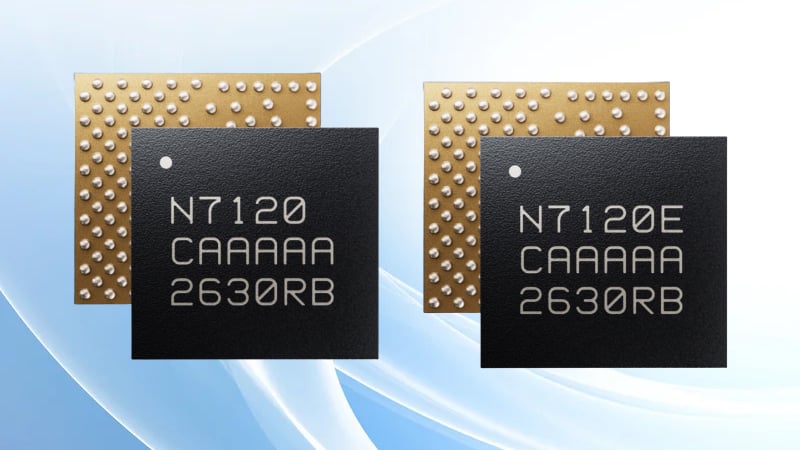
Nordic Semiconductor announced its nRF71 series of wireless systems-on-chip on November 3, 2026, combining application processing, multiple wireless protocols and local machine learning in a compact package. The company claims standby power can fall to one-twentieth of its current-generation nRF70 Wi-Fi products under the relevant operating conditions. The improvement targets connected devices that spend most of their operating time waiting for events rather than continuously transmitting data.
The November announcement identifies two initial models. The nRF7120 supports Wi-Fi 6 on the 2.4 and 5 GHz bands. The nRF7120E adds 6 GHz operation and a dedicated Axon neural processing unit. Both were sampling with selected customers at the announcement, rather than broadly available in production. Featured product artwork: Nordic Semiconductor via All About Circuits.
Three computing engines in one package
Both chips contain a 256 MHz Arm Cortex-M33 application processor and a separate RISC-V coprocessor running at the same frequency. The enhanced model adds a 256 MHz neural accelerator. Each device provides 4 MB of nonvolatile memory and 1 MB of user-accessible RAM. A manufacturer specification lists software-defined peripheral support on the RISC-V coprocessor. Developers can distribute application logic, timing-sensitive interfaces and supported machine-learning operations across different engines.
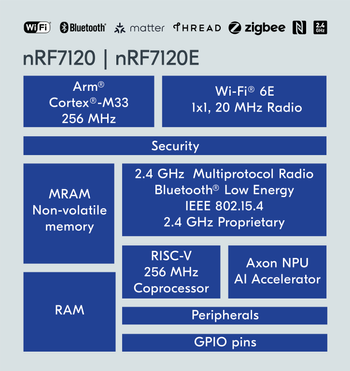
Nordic reports that the Axon NPU executes machine-learning models between 10 and 17 times faster than the Cortex-M33 alone. That comparison concerns inference execution and does not establish an equivalent reduction in whole-device energy use. The base model can still execute small neural networks using its CPU.
What connected standby consumes
Nordic specifies 8 microamps of current at 3.6 V during connected standby on the 5 and 6 GHz bands using DTIM10, a setting that governs how frequently sleeping clients listen for designated wireless traffic. Multiplying the stated voltage by current gives 28.8 microwatts. At 2.4 GHz, the listed 14 microamps corresponds to 50.4 microwatts. Neither result includes all the energy needed by a finished product, and neither represents continuous Wi-Fi transmission.
Independent All About Circuits coverage highlights the integration of two independent radio subsystems. A connected sensor can receive Wi-Fi traffic while also listening for Bluetooth Low Energy or Thread traffic, although actual coexistence performance depends on radio configuration and interference.
Why inference and connectivity belong together
Consider an industrial vibration sensor. A compact local model could classify incoming measurements and transmit alerts rather than continuously upload raw samples. Reducing radio activity may extend operating life, provided inference costs less energy than the communication it replaces. Validation requires representative signals, detection accuracy measurements and current profiling across the complete operating cycle.
Related BitcoinVersus.Tech reporting examines Qualcomm heterogeneous processors, Synaptics memory-integrated AI microcontrollers, Efinix configurable RISC-V cores and Andes custom processor instructions. The common engineering theme is specialization, with computation placed where it can reduce unnecessary work and data movement.
Nordic’s new design combines more capabilities in a single chip, but production availability and independently measured battery endurance remain important questions. Engineers should evaluate active power, standby intervals, inference frequency and wireless coverage before treating the vendor’s standby comparison as a system-level efficiency result.
We volunteer daily to ensure the credibility of the information on this platform is Verifiably True. If you would like to support to help further secure the integrity of our research initiative, please scan the QR code below.



Leave a Reply