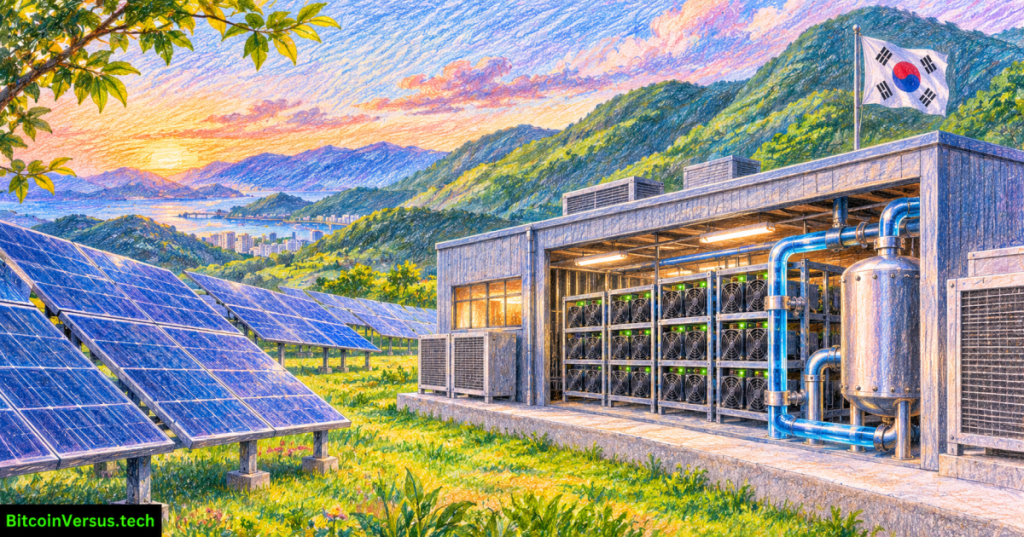
Could South Korea turn surplus solar electricity into a revenue stream without selling it to conventional electricity customers? A study published online October 28, 2026, in Energy Economics examines a national-scale Bitcoin mining system that would operate during periods of solar surplus. The authors report simulated annual profits exceeding $120 million under their modeled conditions. No government mining authorization or operational fleet is established by the research.
Why solar generation can go unused
Solar panels generate electricity according to sunlight rather than customer demand. During midday, local generation can exceed consumption or the transmission network’s ability to export power. Operators may then reduce renewable output to maintain grid balance. A flexible computing facility could consume available energy near the generation source, provided its operating schedule matches actual grid constraints.
The distinction between surplus electricity and physically curtailed generation matters. Energy remaining after net metering is not necessarily electricity that would otherwise be wasted. Some of it might be exported, stored or sold. The economic opportunity depends on the real alternative use for each kilowatt-hour.
Modeling more than 100,000 mining machines
Researchers Yoonseul Choi, Jaehong Jeong and Jungsoon Choi evaluated scenarios involving 111,269 and 166,887 Bitmain Antminer S21 XP Hyd units. Their published abstract assumes a public operator paying zero for electricity and adjusting miner clock speeds during solar production hours. The authors also used random forest regression and long short-term memory models to estimate Bitcoin price scenarios.
The two fleet sizes represent modeled alternatives rather than purchase orders. The larger scenario contains roughly 50% more machines than the smaller one. Additional hardware could absorb more energy during periods of abundance, but extra capital may sit idle when solar generation falls. Optimal capacity therefore depends on the distribution of surplus power across hours, not merely the maximum available power.
Free electricity is a modeling assumption
Even if an operator pays nothing for surplus generation, mining is not costless. ASIC purchases, transformers, switchgear, hydraulic cooling, maintenance, networking and financing remain necessary. Revenue fluctuates with Bitcoin prices, transaction fees and network difficulty. Lower utilization increases the effective capital cost of each unit of computational work.
The authors propose potential benefits for Korea Electric Power Corporation (KEPCO), including new revenue and reduced financial pressure. The Hanyang University applied statistics department also describes the work as an economic feasibility analysis. The reported profit should not be interpreted as a guaranteed return or an independently verified utility saving.
Mining versus storing surplus electricity
Battery storage can shift solar output to evening demand, while mining converts electricity into computational work without returning electrical energy to the grid. A battery may be preferable where time-shifting electricity has substantial value. Mining may be competitive where export limitations persist and alternative uses are uneconomic. Comparing both requires a common energy dataset, consistent financing assumptions and realistic maintenance costs.
A separate October 2026 iScience study also cautions that technically flexible mining loads can still increase demand during ordinary high-price hours. For a utility-led mining strategy, contractual curtailment requirements, metering and priority for existing customers would be essential. The Korean proposal remains an analytical scenario; a field demonstration would be needed to measure the actual financial and grid effects.
Related reporting: renewable mining and flexible demand, Austrian solar mining heat recovery, MIT surplus-power computing research and Texas mining electricity-price research.
Editorial note: The analysis relies on the published paper’s accessible abstract and highlights rather than its complete paywalled methodology. The cover is a conceptual colored-pencil illustration, not an actual installation.
Editor’s Note: We volunteer daily to ensure the credibility of the information on this platform is Verifiably True. If you would like to support to help further secure the integrity of our research initiative, please scan the QR code below.



Leave a Reply