Synaptics introduced its Astra SR200 processor family on October 20, 2026, combining microcontroller-class CPU cores with a neural accelerator and integrated dynamic random-access memory. The company calls the design an xMCU, positioning it between traditional microcontrollers and larger application processors. The launch targets devices that need to process camera images, speech and other sensor information without constantly contacting remote servers.
The manufacturer announcement identifies three pin-compatible products: SR210, SR230 and SR250. Their advertised neural-processing capacities are 200, 300 and 400 billion operations per second, respectively. Synaptics credits its collaboration with Google Research for the Coral neural processing architecture used by the Torq AI engine. Featured processor illustration: Synaptics.
Why memory matters more than peak arithmetic
Neural networks require storage for parameters, intermediate results and temporary execution buffers. A camera also needs memory for incoming frames. Consider a hypothetical uncompressed RGB image at 1920 by 1080 pixels, with three bytes per pixel. One frame occupies 6,220,800 bytes, approximately 5.93 MiB. Two such buffers occupy approximately 11.87 MiB before any model or operating-system allocation. Actual cameras may use other formats, compression or streaming pipelines.
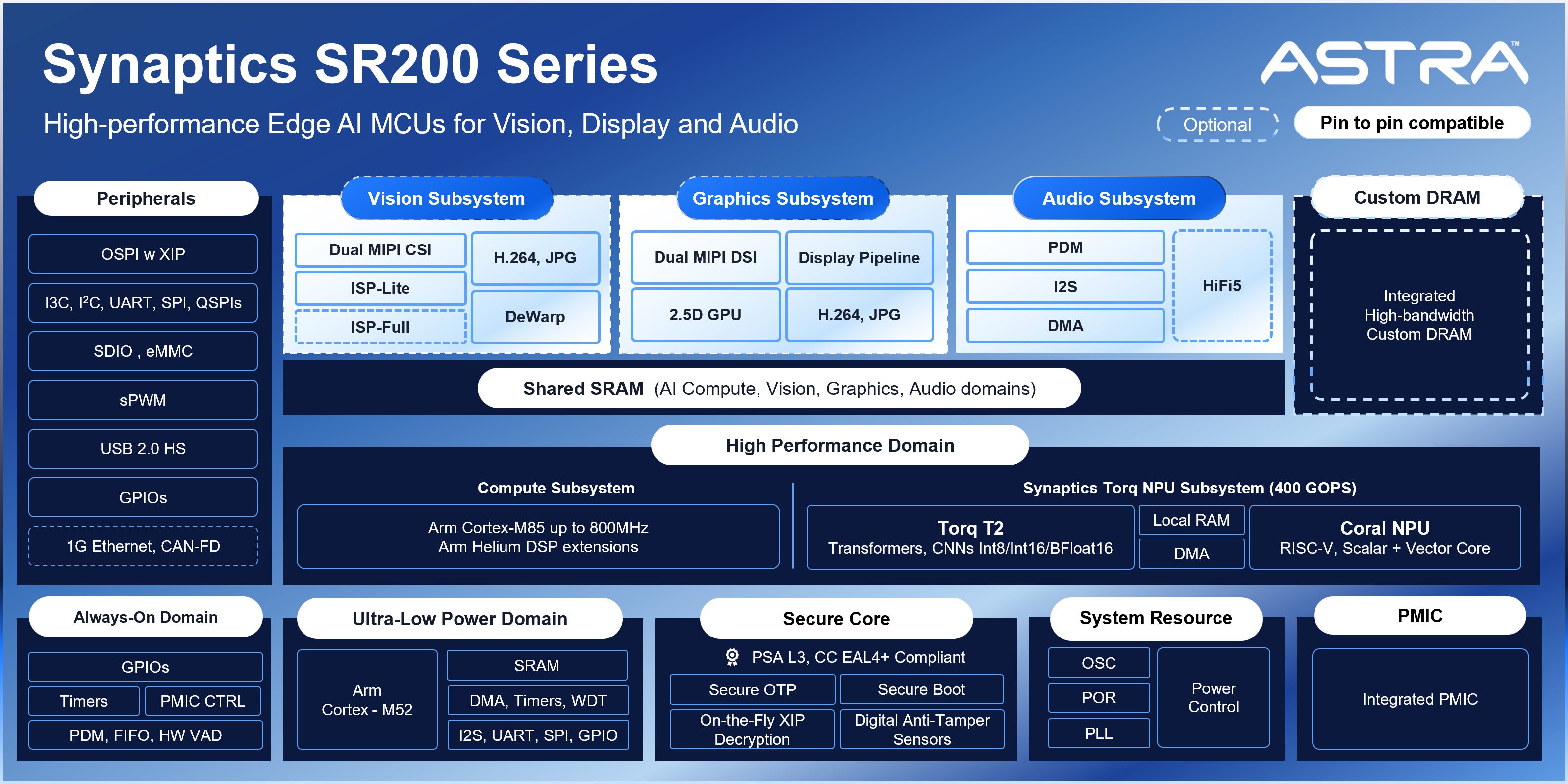
According to the SR200 product documentation, the family combines up to 8 MB of shared SRAM with custom DRAM that scales into the hundreds of megabytes. Packaging memory alongside the processor allows designers to support workloads that would exceed conventional on-chip SRAM capacity. Exact DRAM capacity and measured bandwidth for each configuration remain important purchasing questions.
Different engines for different workloads
The CPU subsystem pairs a Cortex-M85 running at up to 800 MHz with a 200 MHz Cortex-M52. The former handles demanding application work, while the latter can operate on less intensive sensing and control tasks. An optional audio DSP and separate vision hardware further reduce the need for general-purpose CPU processing.
Synaptics describes four independent power domains in its engineering overview. A battery-powered camera could keep a low-power detection function active and enable more demanding imaging hardware only after an event. Such scheduling may reduce average energy consumption, depending on how often the device wakes and how long processing lasts.
A more capable microcontroller, not a universal AI computer
The SR200 supports Zephyr RTOS and an open-source compiler for its neural accelerator. The software environment may help developers deploy compact neural models without adopting a full Linux application stack. Independent engineering coverage also emphasizes the integrated memory architecture and heterogeneous Arm cores.
Earlier BitcoinVersus.Tech reporting explored Arm vector processing, Ambarella edge inference, custom RISC-V instructions and Qualcomm industrial processors. Each approach illustrates a different way to distribute computation across specialized hardware.
Peak GOPS ratings do not establish inference latency, model accuracy, battery life or energy per inference. Those outcomes require measurements using specified models, numerical formats and realistic workloads. The notable development is a microcontroller family designed around the memory demands of local AI, rather than arithmetic throughput alone.
We volunteer daily to ensure the credibility of the information on this platform is Verifiably True. If you would like to support to help further secure the integrity of our research initiative, please scan the QR code below.



Leave a Reply