The second phase is commissioned
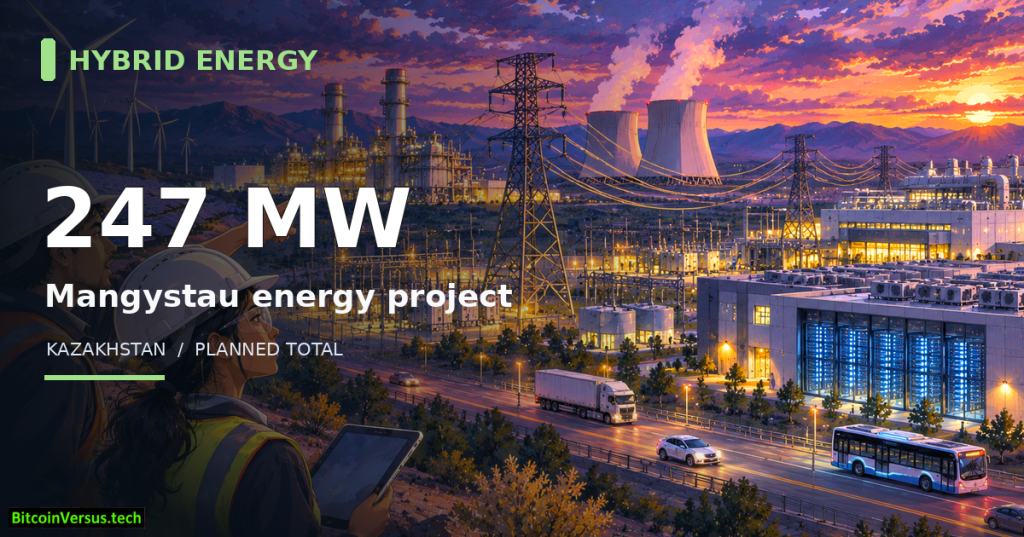
Eni announced on November 24, 2026, that the 120 MW gas-fired component of its Mangystau hybrid power development in Kazakhstan had completed commissioning. Samruk-Kazyna separately reported on November 25 that commercial operation had begun in July 2026 and that the plant had already generated more than 26 GWh. The November announcement therefore should not be interpreted as the first date of electricity production. The project is being developed with KazMunayGas and Plenitude. A 50 MW solar facility was commissioned in September 2025, while the 77 MW wind component remains a future construction and operating milestone. The total intended capacity is 247 MW, not a claim that all 247 MW are now available.
Featured cover: conceptual editorial illustration, not a photograph of the named project. Documentary and contextual images are identified in their captions.
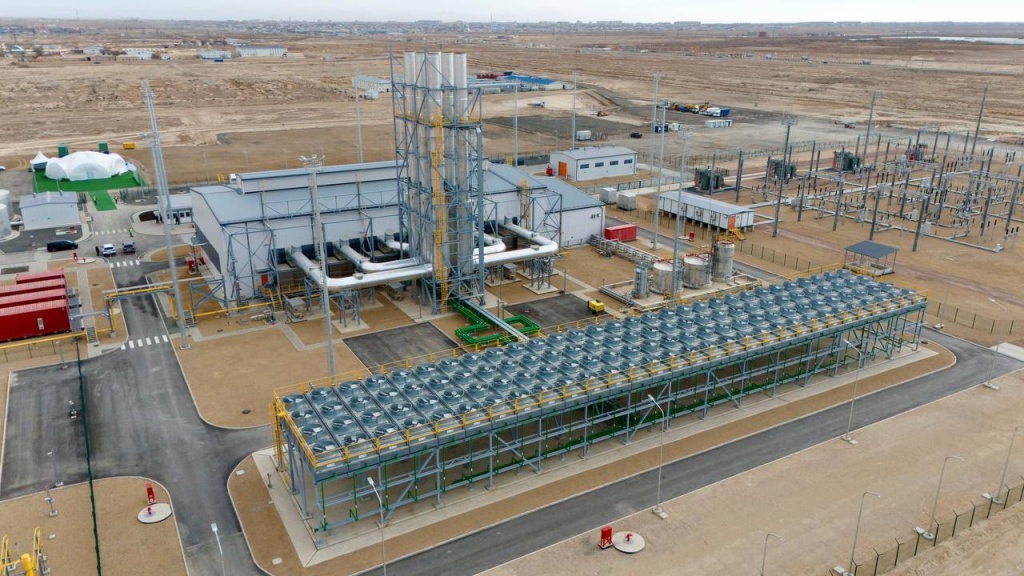
Zhanaozen gas power plant. Credit: Samruk-Kazyna.
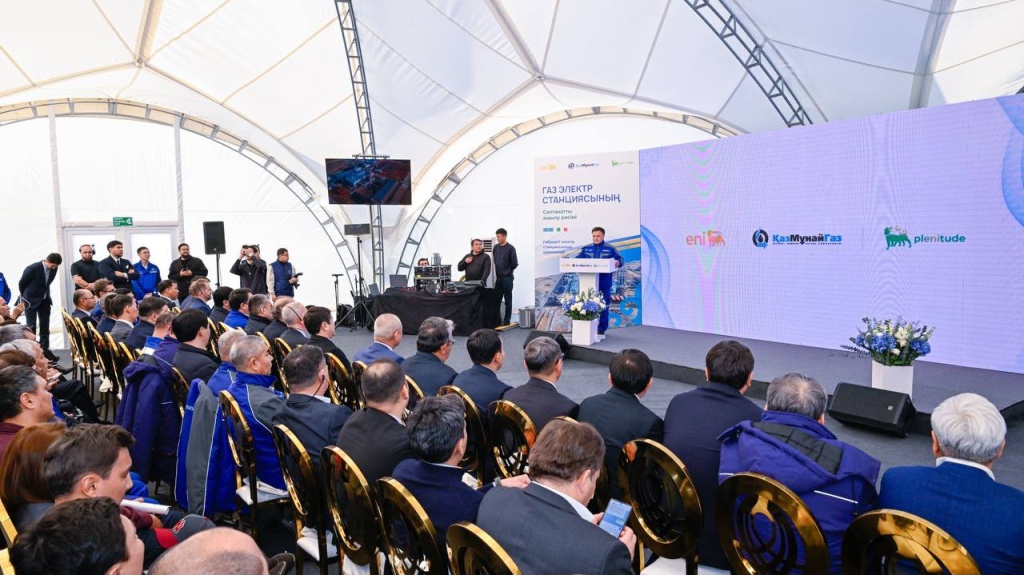
Zhanaozen gas project ceremony. Credit: Samruk-Kazyna.
Combining different generation profiles
Solar panels generate electricity during daylight, with output changing according to weather and the angle of incoming sunlight. Wind turbines depend on local wind conditions. A natural gas generating unit can provide controllable output within equipment and fuel supply limits. Combining these technologies can reduce dependence on one source while providing flexibility to accommodate variable generation. The actual system performance depends on the control strategy, network constraints and demand.
How the portfolio divides capacity
The gas component accounts for about 48.6% of planned nameplate capacity, solar for 20.2%, and wind for 31.2%. Together the planned renewable components represent 127 MW, or 51.4%. Those percentages are based on rated power rather than annual electrical energy. Different operating schedules and resource conditions may produce a very different annual energy mix. The 50 MW solar and 120 MW gas components account for 170 MW of announced commissioned capacity.
A dispatch example
Consider a hypothetical customer load of 100 MW at a time when the completed solar installation produces 30 MW. A gas plant could supply the remaining 70 MW if the equipment were available and the network permitted that operating arrangement. When wind generation becomes available, it could further reduce the residual demand on controllable generation. The example illustrates a dispatch concept rather than reporting Mangystau’s actual control system or commercial dispatch arrangements.
Commercial performance will require measurements
Eni expects the wind component to begin commercial operation in 2027, completing the intended configuration. The project is intended to supply industrial customers affiliated with KazMunayGas. Evaluating performance will require hourly generation and demand data, fuel consumption, outages, curtailment and emissions. A hybrid design does not automatically guarantee lower operating costs or continuous supply; the value depends on how its components work together. The commissioning of the gas component establishes a concrete project milestone, while the full hybrid system remains incomplete.
Grid integration determines whether the three resources can function as a coherent portfolio. Dispatchers must account for short-term renewable forecasts, planned maintenance, generator operating limits and the capacity of local transmission equipment. Fuel savings cannot be calculated from installed renewable capacity alone. Hourly production and gas consumption records would make it possible to determine how much renewable electricity actually displaces fuel-fired generation.
Sources and further reading
Announcement or reporting | Additional source
Fervo’s geothermal transmission rights | China’s 60 MW liquid-air battery | U.S. electricity generation mix | Utah’s 600 MWh battery
We volunteer daily to ensure the credibility of the information on this platform is Verifiably True. If you would like to support to help further secure the integrity of our research initiative, please scan the QR code below.

For mobile scanning, open the article on another display and scan the QR code with a Bitcoin wallet. The voluntary donation amount is 5,000 sats. Verify the receiving address 3C9o19EH5HSiwEPyCTmEKzxhNCbo2X6TTb before sending.
BitcoinVersus.tech is not a financial advisor. This media platform reports on financial subjects purely for informational purposes.


Leave a Reply