Open-Source History of Engineering • Intermediate • Estimated study time: 35 minutes
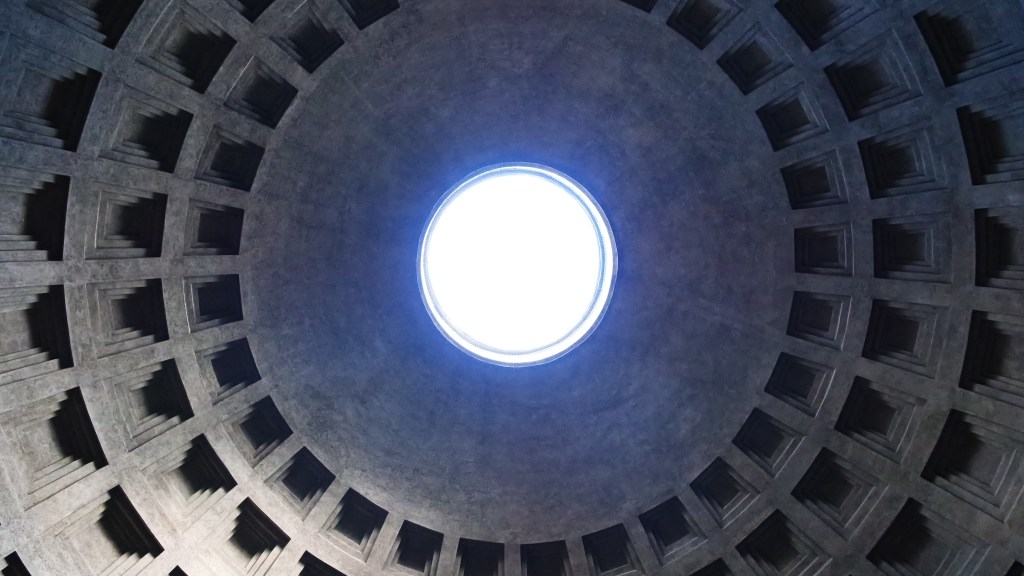
Completed during the Roman imperial period around AD 125, the Pantheon in Rome preserves a vast dome of unreinforced concrete. Its approximately 43.3-meter internal diameter demonstrates how geometry, materials and load distribution can work together. Unlike the Roman aqueducts studied in OSHE.009, the primary structural challenge was supporting a large enclosed space rather than conveying water.
Learning objectives
- Describe the Pantheon’s geometry, drum and oculus.
- Explain how a masonry dome transmits forces.
- Distinguish concrete density grading, thickness variation and coffering.
- Calculate the projected area and oculus area fraction from approximate dimensions.
- Evaluate historical engineering evidence without confusing simplified models with actual structural measurements.
Geometry and historical context
The present building is generally dated to the reign of Hadrian, although the inscription commemorates an earlier building associated with Marcus Agrippa. The surviving designer’s identity is not securely established. The circular rotunda supports a roughly hemispherical interior dome. The Smarthistory architectural analysis explains its spatial and construction features. As with the Red Pyramid, geometry helps explain the structure, but it does not establish the exact sequence of ancient construction.
Load paths and structural behavior
Gravity loads pass through the dome into the surrounding masonry drum and foundations. A curved shell carries loads through forces along its surface as well as bending near discontinuities. Meridional compression runs along curves from crown toward base. Circumferential or hoop forces can change from compression near the crown to tension farther down in an idealized hemisphere under self-weight. Roman concrete is comparatively weak in tension; cracking and redistribution of forces therefore matter. The thick drum and exterior step rings help support the structure. The University of Washington Engineering Rome student analysis discusses the dome’s structural behavior and cracking. A simplified shell model cannot establish the stress state of the actual monument.
Managing dead load
Roman concrete combined mortar and aggregate. Builders varied aggregate density and reduced dome thickness toward the crown; lighter volcanic materials were used higher up. Recessed coffers also remove some material while creating a regular interior pattern. These are complementary strategies, not interchangeable mechanisms. A lower mass reduces gravitational loading, while the remaining cross-section must still carry forces safely. Compare the material and load-path choices with the Bent Pyramid’s changing geometry.
Worked geometry
Approximate the dome’s plan as a circle with diameter 43.3 m and the oculus as a circular opening 9 m across, consistent with the dimensions discussed in Engineering Rome’s Pantheon analysis. The plan area is π × 21.65² ≈ 1,473 m². The oculus area is π × 4.5² ≈ 63.6 m². Its share of the projected plan area is (9/43.3)² × 100 ≈ 4.32%. The opening admits daylight and eliminates material at the crown. The calculated percentage is a plan-area ratio, not a measured percentage of removed concrete mass or stress reduction.
Evidence and safe learning
Compare surviving masonry, measured dimensions, historical texts and modern structural studies. Distinguish visible features from hypotheses about temporary timber support and construction sequencing. As in the Great Pyramid surveying lesson, a geometrically plausible method is not proof of the ancient method. Use a paper model or digital simulation; do not climb, alter or load historic structures. Modern construction requires qualified engineering analysis and applicable approvals.
Exercises and answer key
- What supports the dome at its perimeter? Answer: the massive circular drum and associated structural system.
- What is the difference between a coffer and the oculus? Answer: a coffer is a recess; the oculus is an open circular aperture.
- If a circular opening doubles in diameter, how does its area change? Answer: it quadruples.
- Does the 4.32% plan-area fraction establish mass reduction? Answer: no; thickness, material density and three-dimensional geometry must be known.
Featured photograph: T. Le Berre, 2019, Wikimedia Commons, CC BY-SA 4.0, unmodified.
We volunteer daily to ensure the credibility of the information on this platform is Verifiably True. If you would like to support to help further secure the integrity of our research initiative, please scan the QR code below.

BitcoinVersus.tech is not a financial advisor. This media platform reports on financial subjects purely for informational purposes.


Leave a Reply