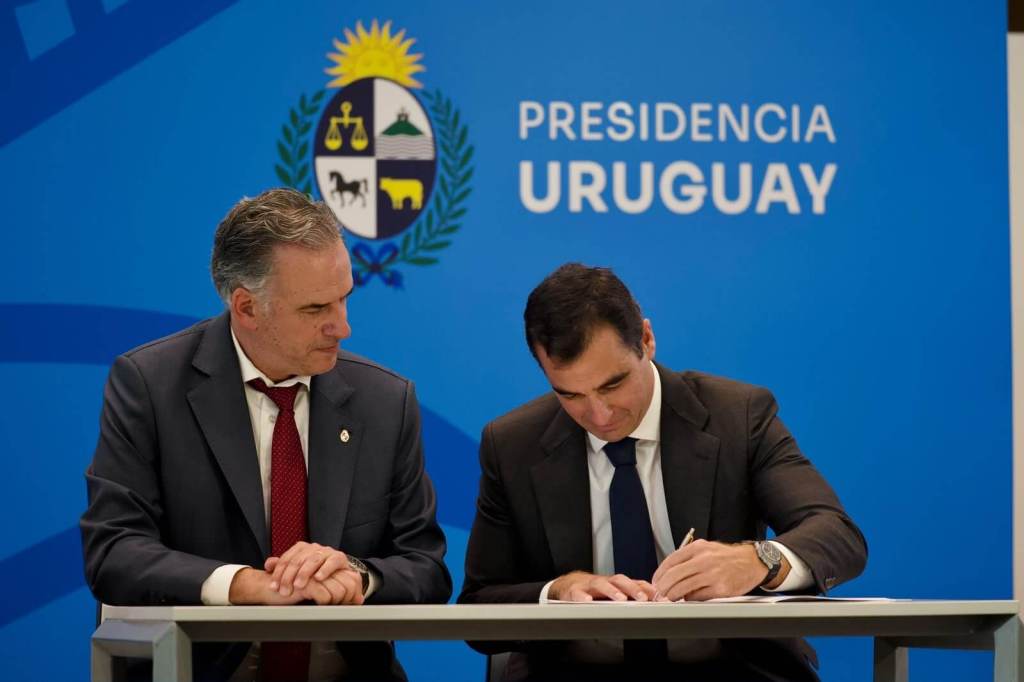
Uruguay is coordinating a major digital infrastructure proposal with Spanish renewable energy developer Solaria. On November 9, 2026, the country’s presidency confirmed meetings with regional authorities to advance work on a proposed 500 MW data center park and 350 MW of solar generation. The meetings followed an October 14 strategic agreement with Solaria and participation by state electricity utility UTE. Announced investment totals $5.7 billion; completed expenditure and energized computing capacity have not been established.
The developer’s announcement describes an initial 200 MW of data center capacity followed by another 300 MW. The first phase would also install the planned photovoltaic generation. Data center development is expected in Canelones and San José, with solar installations in Florida. Government estimates allocate $5.5 billion to digital infrastructure and $200 million to the solar component. Land acquisition, environmental assessment and permitting remain necessary.
Why the 500 kV connection matters
Rather than relying on a dedicated solar array alone, the developer intends to establish a connection to Uruguay’s high-voltage transmission system. Solaria would provide land, electrical infrastructure and associated services to computing operators within a free-trade zone. UTE would purchase the photovoltaic electricity under a proposed agreement lasting up to 40 years. The arrangement resembles the coordinated powered-land approach behind Norfolk’s solar-backed campus proposal, although each project’s commercial and network arrangements differ.
A high-voltage connection allows a large load to exchange power with the wider system while limiting current for a given power transfer. Transformers step down the incoming voltage before distribution to individual buildings, where further conversion supports IT equipment and cooling. Redundant supplies, protection systems and backup generation must be designed around actual reliability requirements rather than the headline connection rating.
Solar capacity does not equal continuous supply
If a 500 MW facility operated at its maximum electrical rating throughout a non-leap year, it would consume 4.38 TWh. A 350 MW solar array operating at an illustrative 20% capacity factor would generate about 613.2 GWh annually, equivalent to 14% of that hypothetical demand. Neither the assumed capacity factor nor the continuous load is a project forecast. Actual generation depends on weather, equipment, losses and curtailment. Solaria says the initial focus is cloud services, with water-efficient closed-loop cooling or equivalent systems. The difference explains why grid access remains important even when generation is developed alongside data centers, as illustrated by Malaysia’s solar and storage development and AirTrunk’s renewable procurement plans.
At the initial 200 MW scale, the same solar assumption would cover approximately 35% of annual energy demand under continuous full load. Hourly matching would be considerably more complicated because photovoltaic production falls to zero at night. Uruguay’s broader electricity portfolio and transmission network could provide complementary supply, but the terms of the proposed procurement and any storage requirements need clarification.
The project strengthens South America’s role in energy-oriented digital infrastructure, alongside Paraguay’s hydropower-oriented computing infrastructure. Its next meaningful milestones are confirmed site acquisitions, permits, detailed transmission specifications, finalized electricity contracts and construction commitments. The November meetings demonstrate coordination, not completed facilities or operating AI hardware.
We volunteer daily to ensure the credibility of the information on this platform is Verifiably True. If you would like to support to help further secure the integrity of our research initiative, please scan the QR code below.

For mobile scanning, open the article on another display and scan the QR code with a Bitcoin wallet. The voluntary donation amount is 5,000 sats. Verify the receiving address 3C9o19EH5HSiwEPyCTmEKzxhNCbo2X6TTb before sending.
BitcoinVersus.tech is not a financial advisor. This media platform reports on financial subjects purely for informational purposes.


Leave a Reply