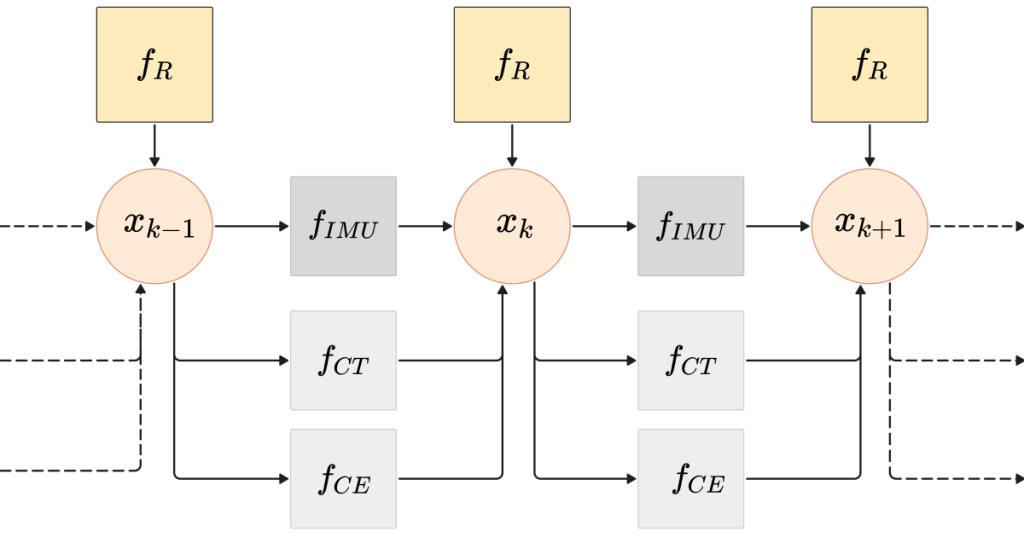
The University of Zagreb’s Laboratory for Autonomous Systems and Mobile Robotics (LAMOR) announced a new IEEE Robotics and Automation Letters paper on November 4, 2026. Researchers Vlaho-Josip Štironja, Luka Petrović, Juraj Peršić, Ivan Marković and Ivan Petrović developed a radar-inertial navigation method that estimates timing discrepancies and physical sensor alignment during operation. On an unsynchronized benchmark dataset, the authors report a 33% reduction in mean translational relative pose error compared with their plain factor-graph baseline. The work addresses a different navigation mechanism from LiDAR-based localization with particle filters.
Why sensor timing matters
A radar can measure the velocity of a moving platform relative to surrounding reflectors through Doppler measurements. An inertial measurement unit (IMU) measures acceleration and angular velocity. Integrating inertial measurements helps estimate motion between radar observations, but biases accumulate. Fusing independent sensing methods can constrain that drift.
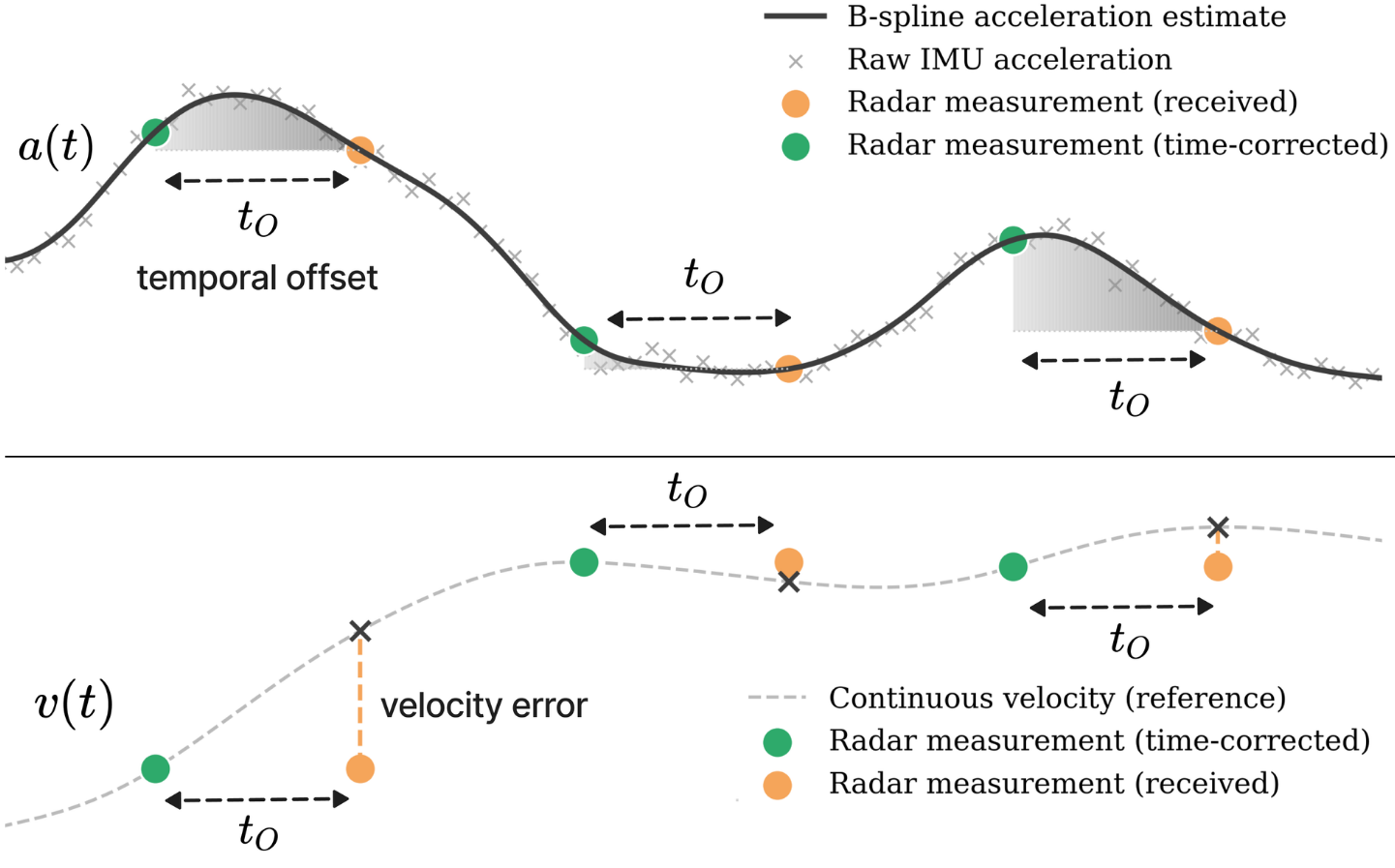
Timing errors matter because measurements taken at different instants may describe different robot states. For example, a vehicle moving at 5 meters per second travels 0.5 meters in 100 milliseconds. Treating delayed observations as simultaneous can therefore distort the estimated trajectory. The actual estimation error depends on motion, sensor geometry and the fusion algorithm.
Estimating time and mounting alignment together
The proposed LC-RIO-ET method uses a factor graph, a mathematical representation of relationships among estimated states and sensor measurements. Its continuous-time inertial model uses cubic B-splines to represent acceleration and angular velocity between sampled timestamps. The optimizer can then evaluate motion at corrected radar measurement times while estimating the relative orientation and position of the radar and IMU. The implementation uses GTSAM and incremental smoothing in a one-second sliding window, according to the researchers’ March preprint.
Performance on unsynchronized and synchronized data
The research project’s published evaluation reports mean translational relative pose error of 0.138 meters and mean rotational relative pose error of 2.377 degrees on the unsynchronized EKF-RIO-TC dataset. The translational result improves by 33% against LC-RIO, the plain factor-graph baseline. On the hardware-synchronized ICINS dataset, LC-RIO-ET and LC-RIO both reported mean translational relative pose error of 0.151 meters. The benefit therefore depends on the presence and magnitude of calibration errors.
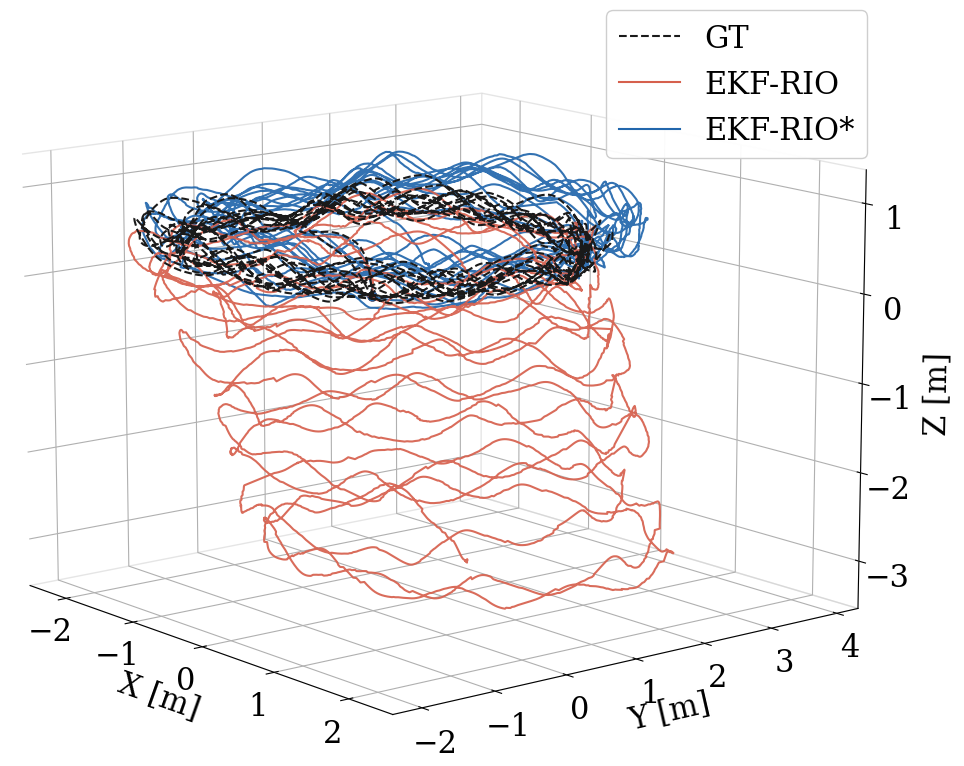
Relative pose error measures discrepancies in estimated motion over specified intervals. It is not equivalent to maximum position error, collision avoidance performance or a guarantee of safe autonomous operation. Even accurate odometry must be integrated with mapping, perception and control, including methods such as pure pursuit path tracking and local obstacle avoidance.
Radar-based navigation offers a complementary sensing approach for conditions where optical observations deteriorate. The development could inform future mobile platforms, but the benchmark does not establish operational readiness for an autonomous vehicle or warehouse deployment such as those discussed in our industrial robotics coverage.
Original scientific research: Radar-Inertial Odometry With Online Spatio-Temporal Calibration via Continuous-Time IMU Modeling, IEEE Robotics and Automation Letters, volume 11, issue 11, pages 13613–13620. The November 4 university announcement confirms publication. The IEEE full text was inaccessible; the accessible preprint and project results support the analysis. The linked repository currently describes the implementation but does not yet expose its source code. Featured image: cropped research diagram, CC BY-SA 4.0.


Leave a Reply