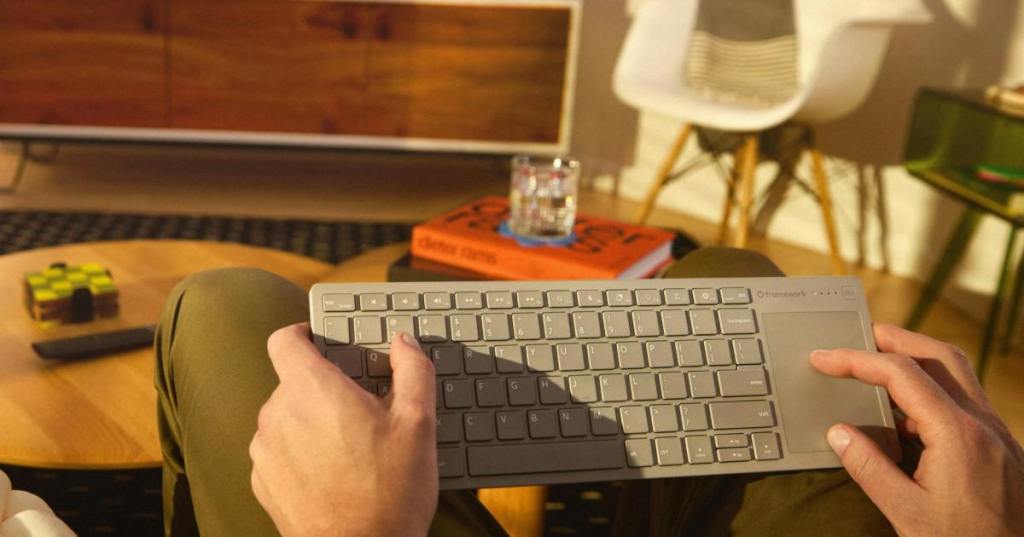
Framework opened preorders for its Wireless Touchpad Keyboard on November 17, 2026, introducing a repairable peripheral intended for living-room computers, server setup and compact workspaces. The company announcement describes a rechargeable replaceable battery, accessible controller and programmable firmware. The product extends the modular design philosophy discussed in our survey of processor-upgradeable laptops. Initial shipments are planned for the first quarter of 2027, rather than confirmed mass delivery in November.
A single peripheral for multiple computers
The keyboard combines a scissor-switch membrane mechanism with a touchpad measuring 68.8 by 85.6 millimeters. Its keys have a specified travel distance of 1.5 millimeters. The product specifications describe multi-touch gestures and connections through Bluetooth, a supplied USB-A receiver or a wired USB-C link. Device profiles allow switching between a television-connected computer, desktop or other compatible host without moving separate pointing devices. The initial layout is US English ANSI and does not include a keyboard backlight.
Framework reports a touchpad sampling frequency of 120 Hz and wired keyboard polling support up to 8 kHz. The figures refer to different operations: touch sensing and host communication. A polling interval of one-eighth of a millisecond at 8 kHz does not establish equivalent total input latency. Key scanning, debounce, operating-system processing and the display pipeline add time. Our display refresh-rate comparison discusses a separate component of the input-to-display pipeline.
Low-power electronics and serviceable components
The company specifies a 1,200 mAh battery and reports a connected low-power current below 50 microamperes. At a hypothetical constant 50 microamperes, dividing battery capacity by current yields 24,000 hours, or approximately 1,000 days. Real runtime will be shorter when active input, radio communication, battery aging and other loads are included. Framework estimates more than a year of occasional-use operation and more than a month with regular desk use. Neither estimate is an independent endurance measurement.
The design uses a Nordic wireless microcontroller and firmware derived from ZMK. Published surface CAD files support custom mounting accessories. The announcement describes planned firmware publication and replaceable control hardware. Software and mechanical accessibility are complementary: a replaceable battery addresses wear, while configurable firmware permits changes in input behavior. The distinction also appears in the MNT Reform Next open-hardware laptop.
Repairability is a lifecycle question
Independent reporting by The Verge puts the keyboard’s US price at $99. Framework requires a refundable $50 preorder deposit. Replacement-part pricing, sustained availability, actual battery endurance and long-term firmware support will determine the product’s lifecycle value. Compatibility with systems such as Linux desktop environments must ultimately be judged through real use. A repairable design makes component replacement possible, but cannot guarantee indefinite service life.


Leave a Reply