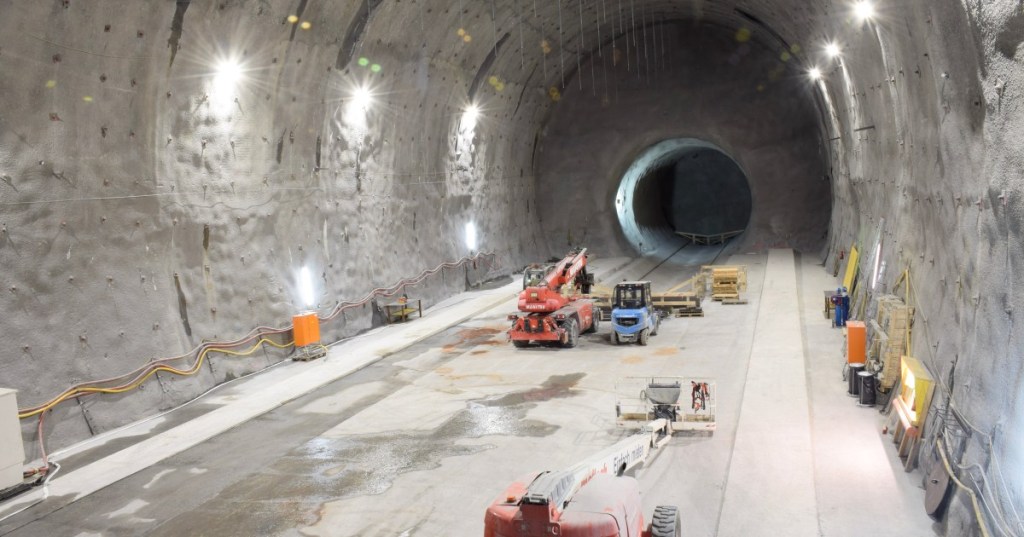
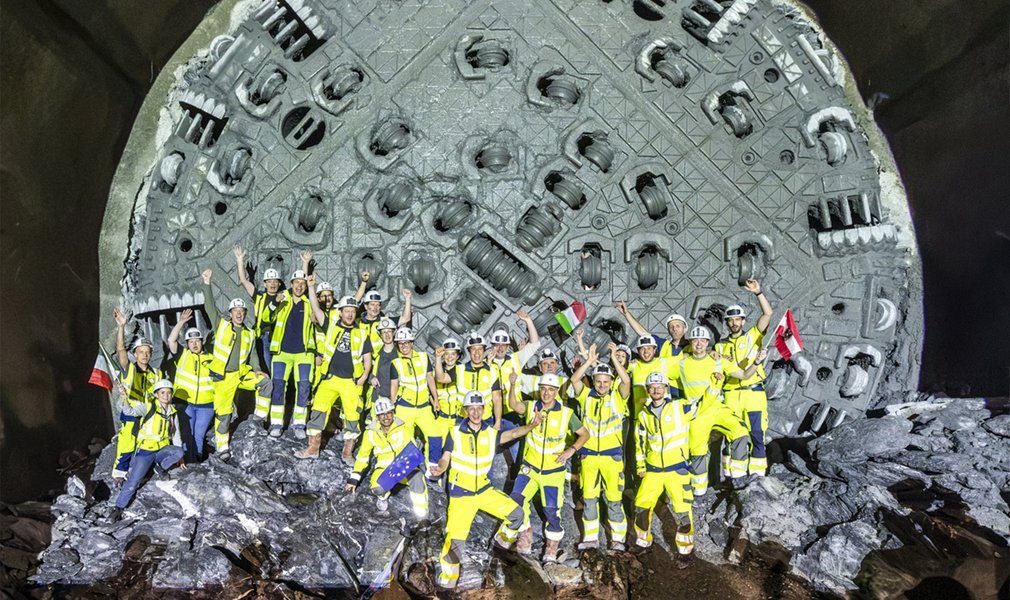
The final tunnel boring machine working on the Brenner Base Tunnel reached its destination on November 24, 2026. The project owner’s announcement confirms the completion of mechanized excavation, concluding the work of nine boring machines on the cross-border railway development. The milestone concerns excavation rather than passenger or freight operations. Other major rail projects, including the Hudson Tunnel Project, illustrate the long engineering sequence separating a boring-machine launch from a finished railway.
Excavating a railway through the Alps
The final machine, Olga, excavated roughly 7.6 kilometers northward in the eastern main tube after beginning work in September 2024. BBT SE reports a cutterhead diameter of 10.37 meters and installed drive capacity of 4.55 MW. The machine developed a specified torque of 26.4 million newton-meters. Those are equipment specifications, not measurements of average power consumption over the drive.
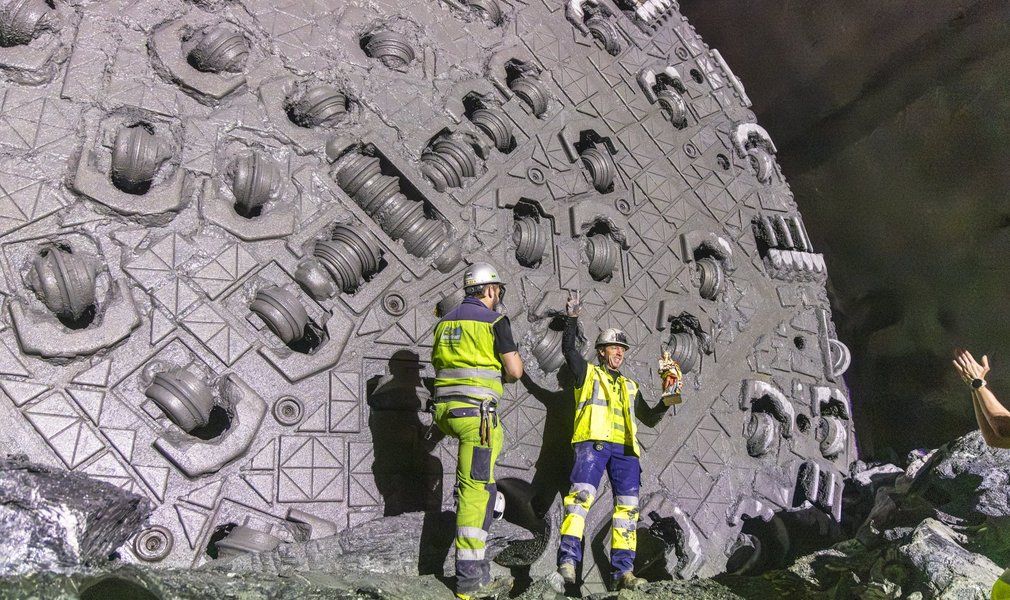
A rotating cutterhead breaks rock at the excavation face. Conveyors carry material away while the machine’s support systems maintain the working environment. Precast concrete segments form structural rings behind the cutterhead. Different ground conditions require adjustments in thrust, rotational speed and support strategy. Distributed strain measurements, such as the techniques explained in our fiber-optic strain sensing lesson, are examples of the broader monitoring tools available to civil engineers; no use of a particular sensor at Olga is asserted.
A lower-gradient freight corridor
The project overview identifies a 55-kilometer railway connection between Innsbruck and Fortezza, with gradients of four to seven meters per kilometer. Lower gradients reduce the traction force required to lift a train against gravity. For an illustrative 1,000-tonne train, a seven-per-thousand slope adds approximately 68.7 kN of gravitational resistance before rolling and aerodynamic losses. Actual energy savings depend on route geometry, traffic and train configuration. Rail infrastructure also supports freight distribution elsewhere, including the Moses Lake freight railway project.
From excavation to railway systems
The owner’s October 20 revised forecast targets operation in 2034 at an estimated total cost of €11.7 billion. Plans include converting the exploratory tunnel into a service tunnel to support maintenance and safety. Railway equipment, communications, emergency systems and integrated testing still need completion. The International Railway Journal’s November 24 report independently describes the excavation milestone. As with the Peusangan hydroelectric commissioning project, completion of a major engineering stage does not establish that the entire system is ready for commercial service.
Commissioning also requires verifying interactions between subsystems. For example, a train detection system, emergency communication network and ventilation controls must operate under normal and degraded conditions. Individual equipment acceptance does not establish system-wide readiness. Cross-border railway infrastructure additionally requires coordination of operating procedures, maintenance responsibilities and interfaces with the adjoining national networks.


Leave a Reply