
Luxor Technology published a new analysis of variable-power Bitcoin mining on November 26, 2026. Its Intelligent Miner Volume II report estimates that a 10 MW Antminer S21 Pro fleet could have generated 11.5% more gross profit using multiple operating profiles rather than binary operation since the model launched in July 2024. The result is a company backtest using ERCOT West electricity prices, not an independently measured profit increase for every mining facility. It extends our earlier analysis of Luxor’s separate curtailment and restart thresholds.
Why intermediate power settings matter
A conventional binary strategy switches miners between their standard operating point and an inactive state. A variable-profile strategy instead evaluates several combinations of clock frequency, voltage, hashrate and electrical demand. ASIC power consumption does not necessarily rise in proportion to frequency, because higher frequencies may require higher operating voltage. Consequently, the operating point with the most hashes per second is not always the one with the highest cash contribution.
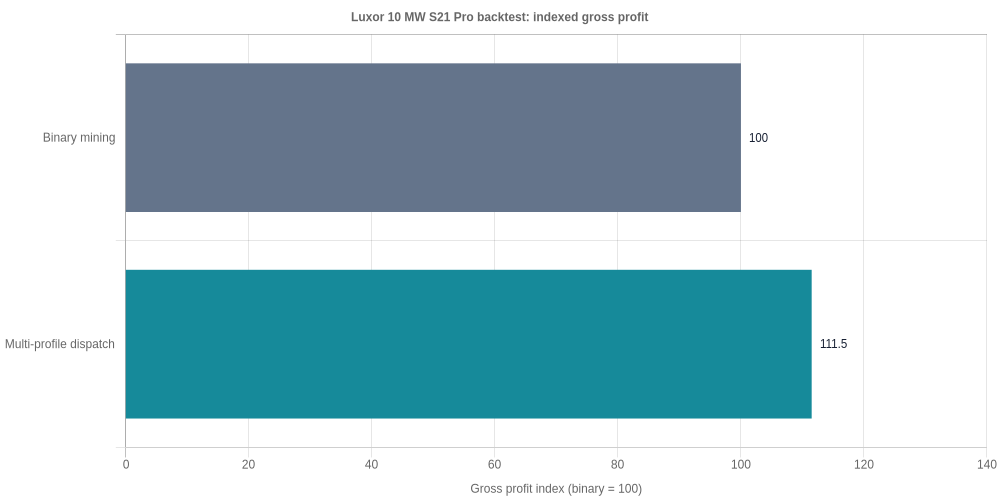
The comparison normalizes the binary strategy to 100 and the optimized strategy to 111.5. It does not disclose absolute dollar profit or establish a guaranteed return. Our coverage of the acquisition premium for sub-11 J/TH hardware illustrates a separate tradeoff: software optimization can improve the use of installed equipment, but cannot erase differences in silicon efficiency.
A fleet-level optimization problem
According to Luxor’s technical documentation, its controller evaluates available machine profiles against power prices, hashprice, site power limits and transition penalties. Each machine receives one operating profile. The fleet-wide selection must remain within the electrical constraints of the facility.
For example, a hypothetical 200 TH/s miner consuming 3 kW earns $0.25 per hour at $30 per PH/s per day. At $60/MWh, electricity costs $0.18 per hour, leaving $0.07 before pool fees, cooling overhead, maintenance and depreciation. A different operating profile may yield a better contribution. Restart behavior also matters, as discussed in our S21 recovery-power analysis.
Grid incentives change the dispatch decision
The report also describes a West Zone congestion-credit case on October 13, 2026. Luxor contrasts approximately $1,300 actually collected during curtailment with a hypothetical $17,500 had the site sustained its normal 3.53 MW. The difference depends on the applicable settlement arrangement, not a universal rule that miners should remain online during expensive intervals.

Our earlier investigation of West Texas wind shortages and mining curtailment shows why electricity contracts and transmission conditions must inform operating decisions. The new report adds a more granular control strategy. Operators should validate its economics using their own power invoices, measured machine profiles, equipment availability and contract terms before treating modeled margins as attainable earnings.
Featured graphic: Luxor and Hashrate Index, November 2026 report launch.
We volunteer daily to ensure the credibility of the information on this platform is Verifiably True. If you would like to support to help further secure the integrity of our research initiative, please scan the QR code below.



Leave a Reply