Microsoft plans to remove the Windows Server Update Services (WSUS) server role from Windows Server 2028, according to its updated feature-removal documentation. BleepingComputer reported the change on November 27, 2026. The next server release remains in preview, and the company cautions that removal plans can change before general availability. Microsoft also says existing supported WSUS servers can continue distributing updates to Windows Server 2028 systems. Administrators therefore face a migration decision rather than an immediate shutdown. The announcement follows continuing maintenance for current systems, including the Windows Server 2025 IPv6 hotpatch.
What the WSUS server actually does
WSUS separates centralized update distribution from installation on individual Windows machines. An administrator synchronizes update metadata with Microsoft or an upstream WSUS instance, selects updates for deployment, and assigns approvals to groups of computers. Windows Update clients retrieve applicable updates according to configured policies. Multiple distribution servers can form a hierarchy for organizations operating across several locations. Microsoft’s deployment guide describes how local content storage can reduce repeated downloads over external links.
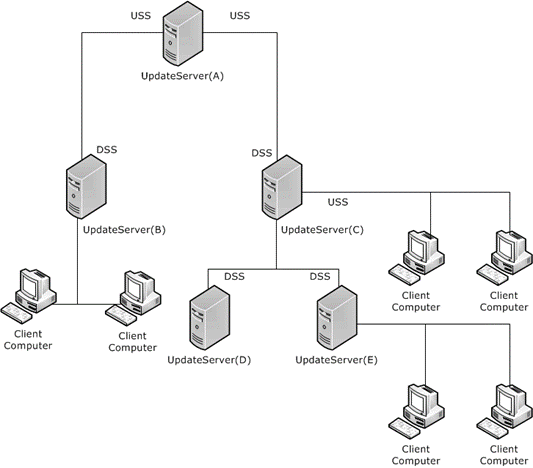
Consider a hypothetical branch office with 100 identical endpoints requiring the same 500 MB update. Separate full downloads would transfer 50 GB across the internet connection. A local repository fetching one complete copy would require approximately 0.5 GB of external transfer for the payload, while serving the remaining traffic over the local network. Actual savings depend on applicability, caching, delta downloads, update variants and existing network architecture. The example illustrates why organizations cannot evaluate a patch-management replacement solely by its administrative dashboard.
Cloud management is not the same as content distribution
Microsoft recommended cloud-based alternatives when it deprecated WSUS in 2024. Its Azure Update Manager coordinates patch assessments and deployment schedules for Windows and Linux servers across Azure and Azure Arc-connected environments. Client device management uses different tools, including Intune and Windows Autopatch. Centralized policy and identity controls are evolving elsewhere in the Microsoft ecosystem, as covered in our hybrid Entra sign-in analysis.
Azure Update Manager does not necessarily replace the underlying update source. Microsoft’s technical FAQ explains that Windows clients may still use WSUS or Microsoft Update while the Azure service coordinates scheduling. An administrator must evaluate both the management plane, where policy and compliance are handled, and the content plane, where the actual update packages are retrieved. Disconnected networks require particular attention because cloud connectivity may be restricted or prohibited.
A staged migration rather than a deadline-driven replacement
Microsoft says WSUS remains supported on earlier Windows Server releases for their applicable lifecycle. Organizations can inventory their current update servers, client policies, synchronization dependencies and network restrictions before introducing replacement technology. A test deployment should verify successful downloads, installation results, reboot behavior and recovery procedures on representative machines. Security teams should retain patch evidence and investigate failures, rather than treating a scheduled installation as proof of remediation. Our legacy vulnerability analysis explains why prolonged exposure to known flaws matters.
Microsoft also lists other planned removals, including SMBv1 and the WMIC command-line utility; WMI itself remains distinct from WMIC. Administrators should identify scripts and legacy applications before upgrading, using evidence-based techniques such as Windows process auditing. The WSUS announcement changes the future server-role architecture, but the operational goal remains unchanged: deliver authenticated updates to the correct systems, verify installation and preserve reliable service.
Featured image: cropped archival thumbnail from the linked Microsoft Mechanics Azure Arc demonstration.
We volunteer daily to ensure the credibility of the information on this platform is Verifiably True. If you would like to support to help further secure the integrity of our research initiative, please scan the QR code below.

BitcoinVersus.tech is not a financial advisor. This media platform reports on financial subjects purely for informational purposes.


Leave a Reply