
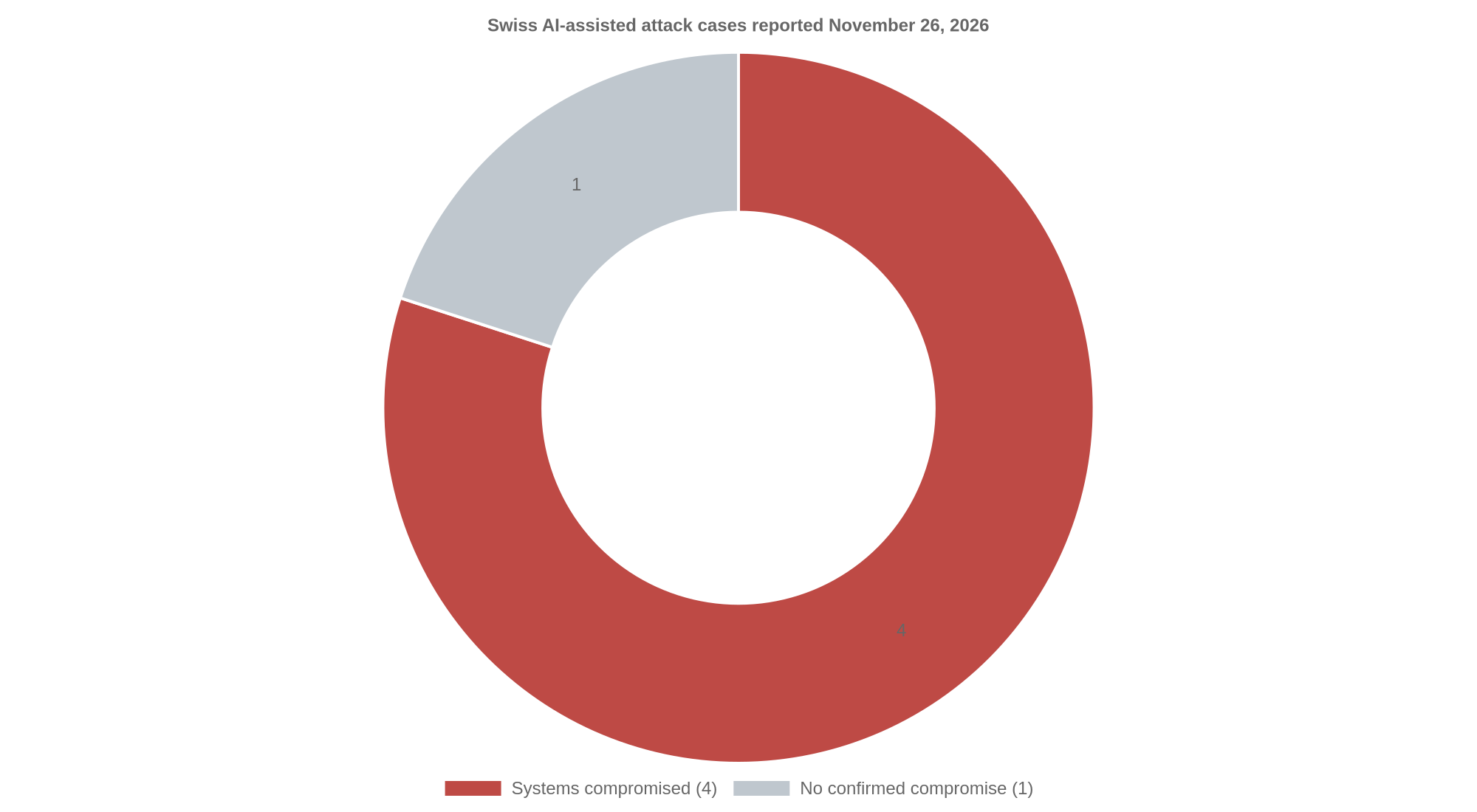
Switzerland’s National Cyber Security Centre disclosed its first confirmed AI-assisted attacks against domestic organizations on November 24, 2026. Two days later, Reuters reported five confirmed attacks, four involving successful system compromise. Three critical infrastructure operators were among the targets. The agency’s director, Florian Schütz, told Swiss public broadcaster SRF that no major outages had occurred. The findings bring a defensive dimension to the growing use of autonomous tools, including the enterprise agents examined in our Workspace developer infrastructure analysis.
The denominator matters
Four out of five cases corresponds to 80% within the reported set. The number does not represent a random sample of attacks. Organizations that detect and report incidents can differ from those that never identify an intrusion. The November 24 notice described successful compromise in all cases then known to the agency, whereas the November 26 reporting identified four successes among five cases. The available reports do not explain the difference in scope. Neither should be extrapolated into a national or global probability of compromise.
The agency has not named affected companies or attributed responsibility. An intrusion into an information technology system does not establish that industrial control equipment was manipulated. Electricity, water and telecommunications are examples of critical infrastructure sectors, not a verified list of compromised operational systems. The absence of major outages reported by SRF is a separate observation from whether data or credentials were exposed.
Why automation changes the defensive clock
Traditional security automation applies predefined rules to identify events and initiate responses. Agentic systems can combine model-generated decisions with software tools, changing their behavior based on feedback. The agency warns that existing security weaknesses remain relevant even when attackers employ newer automation. Our analysis of legacy vulnerability detections illustrates why maintaining current software remains essential.
For infrastructure defenders, exposure time is an operational metric. If a critical patch is released at 08:00 and deployed at 08:00 the following morning, the system remains potentially exposed for 24 hours, assuming no other mitigation. A weekly deployment schedule could leave an exposed service vulnerable for nearly seven days. The Swiss agency recommends installing critical updates for internet-facing systems as soon as possible and within 24 hours. The recommendation is not evidence that every organization can safely complete every industrial update within that period.
Measuring resilience rather than counting alerts
Organizations should inventory externally reachable services, prioritize remediation according to exposure and business impact, enforce strong authentication, constrain privileges and monitor changes in system behavior. Patching requires verification of installation and service health, as discussed in our enterprise patch-management report. Industrial environments may need temporary isolation or other compensating measures when immediate changes would threaten safety or continuity.
Defenders also need reliable recovery procedures and independent evidence that restored systems are trustworthy. The Hex.pm registry incident illustrates why containment and determining the extent of exposure are separate tasks. Switzerland’s findings do not establish that AI can defeat every security control. They do reinforce the need to shorten the interval between identifying a weakness, protecting affected systems and confirming that the protection works.
Featured illustration: Swiss National Cyber Security Centre’s November 24 advisory image, cropped. Not a photograph of an affected system.
We volunteer daily to ensure the credibility of the information on this platform is Verifiably True. If you would like to support to help further secure the integrity of our research initiative, please scan the QR code below.

BitcoinVersus.tech is not a financial advisor. This media platform reports on financial subjects purely for informational purposes.


Leave a Reply