Google announced general availability of its Workspace Model Context Protocol (MCP) servers and command-line interface (CLI) on November 24, 2026. The product announcement identifies eight supported services, including Gmail and Drive, and sets February 1, 2027, as the start of technical enforcement requiring agents to use the governed interfaces rather than ordinary REST APIs. The development follows Google’s October introduction of an enterprise Gemini agent, but addresses the infrastructure available to external developers as well.
Two routes into the same productivity ecosystem
MCP provides a standardized interface through which an agent host discovers available operations and submits structured tool requests. Google’s configuration documentation describes dedicated servers for Gmail, Drive, Docs, Sheets, Slides, Calendar, Chat and Tasks. Developers still need appropriate authorization and must distinguish a generally available service from an individual operation that remains in preview.
The CLI instead exposes operations through a terminal, allowing local software and automation workflows to consume structured results. Neither approach gives the language model unrestricted authority over an account. The host application, identity system, tool interface and authorization policies remain distinct components. Our agent harness engineering comparison explains why orchestration logic matters independently of model selection.
Engineering around the daily quota
Google’s usage documentation specifies a Standard Tier ceiling of 5,000 counted MCP requests daily for each project and product, alongside shorter rate limits. Some tools perform several underlying API operations and consume multiple quota units. Developers therefore cannot assume that 5,000 agent tool invocations will fit into the allowance.
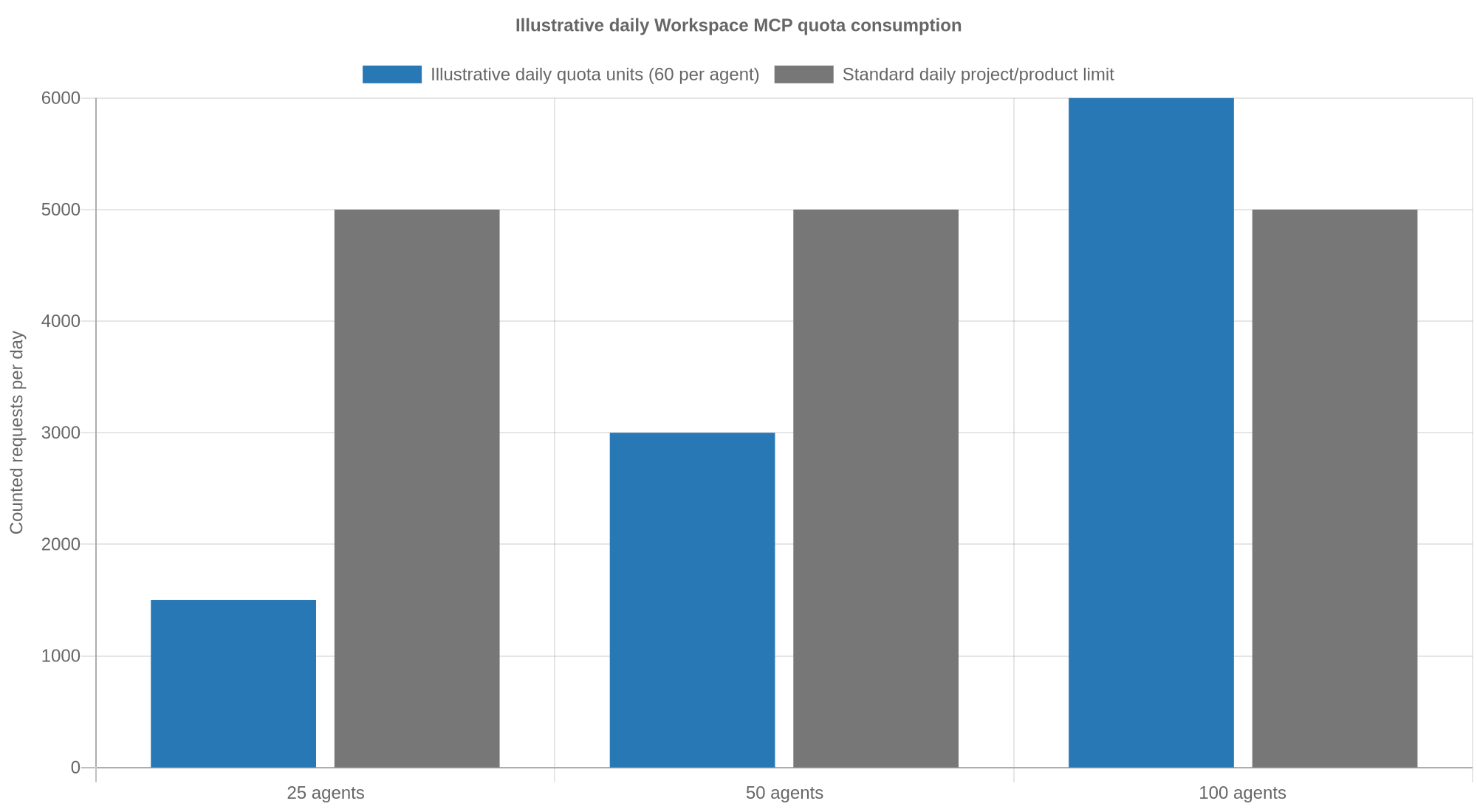
For example, 100 agents consuming 60 counted requests each would generate 6,000 daily units, or 20% above the Standard Tier ceiling. At the same consumption rate, 83 agents would require 4,980 units. Both calculations assume one shared project and one product, with no other traffic. Production systems also need spare capacity for retries and peak workloads. From April 1, 2027, Google’s Scaled Tier billing is scheduled to charge successful MCP requests for Gmail, Calendar and Drive from the first request. Traditional REST API allowances follow a different structure. Business Insider’s November 25 reporting also examines the commercial implications.
Why authorization must extend beyond login
A valid OAuth token establishes delegated access within its permitted scope, but it does not establish that every proposed operation matches a user’s current intent. Google requires distinct agent OAuth clients and describes administrator-managed permissions, data loss prevention, audit logging and confirmations for consequential operations. Its approval documentation describes server-driven interactions for obtaining user confirmation. A request to draft an email has a different effect from transmitting it to an external recipient.
An agent that retrieves documents can also encounter instructions embedded in untrusted content. Developers should keep retrieved data separate from trusted control instructions, constrain write permissions and record confirmed actions. Those controls complement, rather than replace, model reliability evaluations such as our analysis of repeated AI test performance.
The broader transition toward integrated AI tools is also visible in other productivity software. Google’s release establishes a concrete migration schedule for Workspace developers, not proof that every agent is safe or that all promised features have shipped. Before February, engineering teams should inventory direct API dependencies, test supported tool operations and model quota consumption under realistic workloads.
Featured image: cropped historical thumbnail from Google Workspace Developers’ May 2026 Cloud Next special edition.
We volunteer daily to ensure the credibility of the information on this platform is Verifiably True. If you would like to support to help further secure the integrity of our research initiative, please scan the QR code below.

BitcoinVersus.tech is not a financial advisor. This media platform reports on financial subjects purely for informational purposes.


Leave a Reply