The TornadoVM team announced TornadoInsight 2.1.0 on November 2, 2026, introducing an experimental AI-assisted method transformation in IntelliJ IDEA. Unlike a conventional code suggestion, the plugin can compile candidate accelerator kernels and compare their results against the original method. The release extends the developer tooling around TornadoVM 8’s GPU compiler, rather than replacing it. The feature is disabled by default.
Why GPU conversion is more than code generation
Java applications ordinarily compile source into JVM bytecode, as explained in our Java execution fundamentals lesson. TornadoVM can further translate supported computations for accelerators. Moving a loop to a GPU requires identifying independent iterations and ensuring concurrent writes do not introduce data races. A calculation that depends on the preceding iteration may not be safely parallelizable without changing its algorithm.
TornadoInsight proposes alternative implementations, including annotated parallel loops, explicit thread-level kernels and tile-based operations on supported NVIDIA hardware. Developers can request a measured comparison among available implementations. Static analysis rejects incompatible constructs, while optional execution tests compare GPU and original Java results. A candidate that silently falls back to the JVM fails the device test.
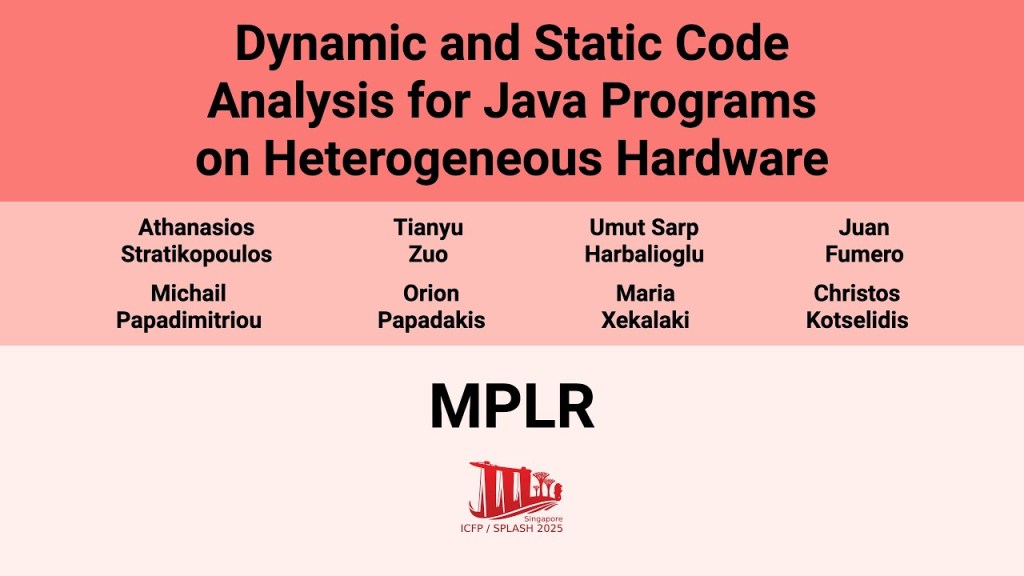
Research presentation on TornadoInsight’s original static and dynamic code analysis, recorded in 2025; background context rather than footage of version 2.1. Watch at source.
The benchmark depends on the workload
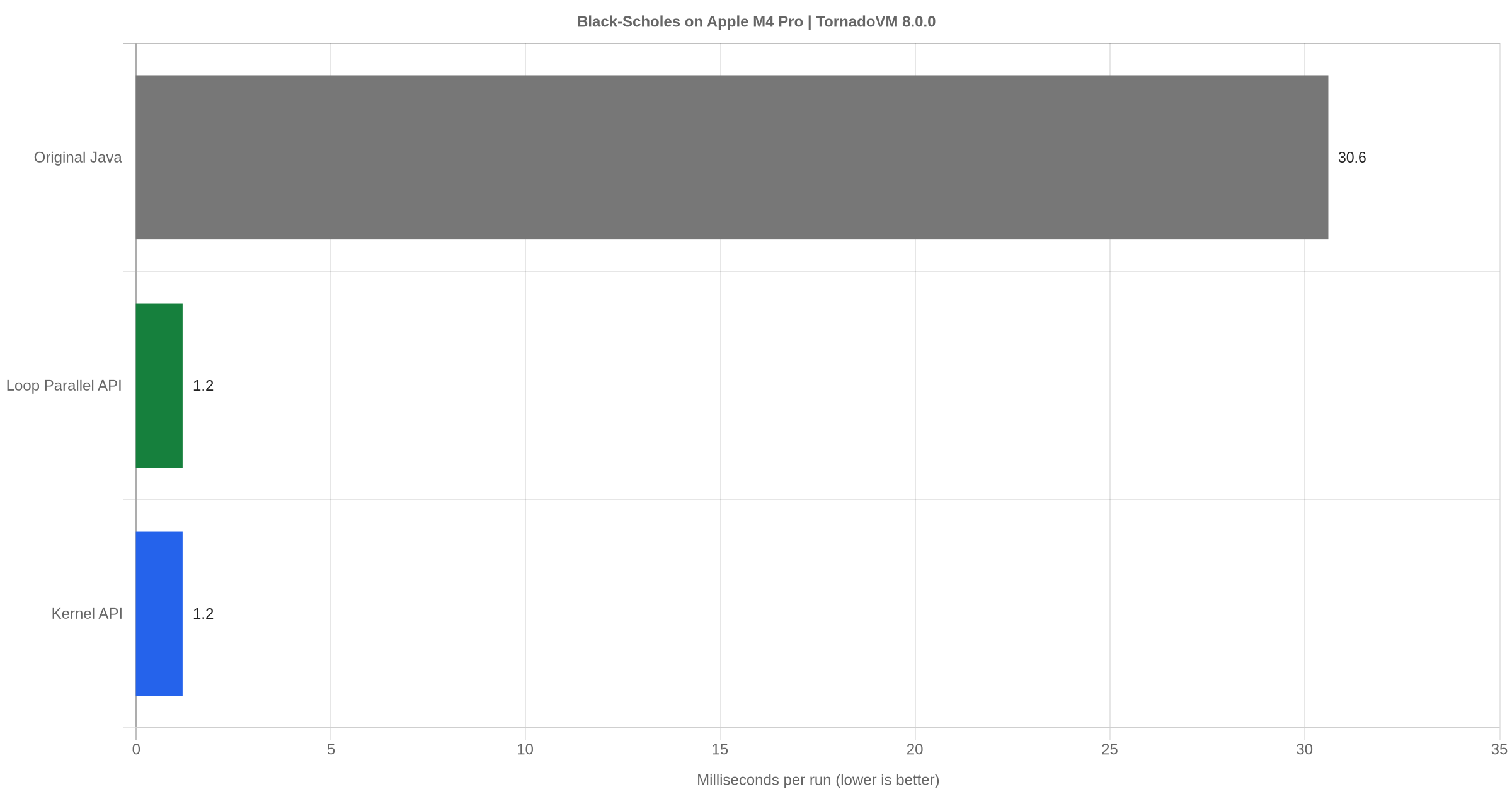
The developers reported a Black-Scholes options-pricing computation on an Apple M4 Pro using TornadoVM 8.0.0 and Metal. Their experiment processed 1,048,576 elements per array, measured ten runs after three warm-ups, and reported median total time. The original Java method took 30.6 milliseconds, while both GPU alternatives rounded to 1.2 milliseconds. The reported speedups were 25.4× for the annotated loop and 24.6× for the explicit kernel; rounded times cannot reproduce both ratios exactly.
The same report describes a SAXPY vector operation running approximately three times slower on the accelerator. Moving data and launching a kernel can outweigh savings when the arithmetic performed per element is small. Our processor architecture comparison explains why parallel throughput and application latency are different properties. Neither benchmark establishes performance across all Java software.
Verification boundaries
The plugin’s optional execution check uses two synthetic input sizes, 4,096 and 4,097 elements. An odd-sized input can expose incorrect assumptions about complete work groups. Passing both tests nevertheless cannot prove correctness for all inputs, floating-point edge cases or concurrent execution patterns. Developers should retain independent regression tests and compare representative production datasets.
The transformation also supplies source-code context to the selected model. Local compatible model servers offer an alternative to a hosted API, but organizations should evaluate data handling and review generated changes before acceptance. The broader engineering review bottleneck remains relevant even when a tool can test code automatically. InfoQ’s Java release roundup independently covers the announcement. The engineering value lies in combining generation with measured execution and explicit review, not in assuming every Java method benefits from GPU conversion.
BitcoinVersus.Tech Editor’s Note: We volunteer daily to ensure the credibility of the information on our platform is Verifiably True. If you would like to support our independent research, please scan the QR code below.

BitcoinVersus.tech is not a financial advisor. The platform reports on financial subjects purely for informational purposes.


Leave a Reply