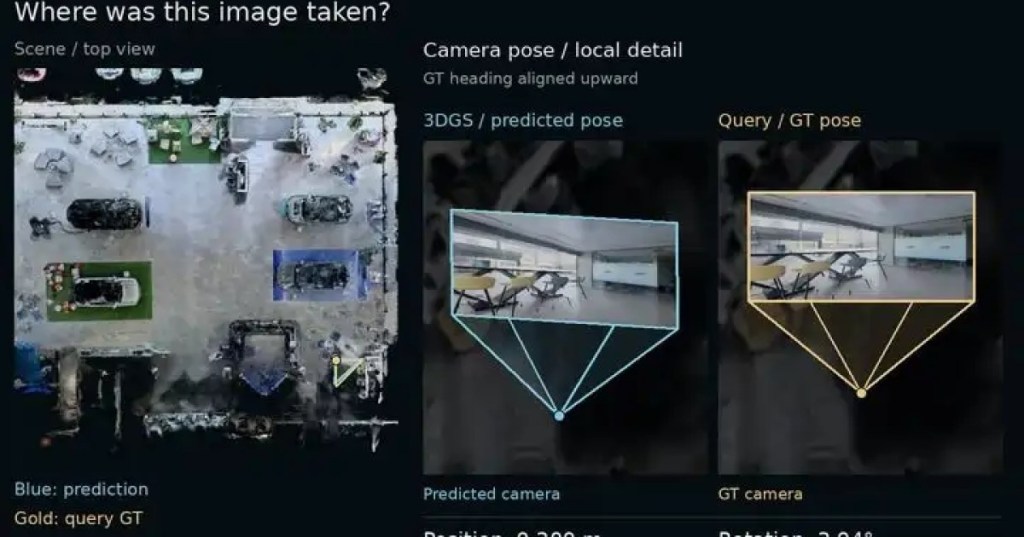
Ant Group’s robotics subsidiary Robbyant announced two robot-navigation models on November 27, 2026: LingBot-Map 2.0 and LingBot-Navi. Its research announcement reports an approximately 85% reduction in long-distance trajectory error using an internal correction mechanism. However, the public mapping repository describes the available code as a base streaming model without that mechanism. The distinction matters for engineers evaluating mobile robots, including systems that use the path-tracking principles explained in our Pure Pursuit lesson.
Correcting accumulated mapping error
A mobile robot must estimate its position while reconstructing the geometry around it. Small errors in successive camera-pose estimates can accumulate over long routes. Conventional mapping systems may recognize a previously visited location and optimize a trajectory using that constraint. Robbyant instead describes Geometric Context Reshaping (GCR), which revises the model’s stored geometric representation using already extracted information. Later predictions can consequently draw upon corrected historical context.
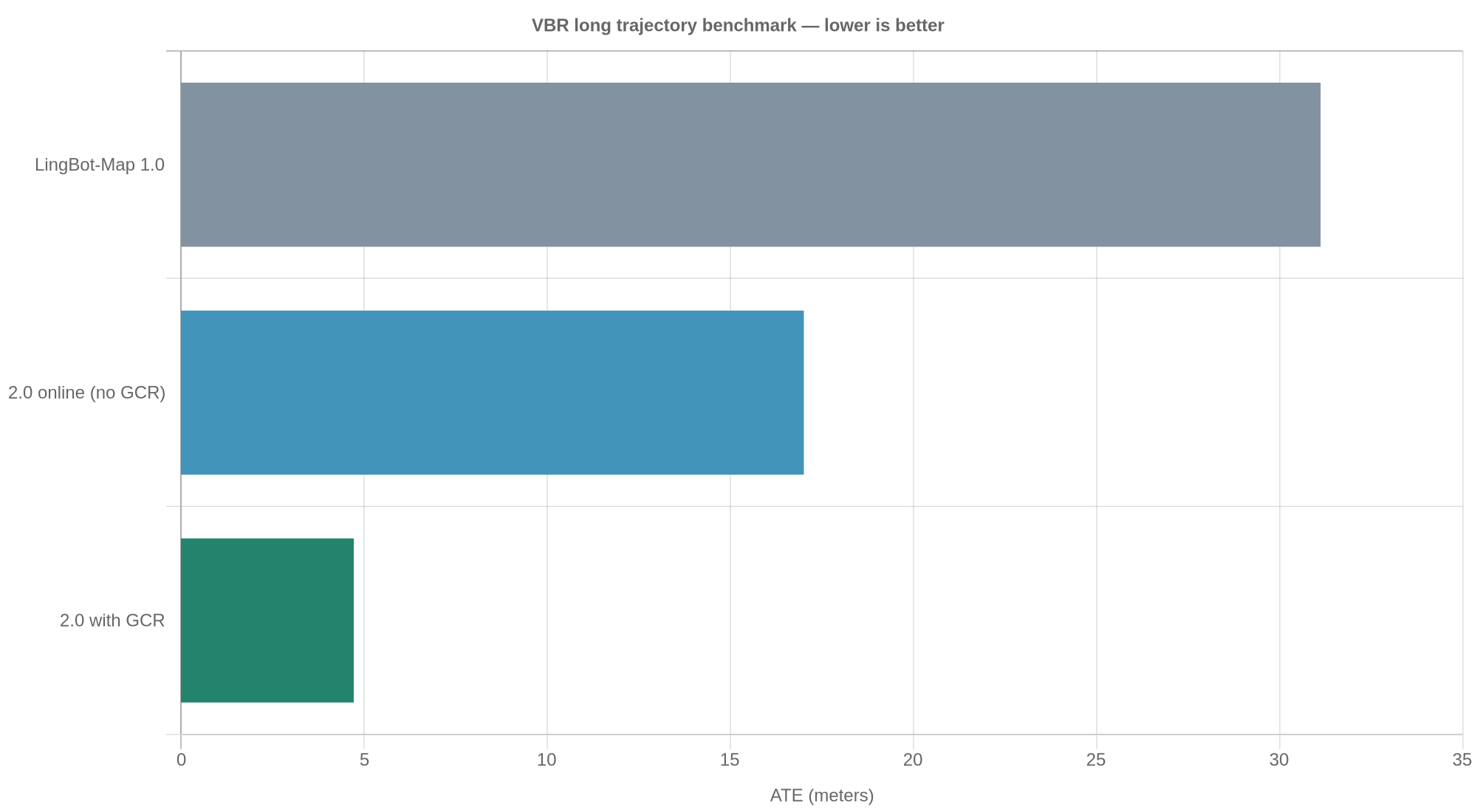
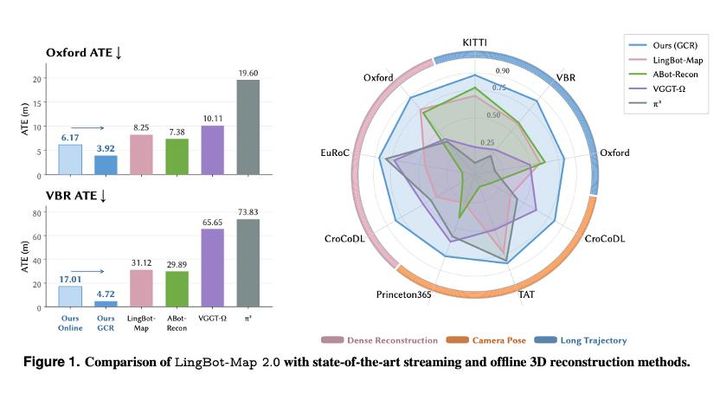
In the reported 5.2-kilometer VBR sequence, the original model recorded 31.12 meters of average trajectory error, while the new online configuration recorded 17.01 meters. Adding GCR reduced the result to 4.72 meters. Relative to version 1.0, the reductions are approximately 45.3% and 84.8%, respectively. These are developer benchmark results, not independently reproduced field measurements. Trajectory error should not be confused with the endpoint positioning tolerance of an industrial robot, a distinction covered in our positioning accuracy lesson.
Remembering a workplace between tasks
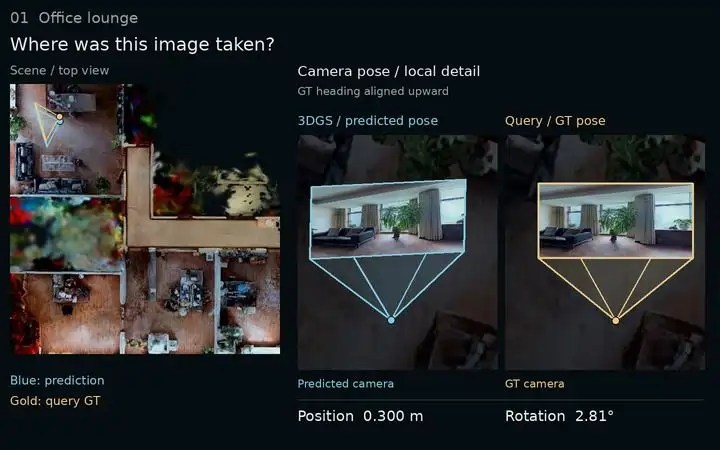
The LingBot-Navi repository describes a navigation architecture that associates visual features with reconstructed surfaces. A robot can use prior observations to locate a requested object and predict a route, even when the object lies outside the current camera image. A separate local planner executes the route. The training resource contains 475 reconstructed scenes and 36 held-out scenes, according to the project documentation.
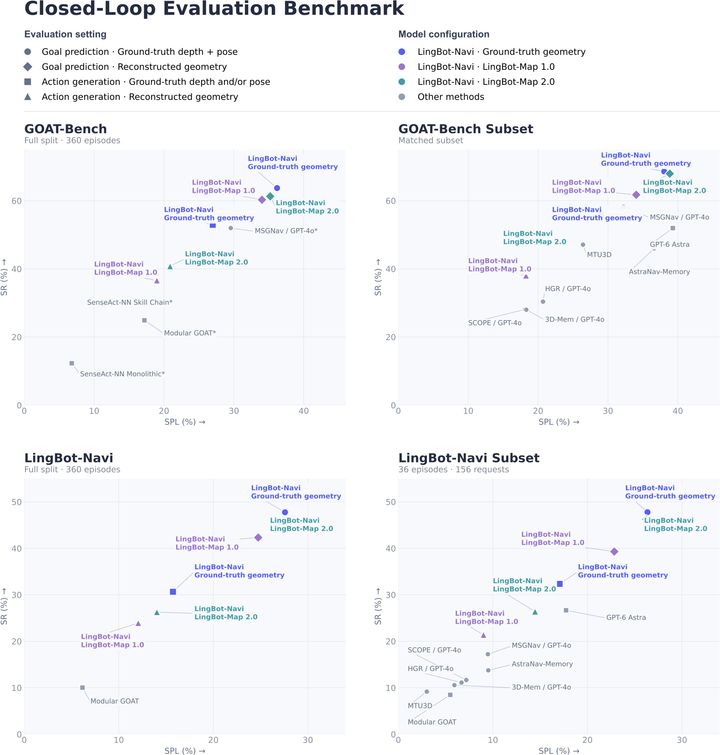
The company reports 68.60% goal-selection success on a GOAT-Bench subset with simulator-controlled navigation. When the model also generated actions in end-to-end simulation, reported success reached 56.09% on GOAT-Bench and 32.36% on the developer’s own evaluation dataset. The corresponding path-efficiency scores were 38.04% and 26.35%. Results from different datasets and execution arrangements should not be treated as interchangeable. Our robot inference analysis similarly distinguishes computing performance from successful physical operation.
What developers can reproduce
The mapping repository requires CUDA-capable hardware supporting BF16 and PyTorch 2.8 or later. Its documentation also indicates that checkpoint downloads require authorized access at the time reviewed. The November announcement therefore should not be interpreted as evidence that every research component is immediately obtainable without restrictions. Robbyant provides an official mapping demonstration video and separate navigation code and data. Robotics & Automation News also covered the release on November 27.
Deployments in warehouses, such as the Siemens logistics automation project, must account for moving obstacles, changed storage layouts, braking distance and recovery from localization failure. Reusable spatial memory can reduce unnecessary exploration, but safe operation requires local obstacle detection and independently validated control limits. The next meaningful benchmark is reliable completion of repeated physical tasks under changing conditions, rather than mapping accuracy alone.
Featured image: cropped Robbyant showroom localization visualization from the official LingBot-Navi project page.
We volunteer daily to ensure the credibility of the information on this platform is Verifiably True. If you would like to support to help further secure the integrity of our research initiative, please scan the QR code below.

BitcoinVersus.tech is not a financial advisor. This media platform reports on financial subjects purely for informational purposes.


Leave a Reply