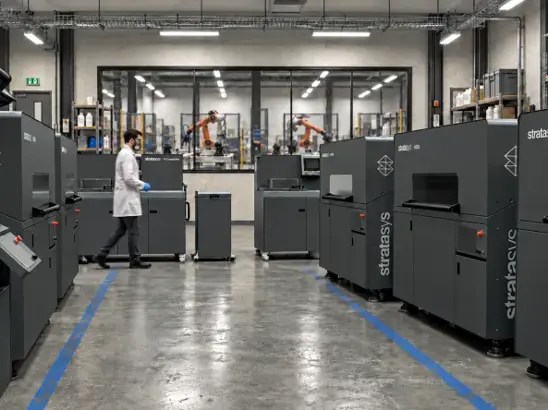
Stratasys unveiled its H550 polymer additive manufacturing machine at Formnext in Frankfurt on November 17, 2026, pairing a 34.2-liter build chamber with an automated powder-processing station. The manufacturer announcement targets serial production rather than individual prototypes, with deliveries planned for the second quarter of 2027. Like the manufacturing methods behind a recent 3D-printed robotic hand, powder-based production can simplify complex assemblies, but factory economics require evaluating an entire manufacturing workflow.
An 80% increase in build volume
The H550 has a nominal chamber measuring 365 × 208 × 450 mm. Its predecessor, the H350, measures 315 × 208 × 293 mm. Stratasys lists respective capacities of 34.2 and 19 liters in its technical specifications. Dividing the listed volumes gives 1.8, or an 80% expansion. The longest chamber axis grows by approximately 43% compared with the predecessor’s longest axis. Usable component dimensions will also depend on orientation and required clearances.
The new machine uses Selective Absorption Fusion, or SAF. A thin layer of polymer powder is distributed across the build area, and printheads deposit an infrared-absorbing fluid in selected regions. Applied thermal energy fuses the treated material, leaving surrounding powder to support the geometry. Repetition builds the object layer by layer. Unlike machining, the process does not begin with a solid billet from which cutting tools remove material. The two methods can complement each other, as illustrated by our desktop CNC manufacturing coverage.
Automating the powder-handling bottleneck
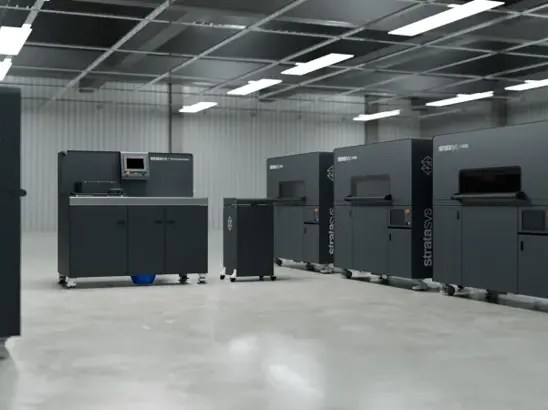
A completed build contains both fused parts and unfused powder. Operators must separate the components, recover reusable powder, remove unwanted material and prepare a controlled mixture for subsequent jobs. The PowderEase T2 combines several of those operations into a shared station. Stratasys says one station can serve up to six H550 printers working with the same material and estimates less than half an hour of total operator involvement per build. The labor figure does not represent elapsed printing, cooling or finishing time.
Why build volume and throughput are different
A larger chamber permits taller components or denser batches, but an increase in chamber volume alone does not establish an equivalent rise in hourly production. The supplier lists a 16-hour full build for the H550 and claims throughput gains of up to 50% over the H350, subject to geometry, material, nesting and settings. A hypothetical factory loading 180 acceptable components into a 16-hour build would average 11.25 components per printing hour before cooling and downstream work. Yield, changeovers and maintenance would reduce the output measured across a complete shift.
The same logic applies to conventional production equipment: effective capacity depends on how machines, operators and supporting systems interact. Our coverage of premium professional tooling examines the value of integrated equipment systems, rather than individual headline specifications.
The commercial test
Applications include custom fixtures, ducting, protective housings and robot end-of-arm tools. A larger bed can remove the need to split certain designs into multiple printed pieces, potentially saving joining operations. Whether the economics justify replacing an existing process will depend on part strength, dimensional tolerances, acceptable surface finish and the amount of material consumed. As demonstrated in our motor engineering explanation, selecting industrial equipment requires understanding the operating conditions, not just a performance headline.
Stratasys projects lower ownership costs relative to competing systems, but independent production benchmarks and customer operating records are needed to substantiate the comparison. The launch is an announcement of future commercial capacity, not evidence of widespread installed H550 fleets. The most consequential feature may ultimately be the shared post-processing station, because parallel printers are only productive when downstream operations can absorb their output.


Leave a Reply