semiconductors
-
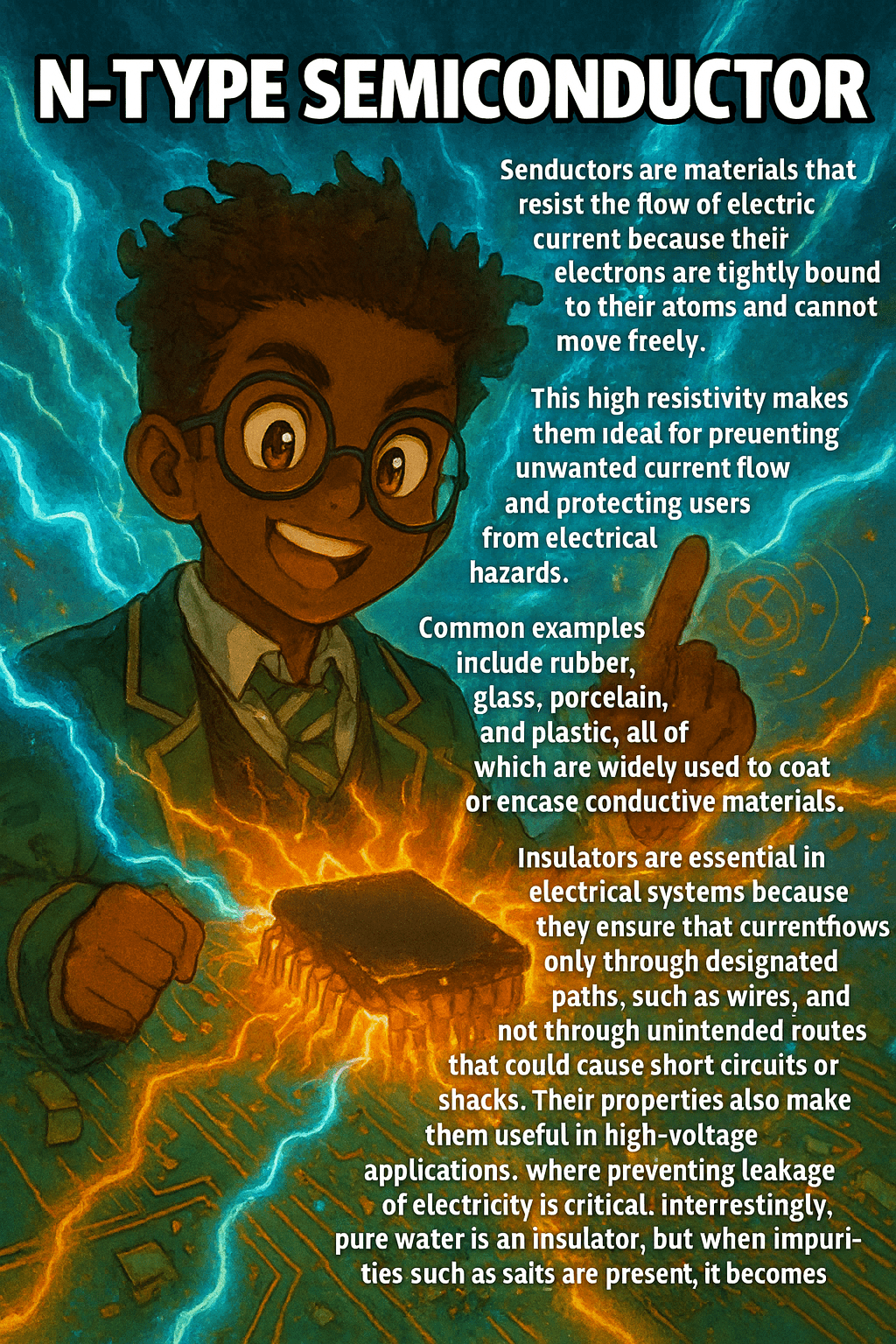
An n-type semiconductor is created by doping a pure semiconductor, such as silicon, with pentavalent elements like phosphorus, arsenic, or antimony. These dopants have five valence electrons, one more than silicon, and the extra electron becomes loosely bound and available for conduction. As a result, electrons become the majority charge carriers in n-type materials, while…
-

Silicon is a chemical element with atomic number 14, belonging to Group 14 of the periodic table, and it is the most widely used semiconductor material. Its electron configuration is [Ne] 3s² 3p², meaning it has four valence electrons available for bonding. In its crystalline form, silicon adopts a diamond cubic lattice structure, where each…
-

Semiconductors are materials whose electrical conductivity lies between that of conductors and insulators, and they are unique because their properties can be controlled and modified. Semiconductors are chemically diverse materials whose electrical conductivity lies between that of conductors and insulators, and their behavior can be precisely engineered. The most common elemental semiconductors are silicon (Si),…
-
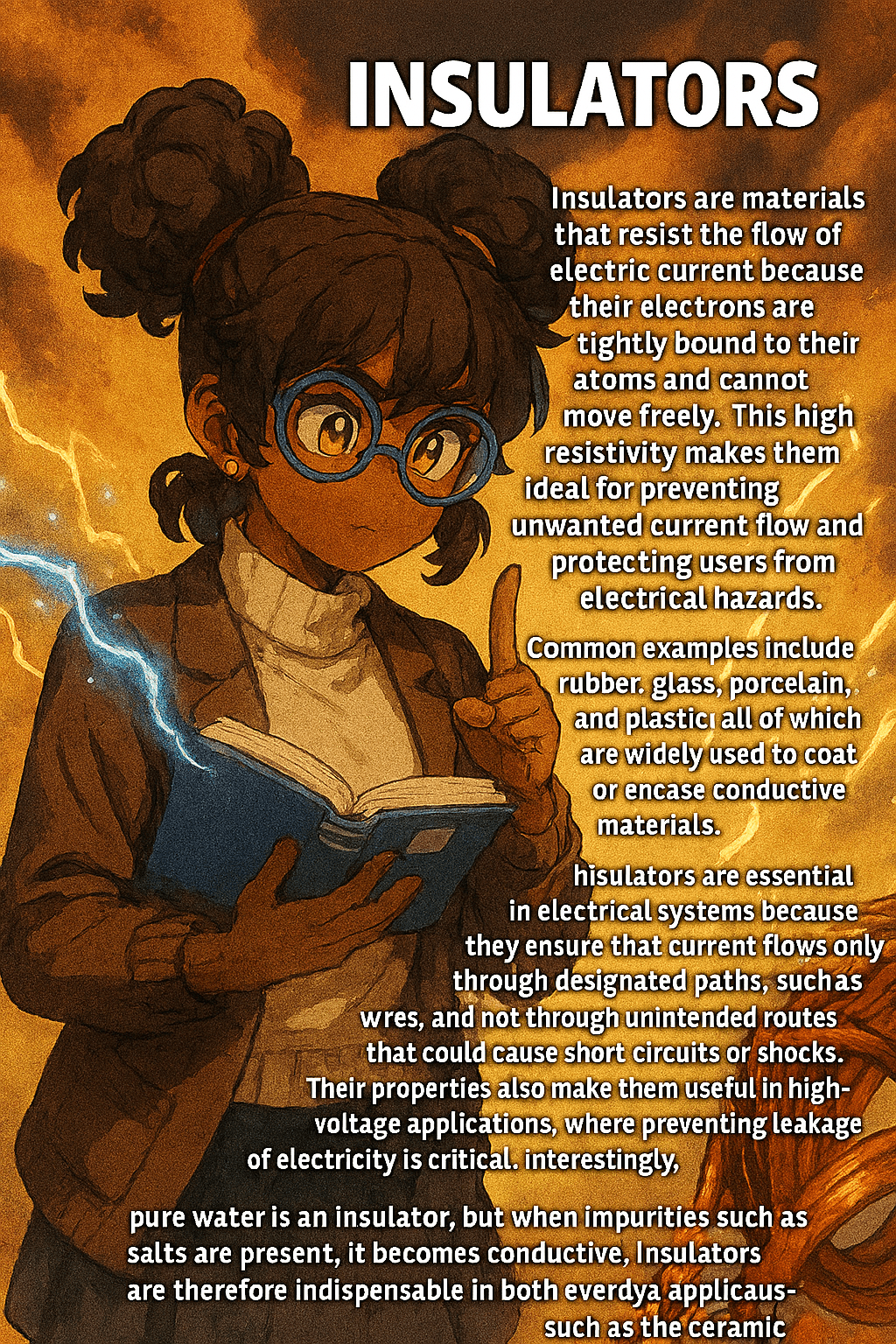
Insulators are materials that resist the flow of electric current because their electrons are tightly bound to their atoms and cannot move freely. This high resistivity makes them ideal for preventing unwanted current flow and protecting users from electrical hazards. Common examples include rubber, glass, porcelain, and plastic, all of which are widely used to…
-
Resistivity is a fundamental property of materials that describes how strongly they oppose the flow of electric current. Unlike resistance, which depends on the dimensions of a conductor, resistivity is an intrinsic characteristic that remains constant for a given material under specific conditions. It is mathematically expressed as, where is the resistance, is the cross-sectional…
-

In semiconductor crystals, the atomic arrangement is defined by a combination of a Bravais lattice and a basis. The Bravais lattice provides the geometric framework—an infinite array of points arranged with translational symmetry—where each point has an identical environment. There are 14 unique Bravais lattices in three dimensions, grouped into seven crystal systems such as…
-

Transmission electron microscopy (TEM) is a powerful imaging technique that uses a beam of electrons transmitted through an ultrathin specimen to produce highly magnified images of its internal structure. TEM works by directing electrons through a sample that is typically less than 100 nanometers thick. As the electrons pass through, they interact with the atoms…
-

RISC, or Reduced Instruction Set Computer, represents a CPU architecture designed with simplified instructions, enabling processors to execute instructions at high speeds with fewer cycles per operation. According to IBM, RISC architectures streamline instruction processing by reducing complexity, enabling faster and more efficient performance at lower power consumption. ARM processors are built on RISC principles,…

