Trending News
-

SpaceX is approaching its first earnings report as a publicly traded company, giving investors their clearest look yet at the financial performance behind Starlink, Starship and the company’s expanding artificial-intelligence infrastructure. Following its record-setting June 2026 IPO, the report will provide a major reality check for a business valued not only as a launch provider,…
-
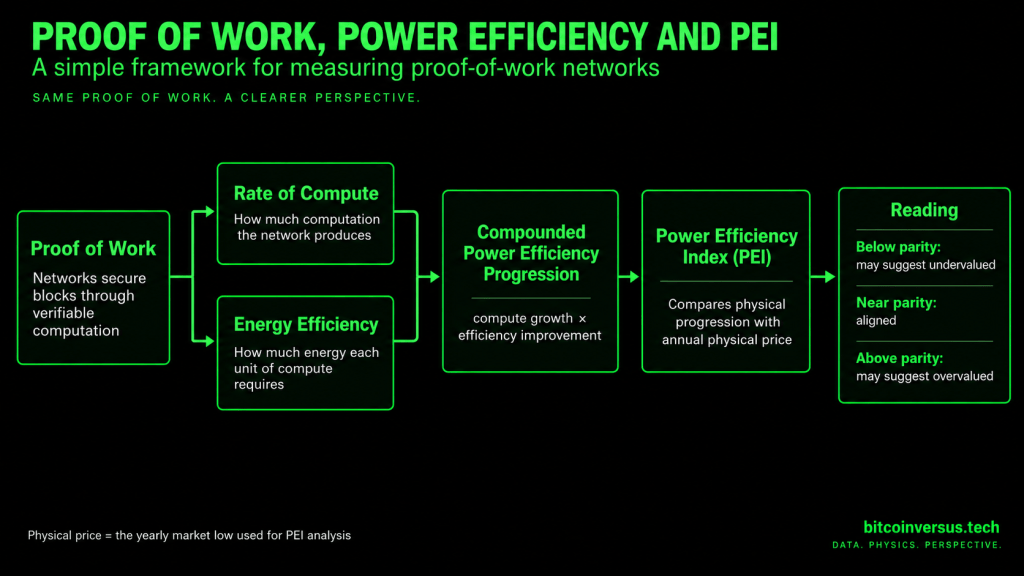
Proof of work is a consensus system in which computers compete to perform verifiable computational work in order to secure a blockchain, validate transactions, and produce new blocks. In practical terms, that work is expressed through the network’s rate of compute—such as hashes per second—and the amount of energy required to produce that computation. A…
-
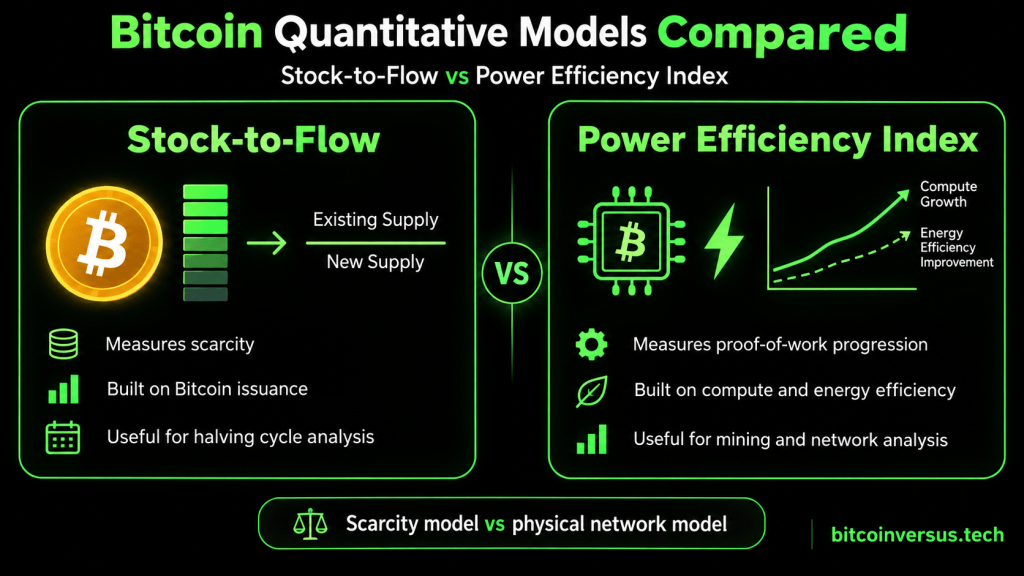
Bitcoin valuation models often begin with the same problem and arrive at very different answers. PlanB, known online as @100trillionUSD, introduced the Bitcoin Stock-to-Flow model in 2019 as a way to quantify scarcity and relate Bitcoin’s programmed supply schedule to market value. The Power Efficiency Index, developed by BitcoinVersus.tech, approaches valuation from the physical side…
-
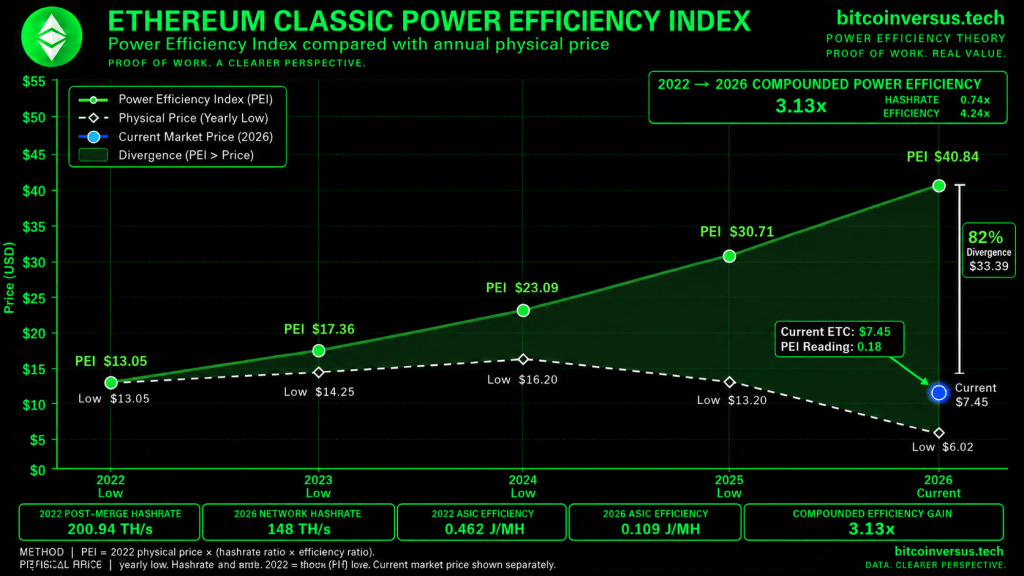
Ethereum Classic presents one of the more unusual Power Efficiency Index (PEI) profiles among major proof-of-work networks. Over the four-year window, ETC’s rate of compute has not expanded in a straight line. In fact, network hashrate remains below the extraordinary post-Merge surge seen in 2022. At the same time, EtHash mining hardware has become dramatically…
-
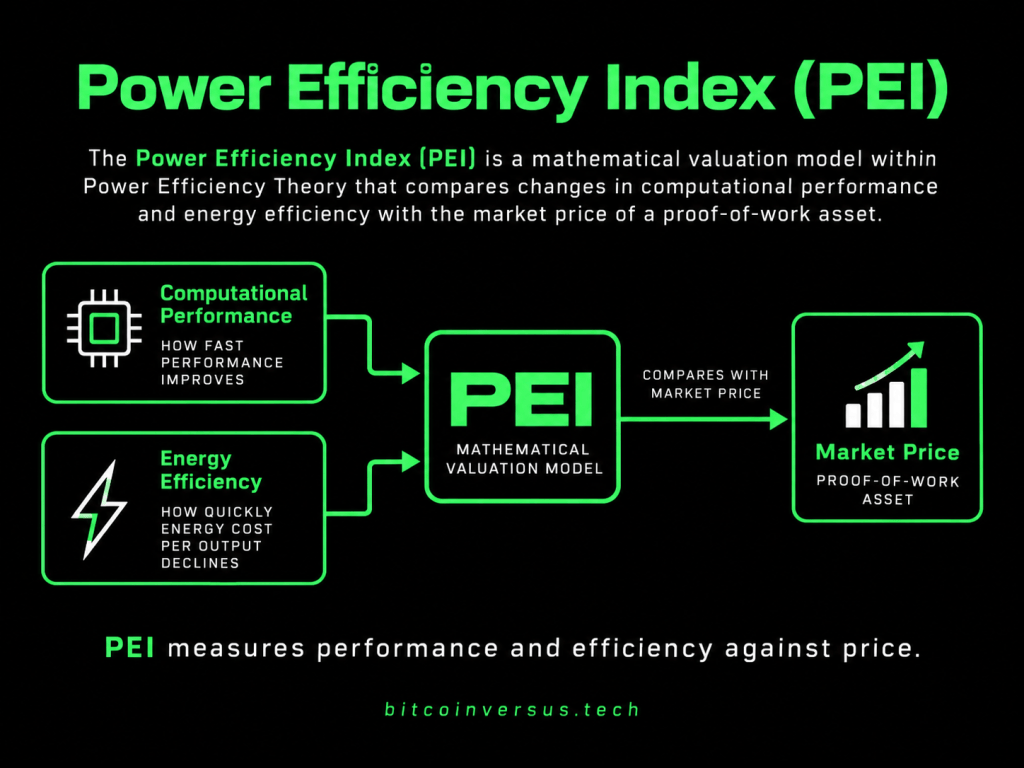
The Power Efficiency Index (PEI) is a mathematical valuation model within Power Efficiency Theory that compares changes in computational performance and energy efficiency with the market price of a proof-of-work asset. Developed by bitcoinversus.tech, PEI measures the growth in a network’s rate of compute alongside improvements in the energy required per unit of computation. In…
-

Kaspa is trading near $0.0296 while a four year Power Efficiency Index analysis from BitcoinVersus.tech places its 2026 implied physical price near $0.1175. The gap puts the PEI reading at roughly 3.97 times the current market price, representing a divergence of about 297%. KAS also remains far below its August 2024 record of $0.2074, while…
-

Physical price is the lowest observed market price of a proof-of-work digital asset during a defined measurement period, typically a calendar year, and is used in Power Efficiency Index (PEI) analysis as the market’s closest observable expression of a network’s underlying digital-physical value at that time. Rather than representing the total replacement cost of mining…
-
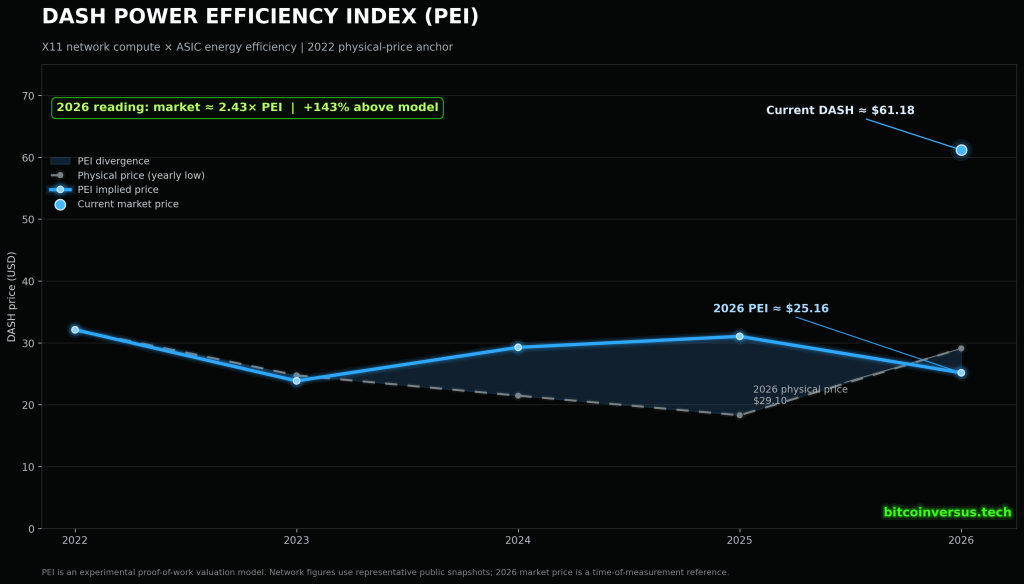
Using DASH’s 2022 physical price of $32.11 as the starting anchor produces a very different valuation trajectory from the one visible in today’s market. DASH’s X11 network was operating around 5.24 PH/s in January 2022, compared with roughly 2.69 PH/s today, representing an approximately 49% contraction in rate of compute. Meanwhile, DASH’s yearly physical prices…
-
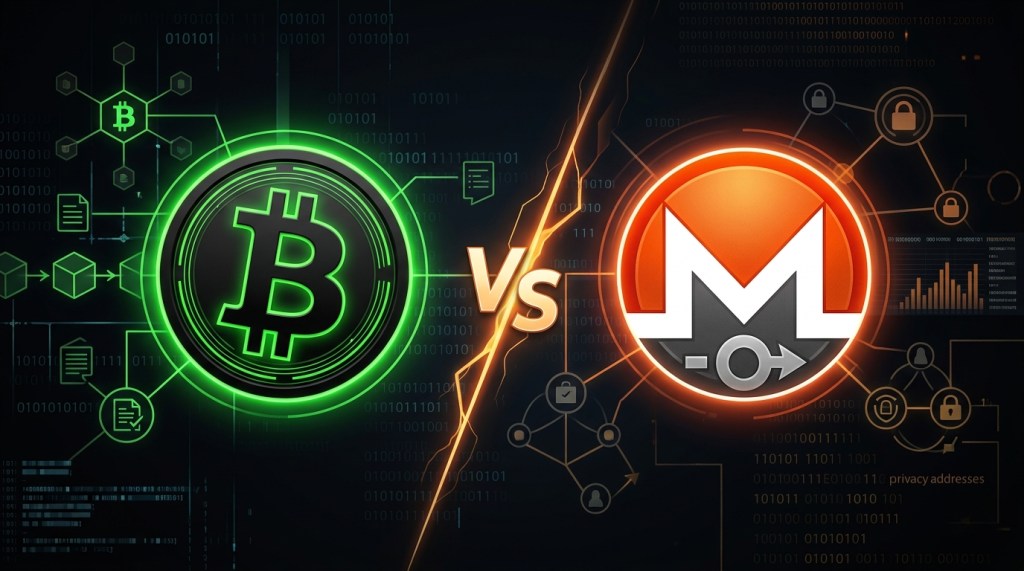
Bitcoin and Monero represent two very different approaches to proof-of-work computation. Bitcoin uses SHA-256 and has developed around highly specialized ASIC mining hardware, while Monero uses RandomX, an algorithm intentionally designed to keep general-purpose processors competitive and reduce the advantage of specialized machines. A raw comparison of Bitcoin terahashes and Monero kilohashes would therefore be…
-
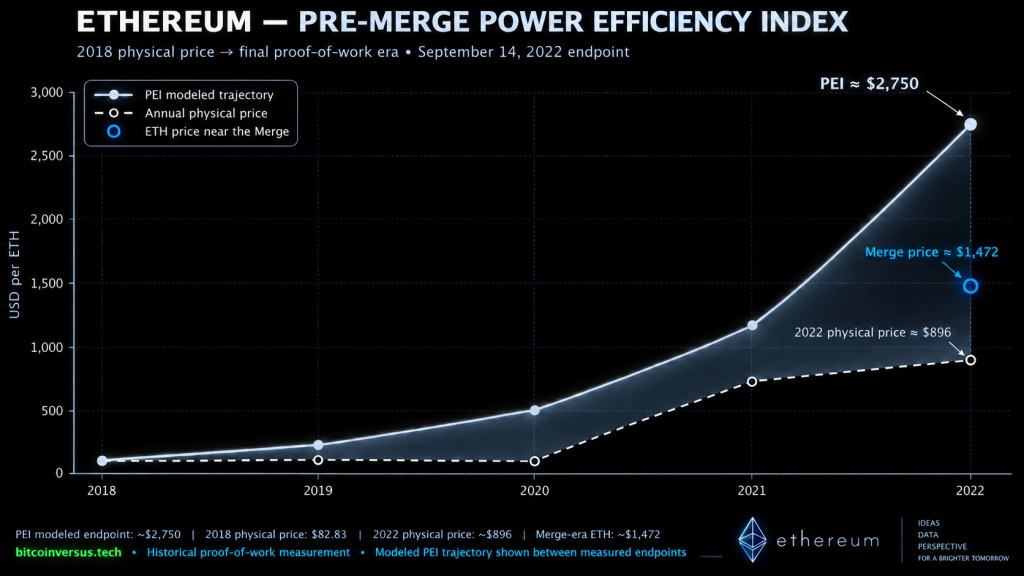
Ethereum’s final four years as a proof-of-work network provide a clean historical window for a Power Efficiency Index analysis. From 2018 through September 14, 2022, Ethereum still depended on mining hardware, network compute, and measurable energy efficiency. Its 2018 physical price was approximately $82.83, giving the PEI model a clear starting point. Over the following…
-
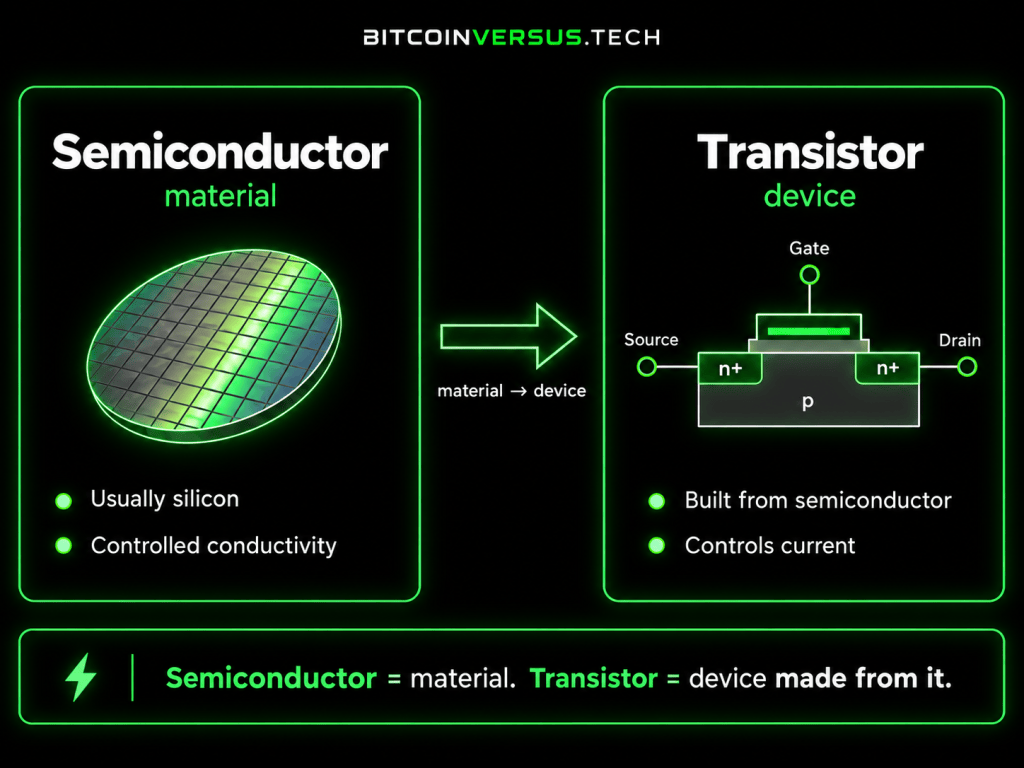
A semiconductor and a transistor are closely related, but they are not the same thing. A semiconductor is a class of material—most commonly silicon—whose electrical conductivity can be precisely controlled. By modifying semiconductor material through processes such as doping, engineers can create regions that either provide or restrict the movement of electrical charge. These properties…
-
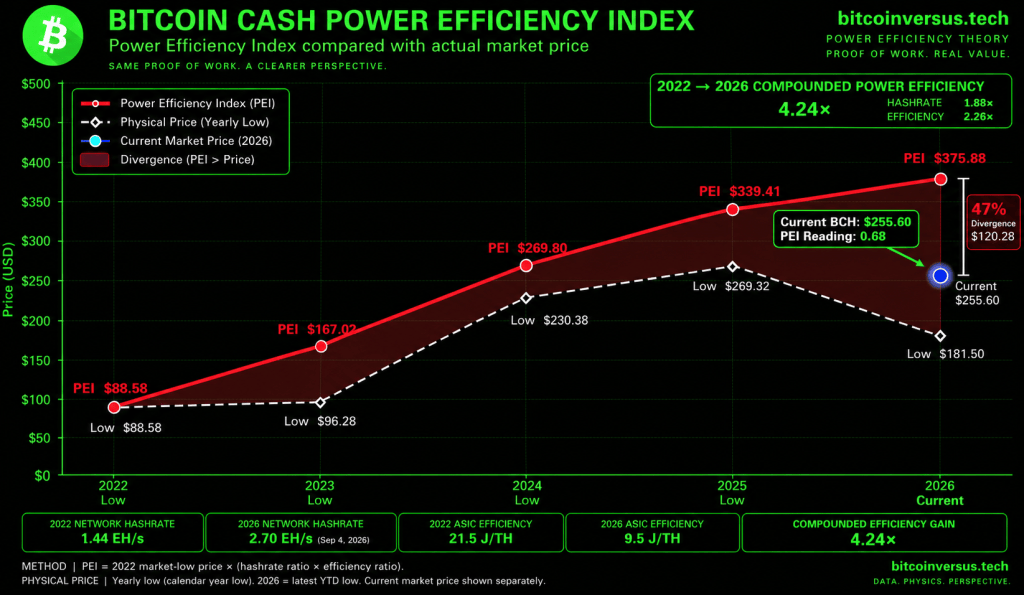
Bitcoin Cash provides an interesting test for the Power Efficiency Index because BCH uses the same SHA-256 proof-of-work algorithm as Bitcoin. That means Bitcoin Cash participates in essentially the same ASIC hardware ecosystem, allowing changes in the rate of compute and the rate of energy efficiency to be compared against changes in BCH’s physical price.…

