Power Efficiency Theory: Upgrading the Power Efficiency Equation (Providing a Realistic Prediction)

Energy could be considered a form of currency.

But we’re (probably) not that far along, yet (as a society).

The closest thing we have is an electronic P2P payment system that requires energy to work.

It’s called bitcoin.

It’s a fascinating science experiment that has required us (humanity) to rethink the fundamentals of computer security, let alone the fundamentals of how we value stuff in relation to the protocol.

So, since it’s fundamentally changing stuff, we might as well, at the very least, consider how this new and emerging system might be valued fundamentally, right?

What if price isn’t the driving force of this new system?

What if the physical improvement and innovation behind the idea was the driving force of the price?

What if you could track the energy metrics of this system, and determine the value solely (or mostly) on the improvement of its physical properties – It’s power and efficiency – over time?
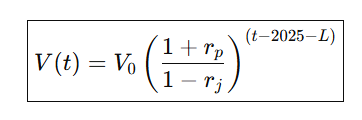
Power Efficiency Theory models a system’s future value as its starting value multiplied by a compounded “power over efficiency” factor. In the equation, V(t) is the value in year t, V₀ is the baseline value, rₚ is the yearly improvement rate in output per second, and rⱼ is the yearly reduction rate in energy used per unit output (efficiency, measured in J/TH). The exponent (t − 2025 − L) adds an explicit market delay L, which can be set to about 5 years, to reflect the idea that hardware progress is often recognized by the market only after a lag rather than immediately at the moment the improvements occur. That lag matters because real world pricing is not driven by engineering progress alone. Even if power and efficiency improve smoothly year over year, markets can still stall or reprice due to variables that are not in the hardware curve, including liquidity cycles, regulation, credit contraction, or an uneventful global event such as a recession. Since those unknowns cannot be timed precisely in advance, the delay term is used as a practical way to separate real time physical improvement from delayed price realization and to keep the model honest about the gap between what improves and when markets choose to pay for it.

That’s basically what I’m trying to do with Power Efficiency Theory.

The problem is, there are several variables we have to account for and then (somehow) we also have to simultaneously account for unknown variables that will happen (like an uneventful global event, A.K.A a recession) even though we don’t actually know when exactly these unknown variables will happen.

So, basically, I have this idea, and if I’m right about the idea, it means we can (probably) use power and efficiency metrics to determine the value of new and emerging technologies.

BitcoinVersus.tech is not a financial advisor. This media platform reports on financial subjects purely for informational purposes.

5 responses to “Power Efficiency Theory: Upgrading the Power Efficiency Equation (Providing a Realistic Prediction)”

  1. […] Rather than comparing the raw hashrates of three fundamentally different proof-of-work algorithms, the model normalizes each network to its own approximate 2022 baseline and measures two forms of physical improvement: growth in network computational output and improvement in leading ASIC Machine efficiency. […]

    Like

  2. […] The Power Efficiency Index (PEI) is a proof-of-work measurement derived from Power Efficiency Theory. […]

    Like

  3. […] Power Efficiency Theory instead treats the comparison pound-for-pound: each network is measured against its own historical hashrate and machine-efficiency baseline, and the resulting rates of physical improvement are then compared. […]

    Like

  4. […] PEI measures 2 sides of the physical system: improving ASIC efficiency matters, yet that improvement has to be considered alongside the amount of computation actually […]

    Like

  5. […] Power Efficiency Theory, the physical price acts as the observed reference point, usually tied to a meaningful market […]

    Like

Leave a comment