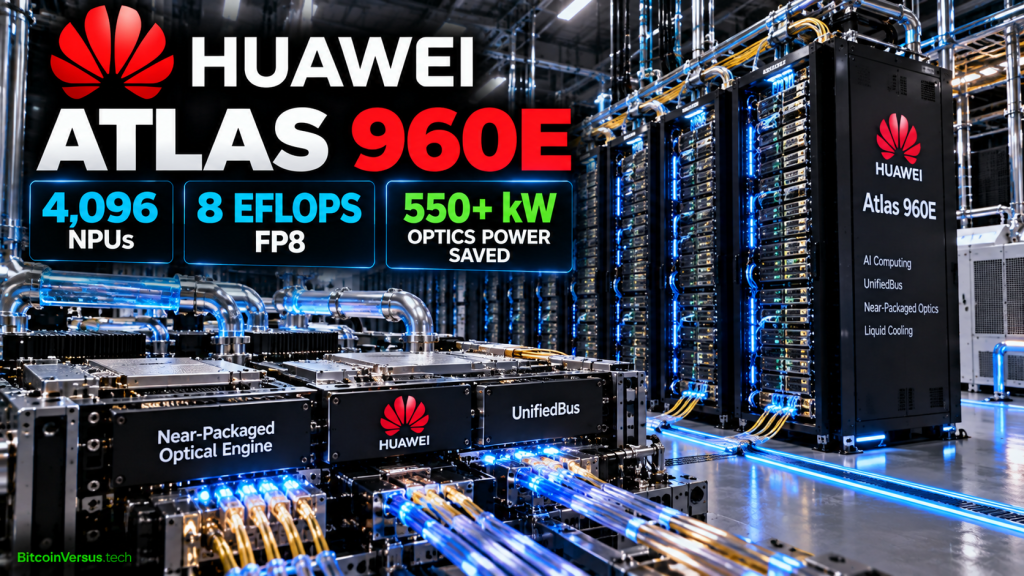
Huawei has launched the Atlas 960E SuperPoD, a new AI computing system that uses near-packaged optics and UnifiedBus to connect as many as 4,096 NPUs while reducing the optical-module count and associated power load.
The system was unveiled at HUAWEI CONNECT 2026. Huawei says a single Atlas 960E can deliver 8 EFLOPS of FP8 compute and 16 EFLOPS of FP4 compute with as much as one petabyte of HBM capacity.
5,500 optical engines replace 48,000 800G modules
The key hardware is Huawei’s Hi-ONE near-packaged optical engine. Each engine provides 7.2 Tbit/s of transmission capacity and includes its own light source. Huawei integrates 5,500 Hi-ONE units into Atlas 960E.
Huawei says that architecture eliminates the need for roughly 48,000 conventional 800G optical modules and cuts optical-interconnect electricity consumption by more than 550 kW. The company also claims the change doubles fault-free operating time and supports 99.8% system availability.
The embedded official Huawei video is in English and explains the UnifiedBus and SuperPoD architecture behind Huawei’s scale-up AI systems.
UnifiedBus ties compute and memory together
UnifiedBus directly connects CPUs, NPUs, memory and SSDs while providing unified memory addressing across physical nodes. Huawei says its LinkDevice supports 176 ports at 1.6 Tbit/s per port for 280 Tbit/s of all-optical interconnection with round-trip latency as low as 2 microseconds.
Across larger clusters, Huawei’s UBG switch can fan out to as many as 1,024 connections. Multiple Atlas 960E systems can be linked into a SuperCluster supporting up to 512,000 NPUs in one topology and as many as one million NPUs using a multi-rail design.
Optics becomes part of the AI compute architecture
The Atlas 960E shows how data-center networking is moving closer to the accelerator itself. Near-packaged optics shortens the electrical path between compute silicon and optical links while attempting to preserve more serviceability than fully co-packaged designs.
The launch follows the same infrastructure trend BitcoinVersus.tech covered in Marvell’s 2 nm optical networking demonstrations, Vertiv’s 2.3 MW AI cooling system, and Huawei’s grid-interactive 800 VDC AI data-center architecture.
Sources: Huawei Atlas 960E announcement and Huawei UnifiedBus architecture announcement.
Advertisement:
BitcoinVersus.Tech Editor’s Note & Disclaimer:
We volunteer daily to ensure the credibility of the information on this platform is Verifiably True. BitcoinVersus.tech provides news, technical analysis and educational information and does not provide financial or investment advice. Verify technical specifications and operational requirements with the manufacturer before making purchasing, deployment or investment decisions. If you would like to support to help further secure the integrity of our research initiatives, please donate here: 3C9o19EH5HSiwEPyCTmEKzxhNCbo2X6TTb


Leave a comment