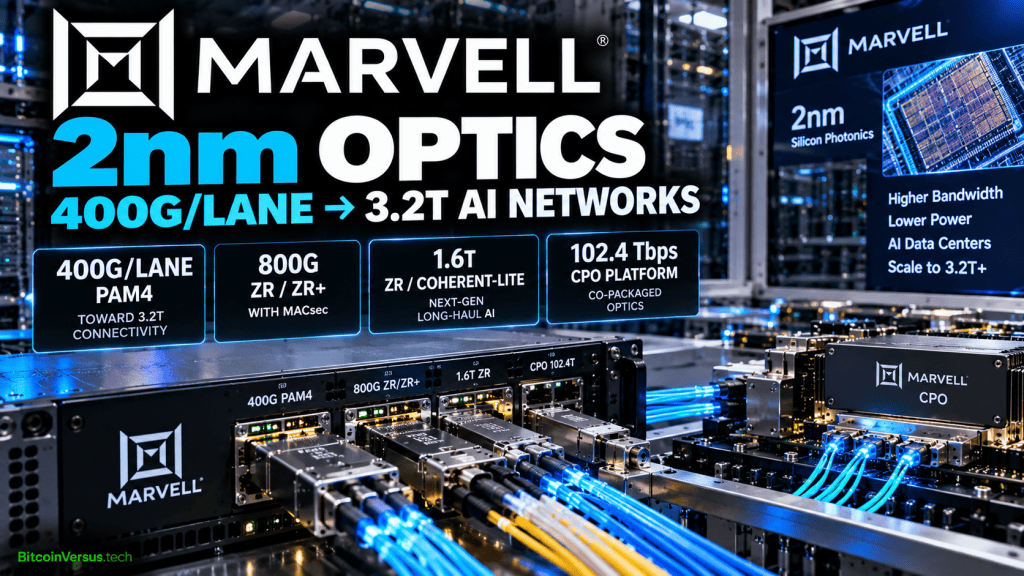
Marvell is demonstrating a new generation of 2 nm optical interconnect technology for AI infrastructure, including 400G-per-lane PAM4, 800G ZR/ZR+ with MACsec, 1.6T coherent optics and a 102.4 Tbps co-packaged-optics platform.
The demonstrations at ECOC 2026 in Málaga, Spain, target the transition from today’s 1.6T optical links toward 3.2T connectivity as data centers connect larger clusters of GPUs, CPUs, accelerators and memory.
400G per lane points toward 3.2T optics
Marvell says its 2 nm 400G-per-lane PAM4 demonstration is designed to provide a path toward 3.2T optical connectivity. Increasing the data carried by each lane can raise bandwidth density while reducing the number of physical links needed for a given amount of traffic.
The embedded Marvell video is in English and explains co-packaged optics, where optical connections move closer to switch and compute silicon to address the bandwidth, reach and power limitations of conventional copper interconnects.
800G security and 1.6T coherent links
Marvell is also showing a live 2 nm 800G ZR/ZR+ OSFP pluggable powered by its Libra coherent DSP with integrated IEEE 802.1AE MACsec. The company is demonstrating 2 nm 1.6T ZR and O-band coherent-lite technology for high-capacity connections within and between AI facilities.
These links sit in the information technology layer between compute clusters. As AI campuses expand, Ethernet, optical fiber and data-center interconnects have to scale alongside accelerator performance.
102.4 Tbps co-packaged optics
Marvell’s 102.4 Tbps CPO platform uses 200G-per-lane silicon photonics and integrates optics directly with AI accelerators and switch silicon. The company says this architecture is aimed at AI fabrics where per-lane speeds and multi-rack clusters begin pushing beyond practical copper reach.
Moving optics closer to silicon can reduce electrical trace distance and improve bandwidth density. That can also lower the electricity consumed per transmitted bit, an increasingly important constraint as AI facilities scale toward hundreds of megawatts and beyond.
Networking becomes part of the AI factory
BitcoinVersus.tech has been tracking the same infrastructure convergence through Giga Computing’s 700 kW GAIFA AI factory, Vertiv’s 2.3 MW NVIDIA DSX Ready cooling system and Synopsys and TSMC’s A14 and 2 nm design stack.
Sources: Marvell and ECOC 2026 technical demonstrations.
Advertisement:
BitcoinVersus.Tech Editor’s Note & Disclaimer:
We volunteer daily to ensure the credibility of the information on this platform is Verifiably True. BitcoinVersus.tech provides news, technical analysis and educational information and does not provide financial or investment advice. Verify technical specifications and operational requirements with the manufacturer before making purchasing, deployment or investment decisions. If you would like to support to help further secure the integrity of our research initiatives, please donate here: 3C9o19EH5HSiwEPyCTmEKzxhNCbo2X6TTb


Leave a comment