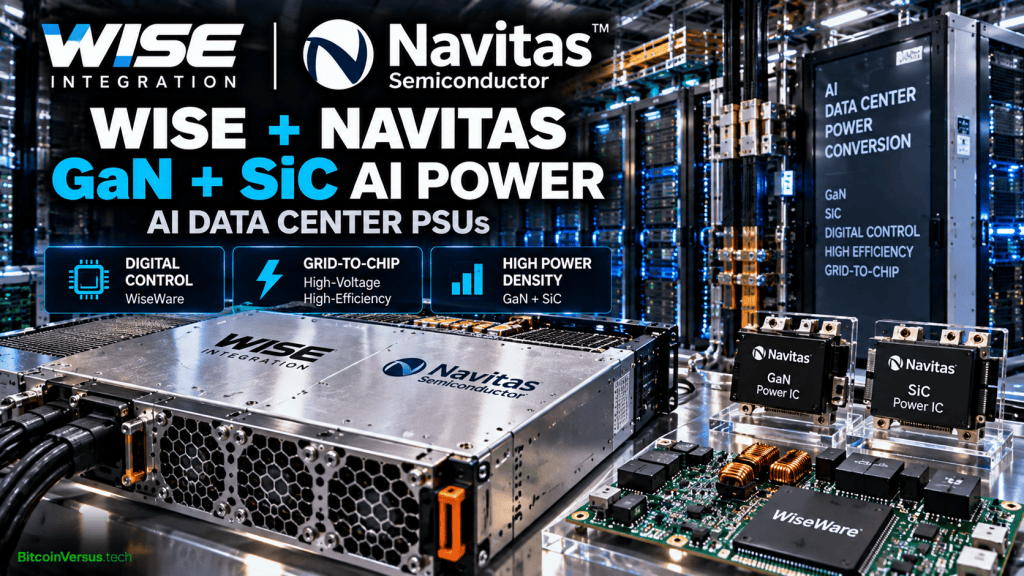
Wise Integration and Navitas Semiconductor have agreed to combine digital power control with gallium-nitride and silicon-carbide semiconductors for next-generation AI computing and data-center power systems.
The Sept. 25 collaboration will focus on AI data-center power supply units and other high-voltage, high-power conversion topologies stretching from the electrical grid to compute silicon.
Digital control meets GaN and SiC
Wise Integration brings WiseWare, its distributed digital-control technology for power converters. Navitas contributes GaNFast gallium-nitride and GeneSiC silicon-carbide devices. The companies say combining those technologies can improve conversion efficiency, power density and real-time control.
The embedded English-language video is published by Navitas Semiconductor and discusses how GaN and SiC power technology applies to AI chips and data-center infrastructure.
Why AI server PSUs are changing
AI accelerators are increasing rack power density, putting pressure on traditional silicon conversion stages. Wide-bandgap devices can switch at higher frequencies and tolerate higher voltages, potentially reducing passive-component size while increasing power density.
Wise and Navitas plan to explore those characteristics alongside digital control that can adjust power-conversion behavior in real time. Their target applications include AI data-center PSUs, AI PCs, high-end workstations, gaming desktops and industrial computing systems.
Grid-to-chip becomes a semiconductor problem
The collaboration reflects a larger architectural shift. As AI facilities move toward megawatt-scale racks and higher-voltage distribution, the path between utility electricity and GPUs increasingly depends on specialized power semiconductors, digital controllers and high-density PSUs.
Navitas is already developing GaN and SiC technology for emerging 800 VDC AI infrastructure. Its previously demonstrated 800 V-to-6 V board uses 650 V GaN devices and is designed to remove the traditional 48 V intermediate conversion stage inside server trays.
BitcoinVersus.tech has recently tracked this grid-to-chip transition through ABB’s 800 VDC AI power system, Vertiv’s 2.3 MW AI cooling infrastructure and Huawei’s Atlas 960E optical-power architecture.
Sources: Wise Integration and Navitas Semiconductor.
BitcoinVersus Twitter:
BitcoinVersus.Tech Editor’s Note & Disclaimer:
We volunteer daily to ensure the credibility of the information on this platform is Verifiably True. BitcoinVersus.tech provides news, technical analysis and educational information and does not provide financial or investment advice. Verify technical specifications and operational requirements with the manufacturer before making purchasing, deployment or investment decisions. If you would like to support to help further secure the integrity of our research initiatives, please donate here: 3C9o19EH5HSiwEPyCTmEKzxhNCbo2X6TTb


Leave a comment