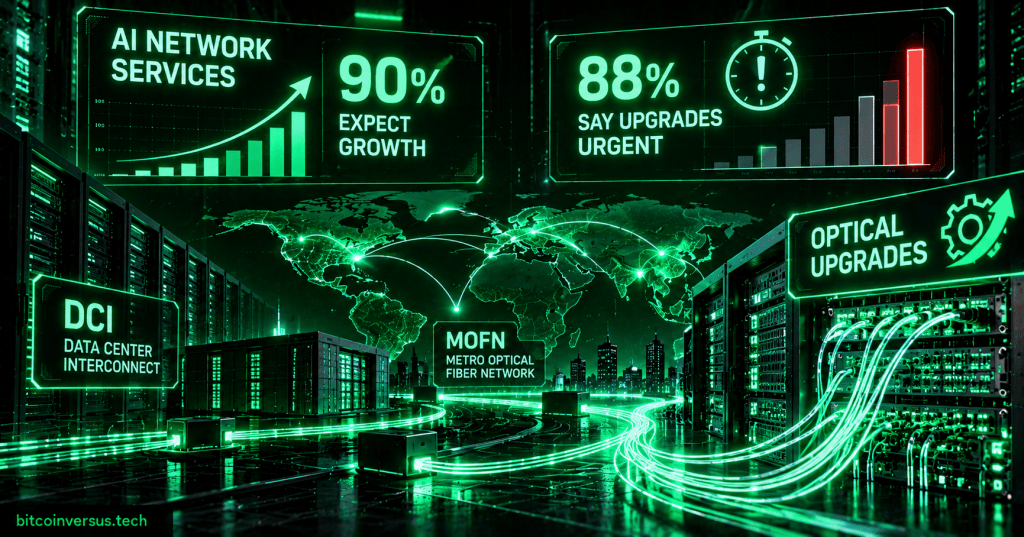
Telecom operators increasingly see AI as a networking business, not just a compute business. A new Ciena survey of more than 1,200 telecom, wholesale and regional service-provider professionals across 12 countries found that 90% expect high-capacity AI network services to drive revenue growth over the next three to five years.
The opportunity comes with a warning. In Ciena’s August 25 survey release, 88% of respondents said there is a strong sense of urgency around optical-network upgrades needed to support premium AI service-level agreements. Mobile World Live’s independent coverage likewise highlighted the gap between carriers’ revenue expectations and the upgrades required to capture that demand.
AI is turning network capacity into a product
The survey’s most important signal is not simply that operators expect more traffic. It is that they expect AI connectivity itself to become a sellable service. Fifty-six percent of respondents identified high-capacity AI networking as their primary source of net-new revenue, while 96% expect managed optical fiber network services to generate revenue from connecting distributed AI compute clusters.
That aligns with the technical direction BitcoinVersus.Tech has been tracking in Ciena’s move from 1.6T coherent optics toward 6.4T co-packaged optical engines. As accelerator clusters become larger and more distributed, the network increasingly determines whether expensive compute can stay utilized.
Ciena summarized the survey in its official X post, noting that 90% of service providers expect high-capacity AI-driven network services to become a primary growth engine while most respondents see optical upgrades as urgent.
Distributed AI pushes more traffic between data centers
AI infrastructure is becoming geographically distributed because power, cooling and real estate are difficult to concentrate indefinitely in one facility. Once training or inference spreads across multiple buildings, campuses or regions, high-capacity data-center interconnect becomes part of the compute system itself.
That is why managed optical fiber networks matter. Instead of selling enterprises only generic bandwidth, carriers can increasingly provide dedicated high-capacity paths between AI facilities with explicit performance, latency and availability targets.
BitcoinVersus.Tech recently covered Cisco extending its NVIDIA AI Factory architecture to rack-scale systems. Those dense racks still depend on the network outside the rack when workloads, storage and compute resources span facilities.
The 88% upgrade number exposes the infrastructure gap
Operators may see revenue ahead, but the survey suggests many do not believe their existing optical infrastructure is ready for the service levels enterprise AI will require. Nearly half described upgrades as critical, and 39% said upgrades are needed within the next 12 to 18 months.
Only 11% said routine upgrades would be sufficient. That is the practical warning inside an otherwise bullish survey: demand can grow faster than the underlying fiber, coherent optics, switching, routing and operational tooling needed to carry it.
1.6T and 102.4T networking are becoming operational requirements
The hardware transition is already visible. Faster coherent optics increase how much data can move between facilities, while new Ethernet fabrics increase the bandwidth available inside AI clusters. The two layers increasingly have to scale together.
BitcoinVersus.Tech’s report on Marvell’s live 102.4 Tbps Teralynx T100 AI Ethernet switch shows how quickly the switching layer is moving. Carrier networks connecting those clusters cannot remain static while the equipment inside them doubles and redoubles bandwidth.
Automation becomes necessary when AI traffic becomes dynamic
The survey also found overwhelming support for more automation. Ninety-six percent of respondents said advanced network automation, including agentic AI, will be important for capturing AI-related opportunities.
That makes sense operationally. AI workloads can create large, bursty flows that move between training, inference, storage and checkpointing phases. Static provisioning becomes increasingly inefficient when the application itself can shift traffic patterns rapidly across sites.
The telecom AI opportunity is really a race to remove bottlenecks
Service providers clearly expect AI to create new revenue, but that revenue depends on something more concrete than enthusiasm. They need enough fiber capacity, enough optical density, enough switching bandwidth and enough automation to deliver reliable service when customers actually ask for it.
The 90% growth expectation and the 88% upgrade urgency belong together. One number describes the opportunity. The other describes the work required to make the opportunity real.
BitcoinVersus.Tech
Advertisement
Editor’s Note
If you value independent technology reporting, consider supporting BitcoinVersus.Tech with a Bitcoin donation: 3C9o19EH5HSiwEPyCTmEKzxhNCbo2X6TTb
BitcoinVersus.tech is not a financial advisor. This media platform reports on financial subjects purely for informational purposes.


Leave a Reply