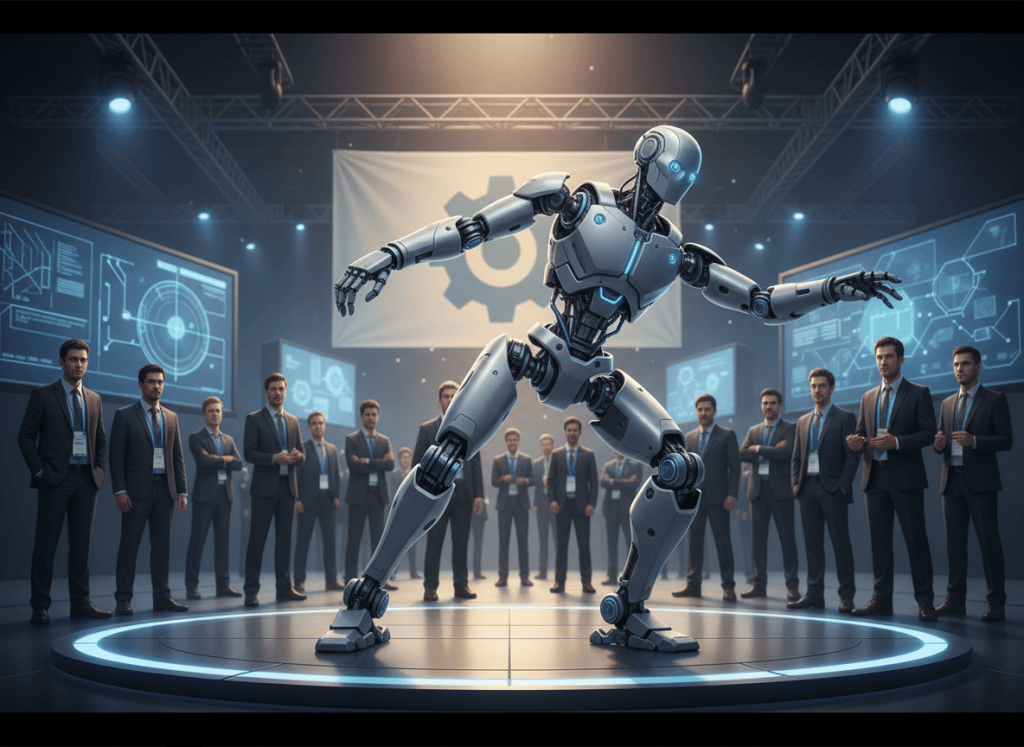
RoboParty has unveiled RP1, also called ROBOTO 01, a full-stack open-source humanoid robot aimed at researchers, robotics developers and embodied-AI teams. The biped made its global debut at IROS 2026 in Pittsburgh, where visitors were invited to push and kick the machine while its control system attempted to recover its balance in real time.
In its October 3 launch announcement, RoboParty said RP1 combines its robot body, Romomo actuator modules, motion control and PartyOS software into a developer-oriented humanoid platform. Dealroom also reported the RP1 debut as the company expands its open-source robotics stack beyond the earlier ROBOTO ORIGIN project.
RP1 turns humanoid robot balance into a public stress test
The most memorable IROS demonstration was deliberately simple: let people disturb the robot. In RoboParty’s RP1 “Kick Me” demonstration on X, the humanoid absorbs pushes and kicks, adjusts its posture and continues moving instead of relying on a carefully protected choreography.
Dynamic recovery matters because useful humanoids cannot assume the floor, payload or people around them will behave exactly like a simulation. BitcoinVersus.Tech recently covered how Skild AI used massive simulated self-play to train humanoid movement. RP1 approaches the same general challenge through a hardware-and-software stack intended to be inspected, modified and reproduced by developers.
PartyOS and UFO train humanoid motion without fixed trajectories
RoboParty says the demonstration is supported by PartyOS and UFO, its general unsupervised reinforcement-learning framework for humanoid control. UFO is designed to discover low-level motor skills rather than depend entirely on predefined motion trajectories, including transitions between skills, disturbance recovery and fall recovery.
That emphasis on learning and reproducibility is important for open robotics. A robot body by itself is not a complete research platform; developers also need access to control software, simulation, training tools and deployment interfaces. That is why the open-source angle is potentially more consequential than another polished humanoid demo. A similar accessibility argument drove interest in Berkeley Humanoid Lite’s open-source hardware approach.
RP1 is designed as an open humanoid robotics development stack
RoboParty says RP1 can deliver peak joint torque up to 160 N·m and is being developed for dynamic motion, embodied-AI training, validation, deployment and data collection. The company plans to progressively open more of the stack, including motion-control systems, simulation environments, SDKs, training tools and the PartyOS development foundation.
That roadmap is the part developers should watch. “Open source” can describe anything from a few CAD files to a genuinely reproducible platform. RoboParty is explicitly promising access across hardware, low-level control and higher-level software, but the value of that promise will depend on how complete, documented and buildable the releases become.
Open-source humanoids could accelerate embodied AI research
Humanoid robotics is moving quickly from isolated demonstrations toward reusable development platforms. Better open hardware can give universities, independent developers and smaller robotics teams a way to test locomotion and manipulation without designing an entire biped from scratch.
The training-data side is evolving just as quickly. BitcoinVersus.Tech recently examined Innodata’s sub-millimeter motion-capture lab for humanoid robot training. RP1 represents the complementary platform problem: once teams have better data and policies, they need capable physical hardware on which those models can be reproduced and tested.
RoboParty says additional RP1 open-source roadmap details are due in October, with broader hardware and software releases plus a mass-production program planned later in the fourth quarter. Until those releases arrive, RP1’s strongest result is the combination of a working dynamic humanoid and an unusually broad open-stack ambition.
BitcoinVersus.Tech
Advertisement
Editor’s Note
BitcoinVersus.Tech follows the intersection of robotics, artificial intelligence, computing infrastructure and open technology.
If you value independent technology reporting, consider supporting BitcoinVersus.Tech with a Bitcoin donation: 3C9o19EH5HSiwEPyCTmEKzxhNCbo2X6TTb
BitcoinVersus.tech is not a financial advisor. This media platform reports on financial subjects purely for informational purposes.


Leave a Reply