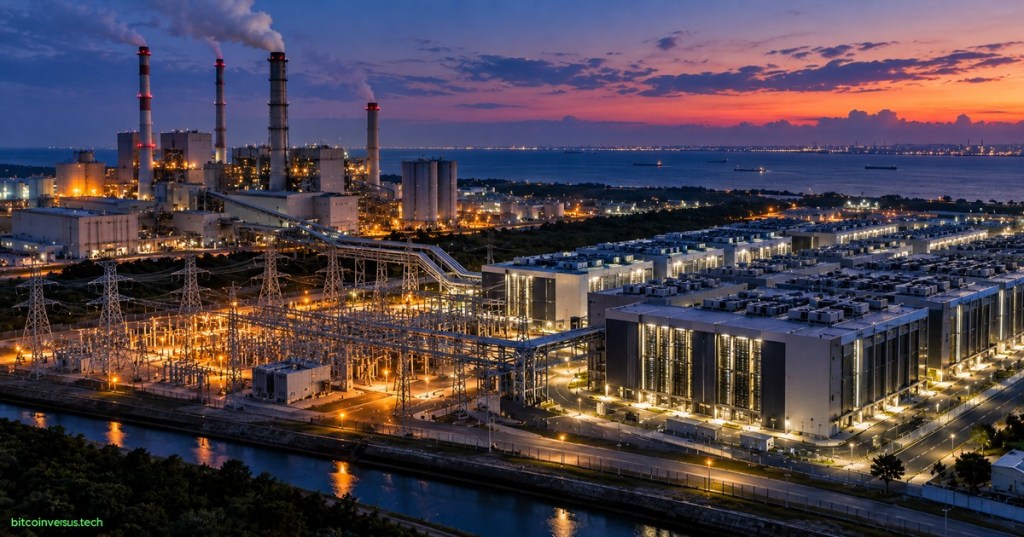
JERA, Dell Technologies and RHAELM are planning a 400 MW AI infrastructure campus beside JERA’s Chiba thermal power station, using behind-the-meter power to shorten the path from generation to compute. JERA’s October 1 announcement says the partners want the Chiba project to become the first version of a repeatable national model that integrates power generation, electrical infrastructure, cooling and rack-scale AI systems from the start.
The design matters because power availability has become one of the main bottlenecks in AI data-center development. Instead of waiting years for a conventional grid interconnection, the Chiba campus is intended to sit directly beside an operating generation asset and draw capacity through a behind-the-meter arrangement.
Behind-the-Meter Power Changes the Data-Center Timeline
A large AI campus normally has to solve several infrastructure problems in sequence: secure land, win grid capacity, build substations, design cooling, procure compute, and then commission everything as one operating system. JERA, Dell and RHAELM are trying to collapse those steps by starting beside existing generation and standardizing the electrical and compute layers together.
Reuters reported that the Chiba project is expected to begin phased operations around 2028, with JERA supplying the site and long-term power, RHAELM handling development and delivery, and Dell supplying standardized rack-scale AI infrastructure.
The power-first approach resembles what BitcoinVersus.Tech recently examined in HIVE BUZZ’s 320 MW Oakville AI campus, where the central question is not simply whether servers can be built, but whether sufficient electrical capacity can be delivered on the project timeline.
Dell Is Standardizing the Compute Layer
The other half of the model is reducing customization inside the data center. Dell’s AI Factory approach packages compute, networking, storage and deployment services into repeatable rack-scale systems so each new site does not have to reinvent the entire server architecture from scratch.
That mirrors the “generator-to-chip” integration BitcoinVersus.Tech covered in Schneider, Wärtsilä and Stanley’s AI power architecture. The competitive advantage increasingly comes from designing power, cooling and compute as one engineering system rather than treating them as separate procurement packages.
400 MW Is Large, but the Repeatable Model Is the Bigger Bet
The Chiba site is planned for up to 400 MW, which would make it one of Japan’s largest single-site AI infrastructure deployments. But the more consequential part of the announcement is the intention to reuse the same model at other JERA locations across Japan during the 2030s.
If that works, existing power-station sites become more than sources of electricity. They become pre-positioned AI-infrastructure zones with generation, transmission access, industrial land and operating expertise already in place.
That kind of efficiency pressure is also visible inside the rack. Lambda recently demonstrated how 19 Blackwell nodes could fit inside a power budget designed for 16, showing that the next phase of AI infrastructure is as much about extracting more compute from constrained power as it is about simply adding megawatts.
Japan Is Treating Power and Compute as One Industrial System
The Chiba project fits Japan’s broader push to coordinate electricity and digital infrastructure instead of planning them independently. AI data centers need reliable power at a scale that can overwhelm normal interconnection queues, while power producers increasingly see large compute campuses as long-term industrial loads.
That is why the project is more important than another large data-center announcement. JERA, Dell and RHAELM are testing whether a power plant, standardized compute platform and dedicated developer can function as one repeatable deployment template. If the Chiba model reaches operation on schedule, the real product may be the blueprint rather than the campus itself.
BitcoinVersus.Tech
Advertisement
Editor’s Note
We volunteer daily to ensure the credibility of the information on this platform is Verifiably True. If you would like to support to help further secure the integrity of our research initiatives, please donate here: 3C9o19EH5HSiwEPyCTmEKzxhNCbo2X6TTb
BitcoinVersus.tech is not a financial advisor. This media platform reports on financial subjects purely for informational purposes.


Leave a Reply