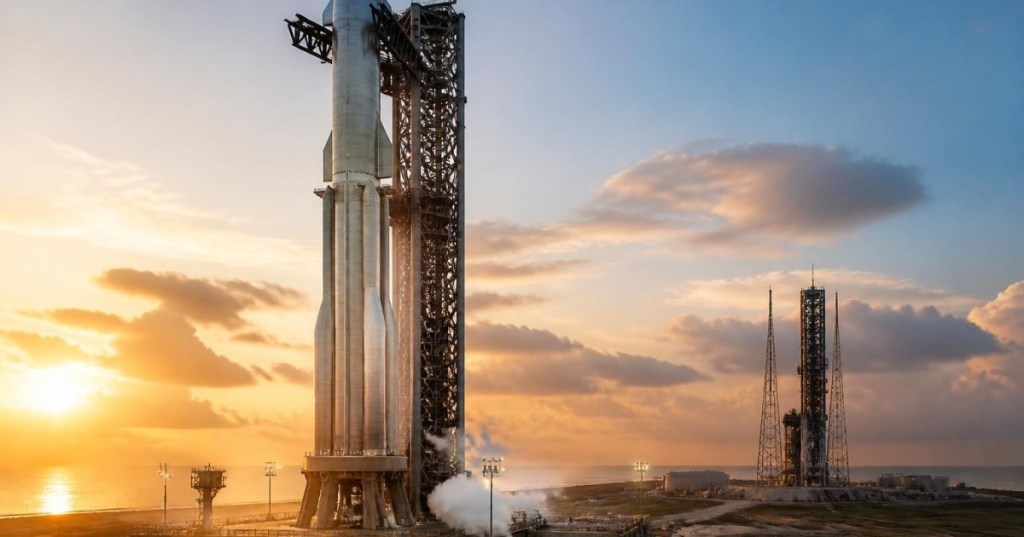
NASA has added Blue Origin’s New Glenn 9×4 launch service to the agency’s NASA Launch Services II catalog, giving the larger New Glenn configuration a path to compete for future NASA science and exploration missions. The key distinction is that this is not a launch award. NASA’s September 29 release says the 9×4 has been added through the contract’s annual on-ramp provision, which lets existing providers introduce new launch vehicles and allows new providers to compete for future work.
The move puts both New Glenn configurations inside NASA’s launch-services framework. Blue Origin says the 9×4 is the next variant of New Glenn and is designed for missions that need substantially more capacity, with more than 70 metric tons to low Earth orbit, more than 14 metric tons direct to geosynchronous orbit and more than 20 metric tons to trans-lunar injection. Blue Origin’s current New Glenn specifications also list an 8.7-meter fairing for the larger vehicle.
Blue Origin confirmed the NASA addition on X, emphasizing that both New Glenn configurations can now compete for NASA science and exploration missions. That matters because NASA’s Launch Services Program operates more like a mission-to-rocket matching system than a guaranteed order book: being on the catalog makes the vehicle eligible, but future missions still have to be competed and awarded.
NASA Is Expanding Its Heavy-Lift Menu
The NLS II contract structure is designed around a mixed fleet. NASA can select among established and emerging domestic launchers depending on mission mass, destination, schedule and integration requirements. New Glenn 9×4 adds another super-heavy option without NASA committing a payload to it today.
The larger configuration also fits Blue Origin’s broader effort to move beyond a single launch architecture. BitcoinVersus.Tech recently covered Blue Origin’s selection to help build NASA’s Mars telecommunications network, a separate program that shows the company expanding its role from launch vehicles into deeper-space infrastructure.
The 9×4 Changes the Competitive Ceiling
The 9×4 designation reflects nine engines on the first stage and four on the upper stage. Its larger payload envelope and higher lift capability move Blue Origin into a different class of mission competition, including large science payloads, lunar hardware, national-security missions and future deep-space infrastructure.
That competition is becoming more important as NASA spreads work across more commercial providers. BitcoinVersus.Tech has already examined which launch companies could challenge SpaceX over the long term. New Glenn 9×4 joining NASA’s catalog does not settle that contest, but it does give Blue Origin another route into missions where payload mass and fairing volume are decisive.
NASA is also continuing to rely heavily on SpaceX for current crew operations. Crew-13 reached the International Space Station in a record 7 hours 55 minutes, illustrating how mature launch and spacecraft systems can dominate on cadence and operational reliability even while newer heavy-lift vehicles compete for future roles.
For New Glenn 9×4, the next meaningful milestone is not simply appearing in the NASA catalog. It is translating that eligibility into an actual mission award, then demonstrating the launch cadence, reliability and integration performance needed to become a recurring NASA option.
BitcoinVersus.Tech
Advertisement
Editor’s Note
We volunteer daily to ensure the credibility of the information on this platform is Verifiably True. If you would like to support to help further secure the integrity of our research initiatives, please donate here: 3C9o19EH5HSiwEPyCTmEKzxhNCbo2X6TTb
BitcoinVersus.tech is not a financial advisor. This media platform reports on financial subjects purely for informational purposes.


Leave a comment