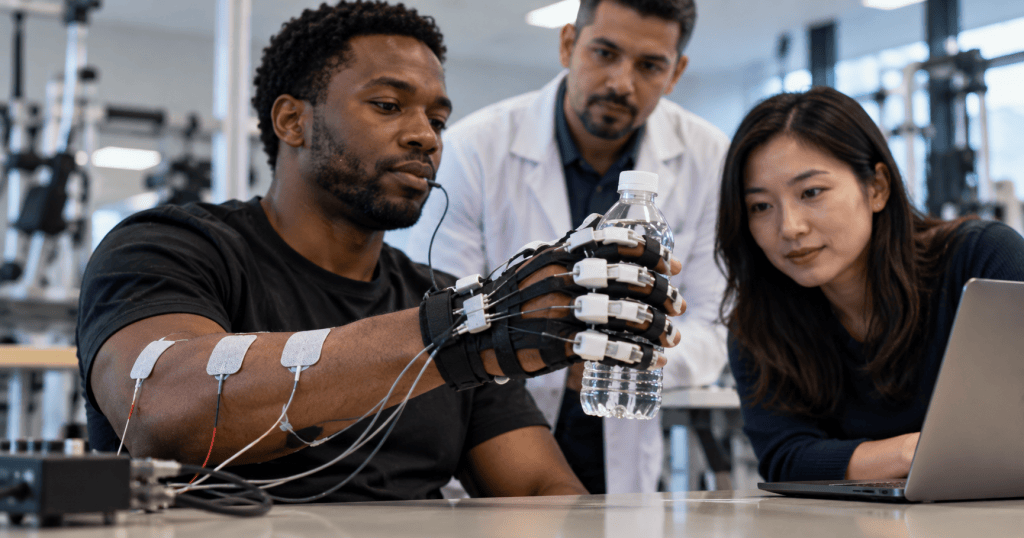
Researchers have demonstrated a tongue-controlled robotic hand exoskeleton that helped five people with cervical spinal cord injury complete everyday grasping tasks with a 96% overall success rate when functional electrical stimulation was used to reopen the hand.
The study, published in npj Robotics on October 8, combines three technologies: a non-invasive tongue interface, a tendon-driven soft hand exoskeleton for finger flexion, and functional electrical stimulation, or FES, for finger extension.
The Tongue Becomes The Control Interface
The control device sits against the roof of the mouth and uses a small array of inductive sensors. Users move a tiny activation element with the tongue to select commands. The current prototype uses 15 sensor coils arranged in a 3×5 grid and weighs about 9.2 grams.
The advantage is straightforward: a person with severe paralysis may have very limited voluntary movement below the neck while retaining highly precise tongue control. That gives engineers a reliable input channel without requiring hand movement, eye tracking, or an implanted brain interface.
The Glove Closes The Hand
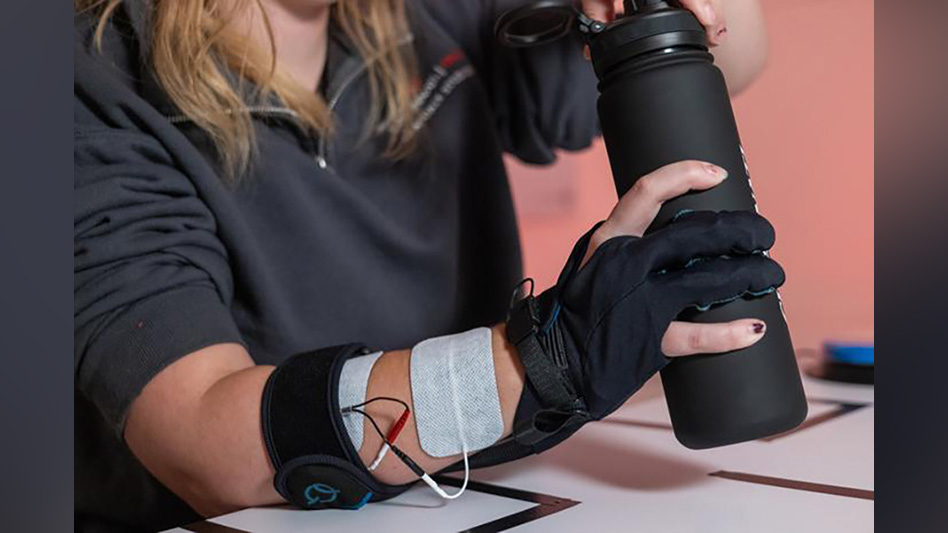
The robotic glove uses tendon-driven actuation to flex individual fingers. The researchers adapted a soft commercial glove into a five-finger system so it could produce several useful grasp patterns instead of simply opening or closing the entire hand as one unit.
Participants used the system to perform five tasks: picking up a plastic strawberry, holding a business card, grasping a bottle, holding an electric toothbrush, and making a pointing gesture. Those tasks were chosen because they represent common combinations of pinch, full-hand grasp, and selective finger movement.
Electrical Stimulation Opens The Hand Again
Closing the hand is only half the problem. To release an object, the system applies FES to the forearm muscles responsible for extending the fingers. Electrical pulses cause those muscles to contract, opening the hand so the user can let go and prepare for the next grasp.
The researchers limited stimulation to brief two-second periods during hand opening to reduce fatigue. The stimulation used 30 Hz pulses with a 150 microsecond pulse width, while electrode placement and current limits were adjusted for each participant.
Five Participants Reached 96% Task Success
Five people with cervical spinal cord injury took part in the experiments. Without the exoskeleton, none could reliably complete all of the required grasp types. With the FES-opening version of the system, the combined success rate across grasping trials reached 96%. A comparison version that relied on passive mechanical reopening reached 89%.
The researchers also reported consistently low levels of discomfort, pain, and fatigue. The study is small, so it does not establish how well the system would perform across a larger or more diverse population, but it shows that the control concept can work in people with long-term cervical injuries rather than only in an engineering demonstration.
This Is Part Of A Bigger Assistive Robotics Shift
The hand exoskeleton sits at the intersection of soft robotics, wearable machines, and human-machine interfaces. BitcoinVersus.Tech recently covered a thread-thin soft robotic motor capable of lifting a chocolate bar, KAIST’s self-installing WalkON Suit F1 exoskeleton, and a tactile robotic hand and haptic glove designed for richer physical interaction.
What makes this project different is the control path. The user does not need enough remaining arm or hand movement to trigger the robot. Instead, the tongue provides the command, the exoskeleton supplies mechanical flexion, and FES recruits the user’s own muscles for extension.
What Still Has To Improve
The system is not yet something a user can simply put on and forget. Researchers still needed to position the glove, place and calibrate FES electrodes, fit the tongue interface, and individualize tendon-force settings. Donning and doffing also still requires assistance in some cases.
The Aalborg University rehabilitation robotics lab is continuing work on tongue-based robot control, soft exoskeletons, and multimodal interfaces. Future versions could become smaller, easier to set up, and better at detecting when a grasp has succeeded without relying on an external operator.
Why It Matters
The result is a useful example of assistive robotics becoming less about building one powerful robot and more about combining several modest technologies that complement each other. The tongue supplies intention, tendons provide mechanical force, and electrical stimulation activates biological muscle.
For someone with severe hand paralysis, that combination can turn a small tongue movement into the ability to grasp a bottle, pick up a card, hold a toothbrush, and release the object again.
Editor’s Note
The featured image is original photorealistic editorial artwork created specifically for this story and is not reused in the body. The body image is a separate photograph illustrating a similar FES-plus-hand-exoskeleton research system. The YouTube video is implemented as a responsive native Gutenberg player, and the Reddit discussion is embedded directly in the article. No normal story text is placed inside cards, panels, callouts, or text boxes.
BitcoinVersus.Tech content is provided for informational and educational purposes.


Leave a Reply