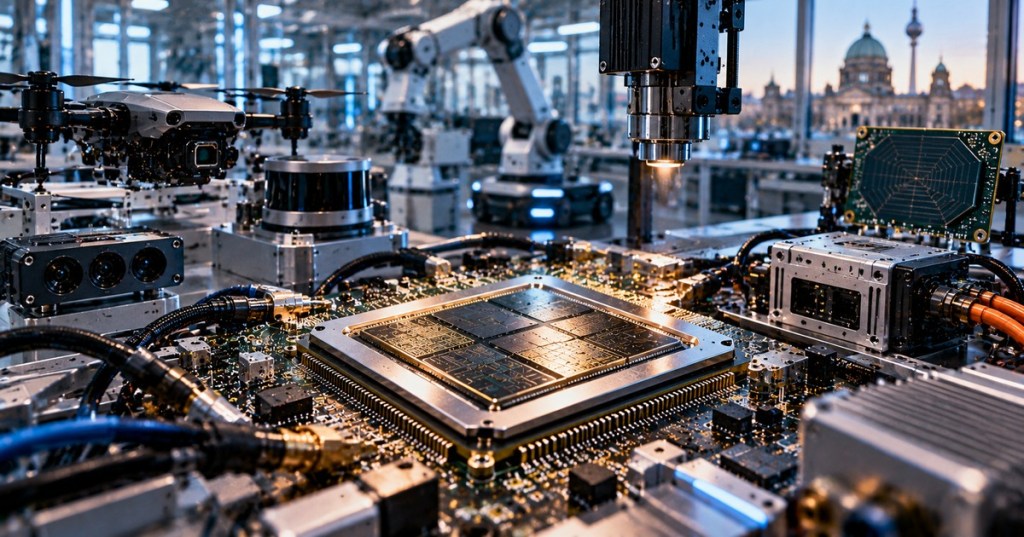
German semiconductor startup Ubitium has raised $14 million to turn its reconfigurable RISC-V architecture into a commercial processor for robots, drones and other machines that need to sense, decide and act in real time.
Ubitium announced the funding on October 13. Ibex Investors led the round, with OpenOcean, KBC Focus Fund, Runa Capital, Inflection and Quantum Systems co-founder Florian Seibel also participating. The company says the new financing brings its total seed funding to $18 million since it was founded in Düsseldorf in 2024.
The more important part of the announcement is that Ubitium now has working silicon. Its UB108 test chip contains 256 processing elements and was manufactured on Samsung’s 8nm process. Ubitium says the chip has already run signal processing, AI inference and real-time control on the same reconfigurable array.
This overview explains Ubitium’s original universal-processor idea: combining several kinds of embedded computing work on one RISC-V-based architecture.
That approach is different from building a system around separate CPUs, DSPs, NPUs and other accelerators. Ubitium describes its design as a coarse-grained reconfigurable architecture whose processing elements can change roles at runtime. The company also uses unified memory and standard RISC-V tools, aiming to reduce chip-to-chip data movement and the software work required to coordinate multiple processors.
A Reddit discussion posted today tracks Ubitium’s $14 million funding round and its attempt to combine sensing, AI inference and control on one processor.
The architecture fits into a broader industry push to simplify physical-AI hardware. BitcoinVersus.Tech recently covered GlobalFoundries’ new FD-SOI roadmap for physical AI, where power efficiency, sensing and real-time operation are becoming as important as raw inference throughput.
Ubitium’s commercial product is not shipping yet. The company plans to tape out a larger UB410 processor with 4,096 processing elements and deliver evaluation units in 2027. Those are roadmap targets, not demonstrated production volumes or independent performance benchmarks. SiliconANGLE separately reported the funding round and Ubitium’s plan to move the architecture toward productization.
ExplainingComputers provides useful background on why the open RISC-V instruction set matters for processor competition and custom computing.
Initial customers are working on high-resolution radar and audio systems, according to Ubitium. That is a practical starting point because both workloads combine heavy signal processing with AI and strict latency limits. Similar integration pressure is visible in robotics chips combining AI compute with high-bandwidth memory and chiplet links.
Ubitium is also part of a larger RISC-V expansion beyond traditional embedded controllers. BitcoinVersus.Tech recently covered AMD ROCm running AI workloads on a SiFive RISC-V data-center server. Ubitium is attacking the opposite end of the spectrum: compact machines that must process sensors, run AI and control hardware locally.
The funding does not prove one processor can replace every specialized chip economically. The UB108 result is a development milestone, while the UB410 still needs evaluation hardware, customer testing and workload-specific benchmarks. But Ubitium has moved the idea beyond a slide deck: the architecture is now in silicon, and the next test is whether it can scale into a useful commercial product.
BitcoinVersus.Tech Editor’s Note:
We volunteer daily to ensure the credibility of the information on this platform is Verifiably True. If you would like to support to help further secure the integrity of our research initiatives, please donate using the QR code provided

For best QR-code scanning results, please scan this donation code from a desktop or larger screen. Mobile screens may prevent camera recognition.


Leave a Reply