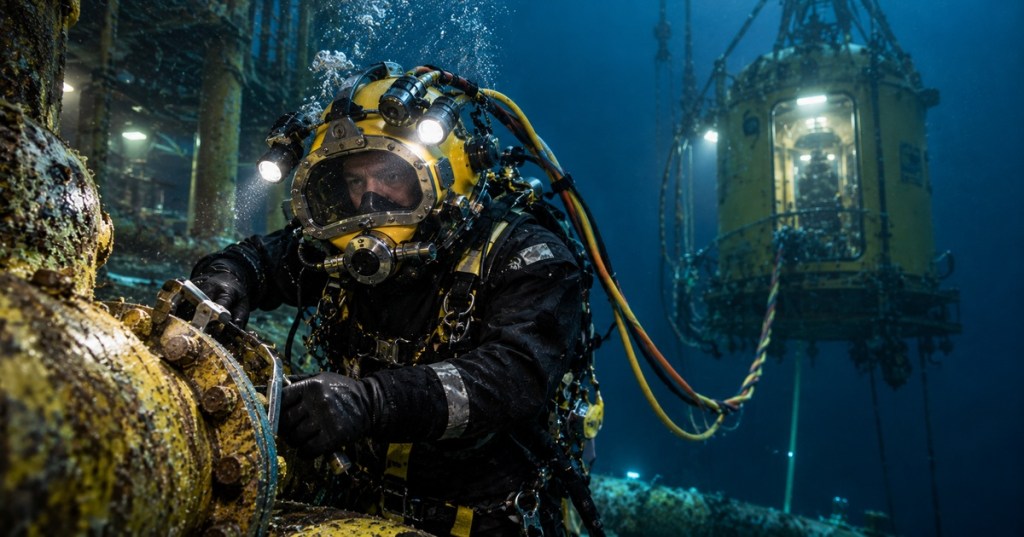
Chris Lemons works in a profession most people will never see up close: deep-sea saturation diving.
We ranked saturation diving No. 1 in our Top 10 Toughest Jobs in the World in 2026. Lemons is the kind of public career profile that explains why.
According to Lemons’ public biography, he has spent more than 20 years in commercial diving and now works as an IMCA diving supervisor. Saturation divers can live inside pressurized chambers for up to 28 days, travel to the seabed in a diving bell and work for hours at depths reaching hundreds of feet.
Lemons explains saturation diving and the accident in a long-form interview.
In September 2012, a dynamic-positioning failure caused the dive-support vessel above him to drift. Lemons’ umbilical—the line supplying breathing gas, heat, light and communications—snagged and severed while he was roughly 300 feet below the North Sea.
He had only minutes of emergency breathing gas. His rescuers took more than 40 minutes to reach him. Lemons was recovered unconscious and revived inside the diving bell.
The story later became the 2019 documentary Last Breath and then a 2025 feature film. TIME’s account explains the real saturation-diving system behind the movie and the extraordinary survival event it dramatized.
What makes Lemons a Career Journalist subject is not only that he survived. He returned to the profession and eventually moved into supervision, carrying experience from one of the most technically unforgiving workplaces on Earth.
His career belongs beside other high-consequence profiles we have documented, including physician-astronaut Scott Parazynski and game designer-turned-explorer Richard Garriott.
Lemons’ résumé is a reminder that some careers demand more than credentials. They require technical skill, trust, physical endurance and the ability to stay functional when the environment itself can become the emergency.
BitcoinVersus.Tech Editor’s Note:
We volunteer daily to ensure the credibility of the information on this platform is Verifiably True. If you would like to support to help further secure the integrity of our research initiatives, please donate using the QR code provided
For best QR-code scanning results, please scan this donation code from a desktop or larger screen. Mobile screens may prevent camera recognition.


Leave a Reply