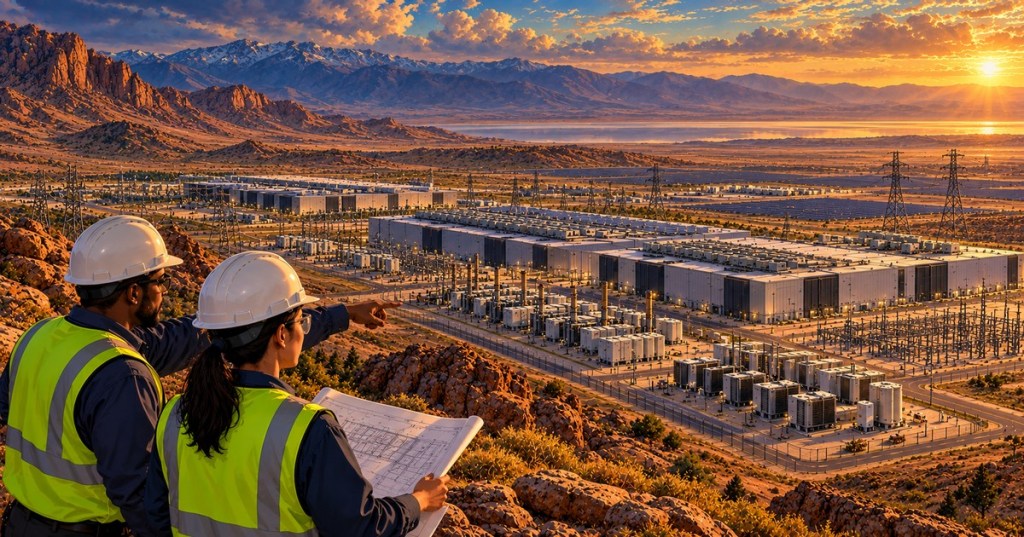
Utah’s largest new AI data center proposals are competing for something more fundamental than graphics processors: enough electricity to power entire new computing districts. The biggest disclosed development plans are Creekstone Energy’s Delta Gigasite, targeting more than 10 GW of combined energy infrastructure; O’Leary Digital’s Stratos campus in Box Elder County, associated with 7.5–9 GW of future on-site generation; and Joule Capital Partners’ 4 GW power-and-computing project near Holden. Their permitting and construction progress varies considerably, and none of those figures establishes an equivalent amount of operating server capacity.
The rankings compare documented maximum planned energy-campus scale, because consistent site-level critical IT power figures are not available for all three. A generator’s nameplate power, a master-planned facility envelope, an approved electrical connection and the IT power consumed by servers are different measures. The three developments are ranked by their published upper-bound campus ambitions, not by who currently operates the most megawatts of computing equipment.
3. Joule High-Performance Compute Campus, Millard County — 4 GW Power Plan
Joule Capital Partners is pursuing an AI and high-performance computing campus near Holden in Millard County. On August 7, 2025, Caterpillar and Wheeler Machinery announced an agreement to support as much as 4 GW of electrical energy for Joule’s development. The design uses Caterpillar G3520K gas generator sets and combined cooling, heat and power technology to serve dense computing systems without relying on a conventional utility connection for its main supply.
Joule held a groundbreaking near Holden in November 2025. Its website reports owned land, heavy-industrial zoning, an executed conditional-use permit and generation equipment on firm order. Utah air-quality records identify the first site and further generator locations. These are meaningful development milestones, but a groundbreaking, an equipment order and a permit are not proof of 4 GW of operating computing capacity.
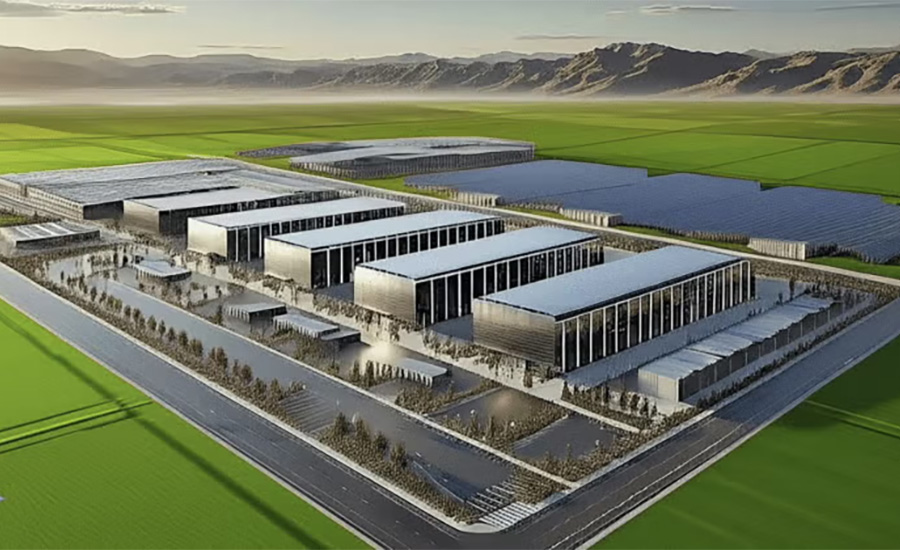
The facility is designed with liquid cooling and on-site electricity generation. Company executives argue that on-site generation can bypass multiyear grid interconnection waits and avoid competition with existing utility customers. Yet dedicated gas engines would still need fuel contracts, environmental permits, cooling hardware and dependable operation at scale. A technical milestone to watch is first delivered IT capacity—separate from the long-term 4 GW generation design. The company’s original target to begin energy production by late 2026 should not be treated as achieved without a current operating disclosure.
2. Stratos Project, Box Elder County — 7.5–9 GW Proposed Generation; Permits Pending
The Stratos Project in the Hansel Valley is associated with investor Kevin O’Leary and O’Leary Digital. In April, Utah’s Military Installation Development Authority approved creation of a project area, followed by Box Elder County’s May 4 agreement. Early presentations described an ambitious 9 GW long-term power-and-data-center development. More detailed fall 2026 engineering and water filings described about 7.5 GW of long-term gas generation, with a first phase of roughly 1.5–2 GW. The figures are proposal envelopes, not permitted server loads.
The original project area encompassed about 40,000 acres. O’Leary subsequently agreed to a smaller effective development footprint after state officials and residents challenged the scale. October reporting described continuing design and environmental studies despite lawsuits; it did not establish that data halls or gas-generation blocks were operating. As of October 28, public project tracking listed Stratos as awaiting permits, with three lawsuits active. A revised area plan is also not the same as confirmation that its future gigawatt demand is financed or allocated.
Box Elder County’s April 27, 2026 commission meeting recording covers the proposed Stratos development and its original power, water and governance assumptions.
Water is a central dispute. An October application requested a change of use for approximately 1,712 acre-feet annually, equivalent to about 1.53 million gallons per day of proposed withdrawal, according to source-linked project records. This is an application, not a meter reading or approval to withdraw that amount. Residents and environmental advocates have questioned the project’s effects on regional water resources and power-plant emissions; the developer says it is refining its plans and conducting required studies.
KSL NewsRadio’s May 26 report examines questions about Stratos’s environmental footprint and the public approval process.
Before Stratos can be described as a functioning gigawatt-scale AI facility, it needs finalized land boundaries, relevant air and water permits, secured power infrastructure and actual data hall construction. Neither the state development-area decision nor the original 9 GW aspiration establishes those outcomes.
1. Creekstone Delta Gigasite, Millard County — More Than 10 GW Planned Energy; Work Underway
Near Delta, Creekstone Energy’s Delta Gigasite is the state’s largest disclosed integrated energy-and-data-center vision on this ranking. The company says it owns 1,143 acres, has heavy-industrial zoning and a conditional-use permit, and is developing a greater-than-10 GW behind-the-meter power stack combining gas, solar and other supply. Utah’s Governor’s Office of Economic Opportunity announced a planned investment of roughly $17 billion in April 2026, describing the development as an energy and AI computing campus that began construction in late 2025.
Creekstone also publishes a more specific computing target: 4.61 GW of proposed full-build IT load, with an initial 220 MW IT-load target, in its engineering overview. Those figures are far more informative about planned computing than the headline multi-source generation figure. On its project page, the company reports a signed gas-interconnect agreement, construction of pipeline infrastructure, and an initial gas supply intended for approximately 230 MW of generating equipment. The complete 10 GW system is not built or generating today.
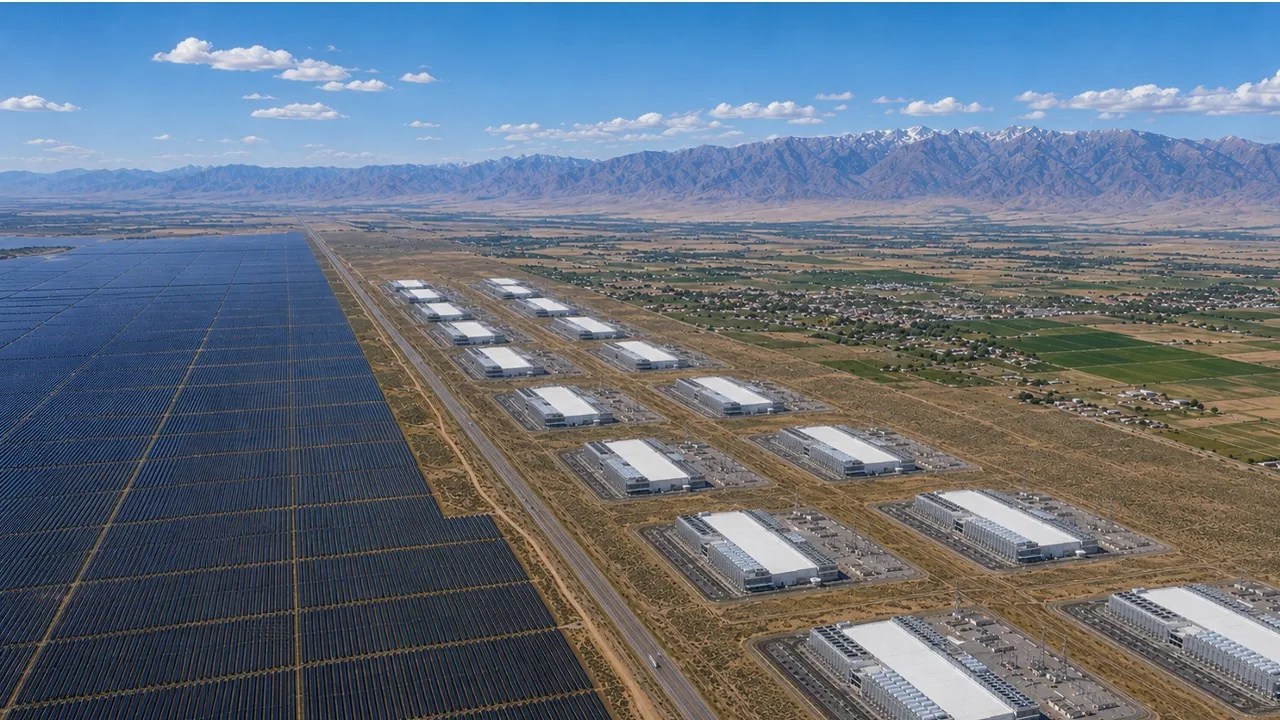
The company has also announced the GIGAWATER research program, which aims to recover water vapor from natural-gas combustion exhaust. Utah News Dispatch reported in September that the technology was still being studied with the University of Utah, rather than validated at commercial scale. Claims about future water recovery should therefore be separated from independently verified water balances, fuel consumption and actual emissions.
Creekstone’s construction page identifies the completed gas-metering building in July, a specific milestone that helps distinguish it from proposals still in land-use negotiation. The next decisive evidence would be completed generating units, operational data halls, a named compute customer and independently supportable first-phase IT power. A project cannot be called the country’s largest operating AI data center merely because its planned energy supply exceeds 10 GW.
Why Valar Atomics’ 9.6 GW Nuclear Proposal Is Not in the Ranking
Another spectacular number comes from Valar Atomics’ Project Beehive near Price in Carbon County. According to NPR’s September 30 investigation, company documents envision 456 small reactors supplying about 9.6 GW of generation for future data centers and industrial uses. The state trust-lands board approved a lease for a much smaller state parcel, while the company’s proposal for roughly 9,000 additional federal acres remained at the application stage.
The American Nuclear Society flagged unanswered questions about the proposed reactor ratings and construction scale. There is no disclosed, comparably substantiated data-center IT load or complete reactor licensing path supporting 9.6 GW of deliverable electricity. We therefore treat that figure as an early nuclear-generation vision rather than a confirmed data center buildout and do not insert it above projects with established site development and permitting milestones. It remains a major proposal to watch if its licensing, site rights and compute requirements become verifiable.
Operating Data Centers Are a Different Leaderboard
The three projects ranked here are not Utah’s largest operating data centers by delivered server power. That distinct market includes Meta’s Eagle Mountain campus, Aligned’s Salt Lake Valley facilities and Novva’s West Jordan campus. Industry facility directories place them among the larger existing operating sites, although published power classifications do not consistently disclose utility capacity and usable IT load on a comparable basis. A future operating-only ranking would need verified live IT-power figures and dates for each campus.
Utah’s competition for AI infrastructure is also a competition over where power is generated and who bears the local impacts. On-site generation may limit a site’s immediate demand from a utility grid, but it cannot remove fuel, water, air-quality or land-use considerations. For additional context, see the Texas Top 7 ranking, the Tennessee edition, and BitcoinVersus.Tech’s data center capacity planning lesson. Announced, contracted, constructed, energized and operating capacity are five different milestones.
BitcoinVersus.Tech
BitcoinVersus.Tech Editor’s Note: We volunteer daily to ensure the credibility of the information on this platform is Verifiably True. If you would like to support our work and help further secure the integrity of our research initiatives, please scan the QR code below to donate 5,000 sats. For best results, scan the QR code from a laptop or larger screen.
Bitcoin address: 3C9o19EH5HSiwEPyCTmEKzxhNCbo2X6TTb. Confirm the destination address before sending.

BitcoinVersus.tech is not a financial advisor. This media platform reports on financial subjects purely for informational purposes.


Leave a Reply