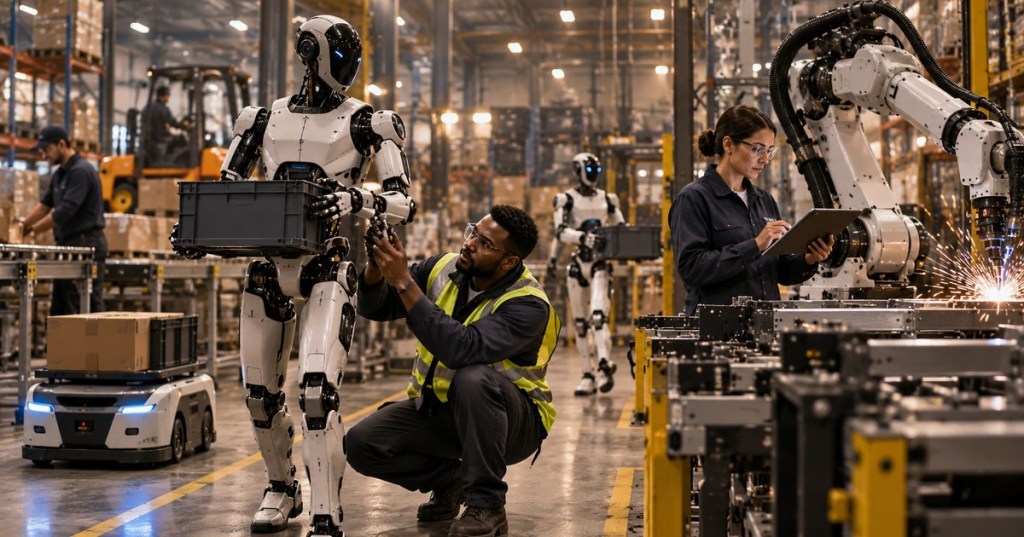
A claim circulating on X that robots could be doing your job within 12 months has sharpened an important question: how fast is physical automation actually advancing? The evidence points to rapid adoption in factories and warehouses, but not to the disappearance of most occupations by October 2027. Industrial robots are being installed in record numbers. General-purpose humanoids, by comparison, remain a young commercial market with substantial technical and economic limits.
The International Federation of Robotics (IFR) counted 603,000 new industrial robot installations worldwide in 2025, up 11% from 2024, and approximately 5.079 million industrial robots operating globally. But a separate IFR survey found only about 7,000 full-size humanoid robots sold worldwide that year for commercial or professional uses beyond research and entertainment. The categories measure different kinds of machines and should not be added together or treated as equivalent jobs.
The post by @rand_longevity raises a forecast rather than reporting a measured takeover of workplaces. The account’s precise claim is not independently substantiated by deployment data. To judge it, the useful questions are how many robots are installed, which tasks they can reliably perform, what they cost to operate and whether companies can integrate them into ordinary shifts.
Twenty-six years of industrial robot adoption
Our chart tracks annual worldwide industrial-robot installations from 2000 through 2025, not total robots in service and not jobs displaced. That is an important distinction: a robot can support several people, perform only one step in an existing job, or replace older machinery rather than a human position.
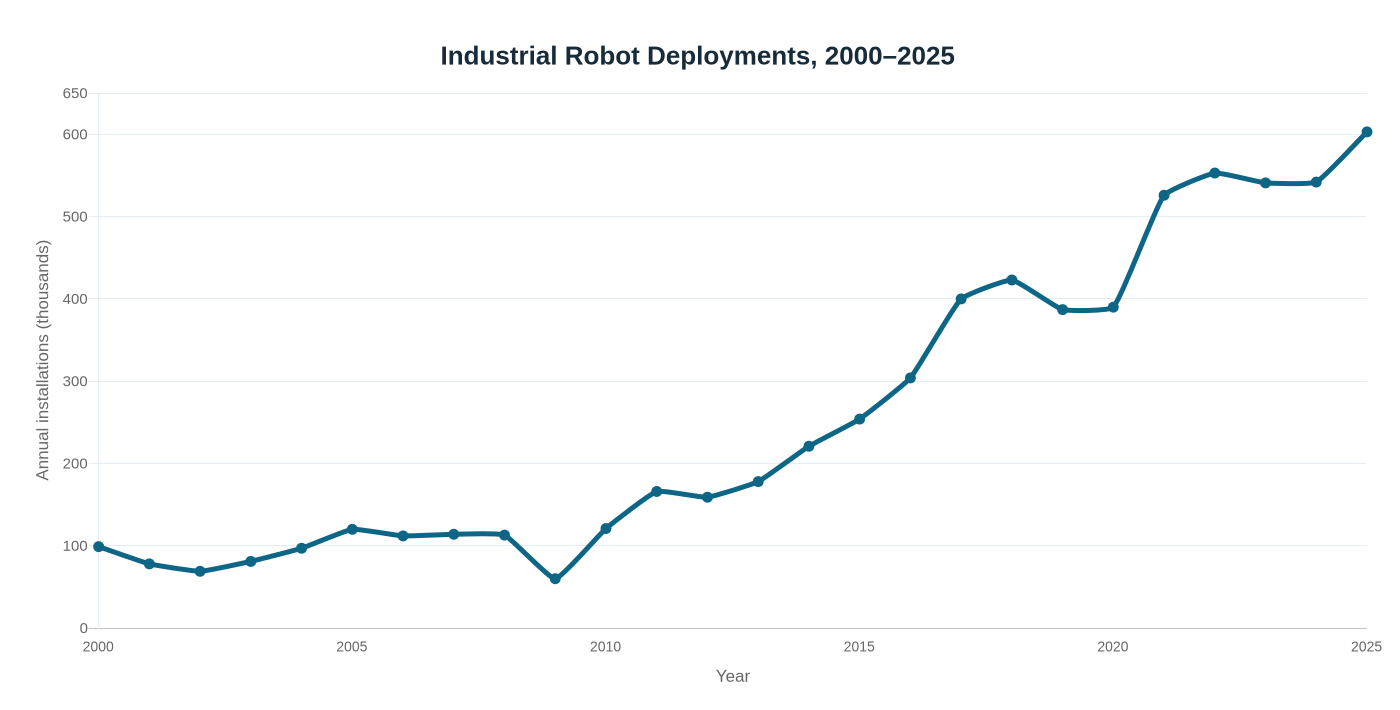
The series rises from approximately 99,000 installations in 2000 to 603,000 in 2025—about 6.1 times as many new industrial robots per year, equivalent to roughly 7.5% compound annual growth over 25 elapsed years. Growth was anything but linear. Installations dropped to around 60,000 in the 2009 financial crisis, then recovered. By 2015 annual deployment reached 254,000; the latest IFR series puts 2020 at 390,000, 2021 at 526,000 and 2025 at 603,000.
These are worldwide annual installations; the stock already working in factories is larger. Early UN-ECE and IFR reporting placed the global operating fleet near 750,000 around 2000. Today it exceeds five million. The IFR projects 655,000 new installations in 2026, but that figure remains a forecast, not a reported year-end result. The September 2026 IFR presentation below provides the contemporary benchmark for the chart’s last decade.
Robot demand also depends on business cycles, capital spending, trade and the industries building new plants. The 2025 increase was especially strong in China and the United States, according to IFR. A rebound in robot purchases is evidence of investment in automation, but it does not measure how many employees have lost work.
Humanoids have started real shifts, but their assignments are narrow
The strongest argument for rapid progress is not a dance demonstration. It is the evidence from production floors. Figure AI reported that its Figure 02 humanoids handled more than 90,000 sheet-metal parts during 1,250 operating hours at BMW’s Spartanburg, South Carolina, plant. BMW subsequently confirmed the scale of the 2025 pilot. The robots supported the production of more than 30,000 vehicles by completing a defined loading task ahead of industrial welding equipment. Figure has since retired that model as it develops successors.
In warehouses, GXO and Agility Robotics said on October 26 that Digit has moved more than 100,000 totes in a Georgia operation. The partners plan new deployments in North Carolina and Tennessee starting in early 2027, not an immediate replacement of entire workforces. Agility reports more than 65,000 real-world operating hours across its programs. Those are company-reported operational milestones, rather than independent audits of profitability or the disappearance of a specific number of jobs.
This is the difference between a robot being capable of a task and a business being able to run an entire operation with robots. A plant still needs maintenance, quality control, work planning, software integration, safety oversight and people who can recover operations when machines fail. Our earlier review of humanoids already doing paid work documents that emerging division of labor.
The limits are economic as much as technical
The clearest challenge to a universal one-year timeline comes from Anthropic’s September 30, 2026 research. Its task-based model estimated that currently available robots could technically perform about 74% of physical tasks in some setting, covering 34% of U.S. work hours. But the same analysis found robots economically competitive with human labor for just 0.3% of job tasks under current assumptions.
Those numbers are not contradictions. A robot might lift a box in a demonstration but still cost more per correctly handled box once its purchase price, installation, electricity, servicing, supervision, idle time and downtime are included. Anthropic estimated that, if robot prices decline along historical trends, reaching cost competitiveness for 10% of tasks could take approximately 40 years. That is a modeled scenario—not a guarantee of slow progress or a prediction that breakthroughs cannot occur.
Power efficiency is part of the race
The cost of useful robotic work depends on more than motor efficiency or battery chemistry. An economically meaningful measure is successful tasks per kilowatt-hour, together with tasks per paid operating hour and maintenance cost per task. Engineers must account for actuators, computing, sensors, charging losses and the energy required to move the machine’s own mass. A humanoid that walks between stations consumes energy that a fixed industrial arm or wheeled robot may not need.
Boston Dynamics specifies that its current Atlas platform can run for about four hours in typical operation or two hours under heavy lifting, with an autonomous battery swap taking about three minutes. A 110- or 220-volt charging connection and rapid swapping can improve availability, but neither figure alone proves the electricity consumed per completed warehouse task. The company’s official introduction to its all-electric Atlas shows the hardware direction, not a universal productivity benchmark.
Agility has also highlighted fast charging for Digit 5, a subject covered in BitcoinVersus.Tech’s report on its nine-minute recharge claim. Short charging interruptions could raise utilization, while better motor drives and thermal design could cut losses. Still, battery life, charging speed, actuator cost and fleet reliability must be evaluated together. Our earlier coverage explains why actuators are such an expensive part of humanoid hardware.
This resembles broader computing’s efficiency problem, but without a universal conversion between compute operations, robotic movement and completed human work. The winning design may be a humanoid, a mobile robot, or a specialized fixed machine depending on what the workplace actually needs.
What is plausible by October 2027?
More factories and distribution centers are likely to automate repeatable work: moving totes, feeding equipment, inspecting predictable objects, counting inventory and handling standardized packages. These are already the environments where robots succeed. The IFR separately recorded nearly 250,000 professional service robots shipped in 2025, with transportation and logistics representing almost half of that sample. This is a different measure from industrial robot installations and full-size humanoid sales.
The same evidence argues against expecting robots to take over most nursing, construction, field repair, childcare or unscripted household work in the next 12 months. Those jobs demand frequent adaptation to people, cluttered spaces, unpredictable damage and safety-critical decisions. Roles may change before they disappear: facilities will still require technicians who service drives and batteries, engineers who integrate control software, and supervisors who manage mixed human-robot operations.
The bigger question is not whether a video shows an impressive machine, but whether an employer can repeat that performance thousands of times safely and profitably. By October 2027, robots are likely to be doing more of the work inside many jobs. The evidence does not support a blanket prediction that they will be doing everyone’s job.
BitcoinVersus.Tech Editor’s Note: We volunteer daily to ensure the credibility of the information on this platform is Verifiably True. If you would like to support our work and help further secure the integrity of our research initiatives, please scan the QR code below to donate 5,000 sats. For best results, open this article on a laptop or larger screen and scan the QR code with your mobile Bitcoin wallet.

BitcoinVersus.tech is not a financial advisor. This media platform reports on financial subjects purely for informational purposes.


Leave a Reply