
Arm and Sumo Digital made Neural Dawn available to download on October 29, 2026, turning their AI-graphics demonstration into a playable Android game. Announced through Arm’s official launch report, the release showcases advanced lighting, ray tracing and neural rendering on phones and tablets carrying the new Mali G2-Ultra NX GPU. Access is limited to five compatible device models; it is not a general Android or iPhone release.
The supported lineup includes OPPO Find X10 Pro Max and vivo X500 Pro/Pro Max using MediaTek’s Dimensity 9600 Pro, plus Xiaomi 18 Fold and Xiaomi Pad 9 Pro Max using XRING O3. Arm’s download page lists an APK installation route and asks owners to check hardware compatibility first. Availability does not establish how many consumers have downloaded or completed the game.
Arm — “Neural Dawn: Showcasing the future of AI-powered mobile gaming” (June 10, 2026). Original gameplay and technical trailer embedded in Arm’s October launch article. This is an earlier demonstration, not the October download announcement.
How the mobile GPU reduces rendering work
The technical change is that the GPU no longer needs to render every final pixel conventionally. Neural Super Sampling reconstructs a higher-resolution image from lower-resolution rendering; Neural Super Sampling and Denoising cleans up noisy ray-traced lighting; and Neural Frame Rate Upscaling creates intermediate frames. The methods address the power and thermal constraints that distinguish mobile silicon from desktop graphics cards.
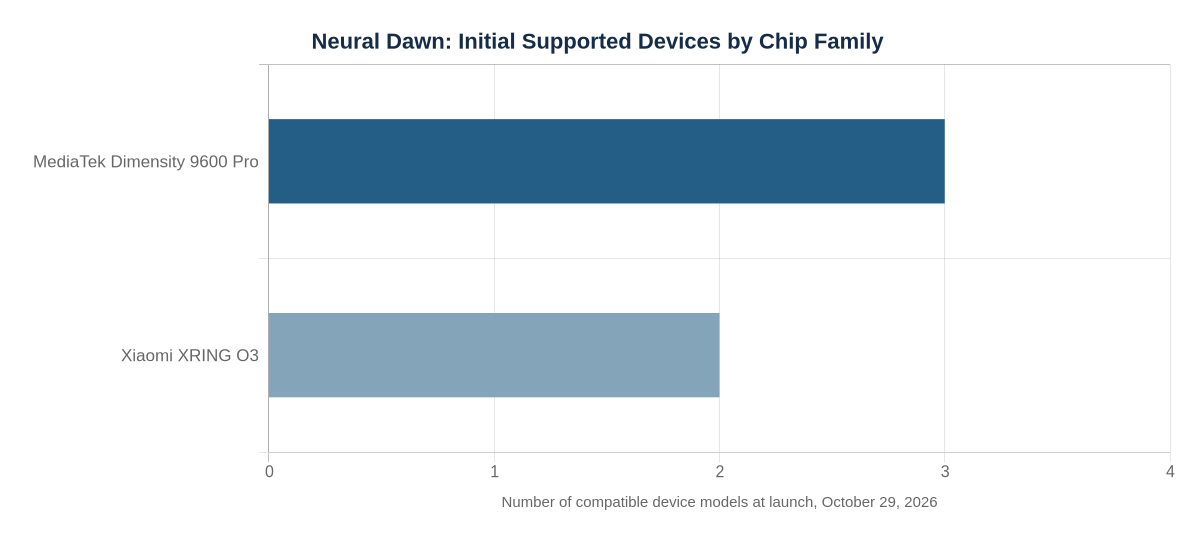
Three of the five currently listed compatible devices use MediaTek silicon, while two use Xiaomi’s XRING O3. Those are device-model counts, not market share, sales or graphics benchmark results. The hardware restriction is material: a powerful phone without Mali G2-Ultra NX is not automatically compatible.
Arm — Neural Dawn mobile game launch teaser (embedded in Arm’s October 29 launch report). Official gameplay from the downloadable title, not an unrelated third-party demonstration.
From a demo to a developer test
Built with Unreal Engine 5.6.1 MegaLights, Neural Dawn uses dynamic cave illumination as a gameplay mechanic. It extends techniques familiar from console AI upscaling into a mobile rendering pipeline. Arm separately claims its neural techniques can reduce some GPU workloads by up to 50% and raise delivered frame rates by up to twice; these are vendor-stated potential benefits, not independent benchmark measurements of all five phones.
The release also tests developer adoption. Arm provides a Neural Graphics Development Kit for integration with Unreal Engine and Vulkan workflows, while Sumo developed a complete experience rather than an isolated rendering scene. This connects to wider game-development tool changes and the role of specialized AI acceleration in graphics.
Epic Games / Inside Unreal — “MegaLights on Mobile: Pipe Dream or Reality? How Arm & Sumo Digital Made It Possible” (June 2026). Arm and Sumo developers examine the rendering workflow and the engineering constraints behind the game.
Next is whether Arm and its partners expand device support, whether studios adopt the toolchain and how independent tests measure frame pacing, image quality and battery use during sustained play. The October launch proves users on supported hardware can obtain a build; it does not prove neural rendering will outperform every conventional pipeline.
Editor’s Note: We volunteer daily to ensure the credibility of the information on this platform is Verifiably True. If you would like to support our work and help further secure the integrity of our research initiatives, please scan the QR code below to donate 5,000 sats.

For mobile scanning, open this story on a laptop or larger screen and scan the original QR using a compatible Bitcoin wallet. Confirm the receiving address 3C9o19EH5HSiwEPyCTmEKzxhNCbo2X6TTb before sending.
BitcoinVersus.tech is not a financial advisor. This media platform reports on financial subjects purely for informational purposes.


Leave a Reply