
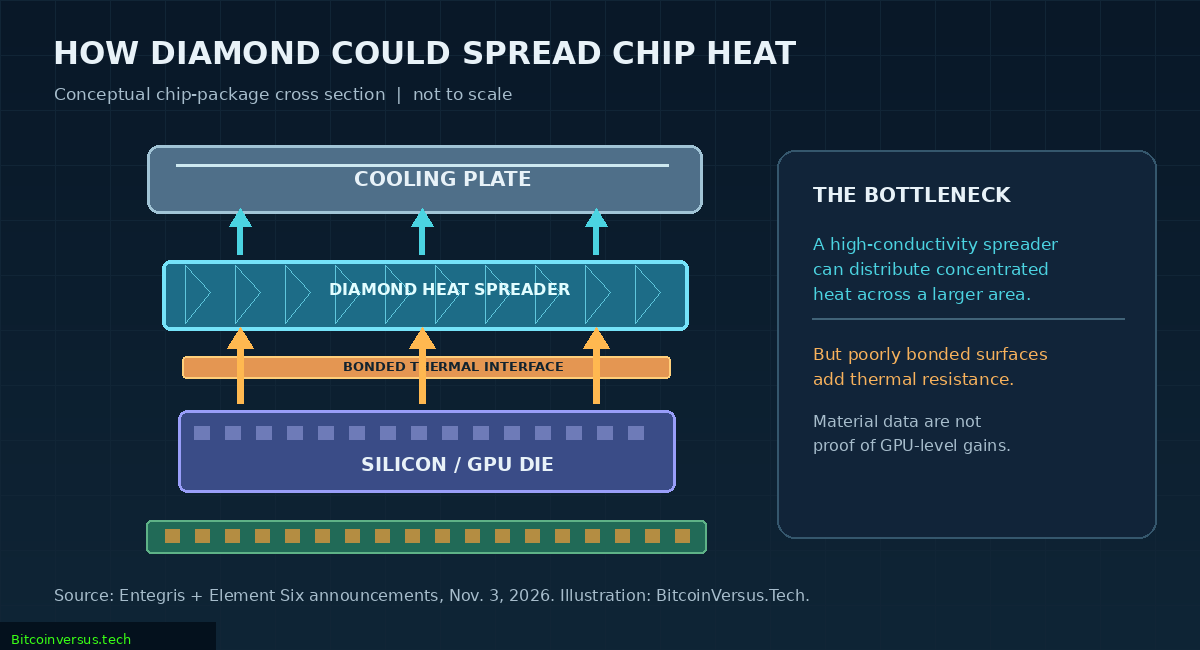
A modern AI processor sheds heat through several layers: silicon, a bonded interface, a heat spreader and a cooling plate. Even a material with exceptional thermal conductivity can disappoint when microscopic contact defects impede heat flow between layers. As power is concentrated into smaller chip regions, package designers must manage heat at the die rather than rely entirely on larger cooling equipment.
On November 3, 2026, Entegris announced a three-part expansion into advanced thermal-management materials: its completed acquisition of Advanced Abrasives Corporation, plans for a manufacturing line in Taiwan, and a long-term synthetic-diamond development partnership with Element Six. The initiatives target semiconductor packaging for increasingly demanding AI and high-performance computing systems.
An acquisition, a factory plan and a materials partnership
Advanced Abrasives, based in New Jersey, produces precision diamond superabrasives for polishing hard materials. Its acquisition extends Entegris’ existing silicon-carbide chemical mechanical planarization portfolio, covering slurries, pads, cleaning and surface preparation. Entegris said a planned Taiwan manufacturing line would help commercialize related SiC solutions while exploratory thermal-interface research continues in the United States.
The acquisition is complete; the factory remains a plan. Entegris did not specify the purchase price, Taiwan investment amount, production capacity or commercial qualification date. A separate Element Six announcement described cooperation on wafer-level bonding, engineered surfaces and both polycrystalline and single-crystal diamond platforms for GPU and radio-frequency devices. The partnership is developmental, not evidence of volume production.
Why diamond’s thermal conductivity matters
Element Six lists synthetic-diamond thermal materials with conductivities ranging from approximately 1,000 to 2,200 watts per meter-kelvin, depending on grade. Conductivity describes how effectively a material transfers heat under a temperature gradient. It does not measure a finished GPU’s temperature reduction, electrical power savings or computational throughput.
Interfaces are crucial. A poorly bonded diamond layer can introduce thermal resistance even when the crystal itself conducts heat efficiently. Thickness, flatness, thermal expansion mismatch, production yield and attachment methods may determine whether the material improves real assemblies. The partners explicitly identify lower thermal boundary resistance and scalable integration as engineering priorities.
Entegris explains the broader advanced-packaging environment in its official “Advanced Packaging” video, published August 2026. Source: Entegris/YouTube. The video does not demonstrate a finished diamond-cooled GPU.
Chip-level cooling is drawing wider attention
Related research spans multiple approaches. BitcoinVersus.Tech previously reported Frore’s diamond-assisted liquid-cooling design and Wiwynn’s diamond-cooling tests. Those efforts are separate from the newly announced Entegris–Element Six collaboration; results from one design cannot be transferred to another without comparable conditions.
Packaging advances also depend on manufacturing processes. Applied Materials and Besi’s work on hybrid bonding illustrates the precision required when connecting semiconductor structures, while Nidec’s 3.2-megawatt coolant distribution unit addresses heat at an entirely different, facility-scale level. High-conductivity packages and liquid-cooling infrastructure are complementary engineering layers, not interchangeable solutions.
The evidence still missing
Entegris has not published a customer-qualified GPU temperature benchmark, volume shipment count or power-efficiency improvement attributable to the new partnership. Meaningful validation would compare otherwise identical packages at the same heat load and coolant conditions, reporting junction temperature, thermal resistance, long-term cycling reliability, yield and cost.
The company has scheduled a presentation of its advanced thermal-management strategy for November 9, 2026. Until then, the defensible conclusion is narrow: Entegris has expanded its materials capabilities and formed a diamond-integration alliance, while commercial benefits remain to be demonstrated.
Primary sources
Entegris announcement (November 3, 2026); Element Six partnership announcement (November 3, 2026); Element Six thermal-management specifications (accessed November 8, 2026).
Editor’s Note: The acquisition, proposed manufacturing investment and collaboration are distinguished by status. No finished GPU cooling gains, production yields or commercial deployments are inferred from laboratory material properties. The cover and explanatory diagram are conceptual graphics, not photographs of company equipment. YouTube video identity and publisher were checked against an official channel listing; playback and site rendering require separate live verification.
Support BitcoinVersus.Tech
To contribute an optional 5,000 satoshis, scan the original BitcoinVersus.Tech donation QR below with a compatible Bitcoin wallet. On a phone, open the article on another screen or use a wallet’s supported saved-image scanning feature. Confirm the destination and amount in your wallet before sending.

We volunteer daily to ensure the information on this platform is Verifiably True. If you would like to support the research, please scan QR code.


Leave a Reply