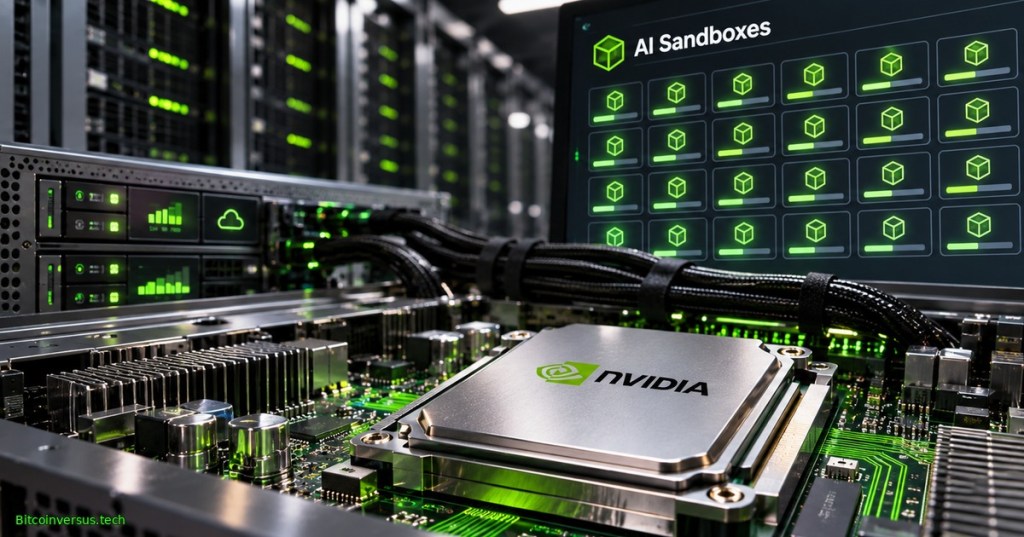
A new NVIDIA performance roundup places a striking number on the CPU bottleneck behind AI agents: 1,000 isolated coding environments ready in 10.8 seconds on its Vera processor. NVIDIA published the result on November 5, 2026, citing infrastructure company Daytona, whose October 7 benchmark report also supplies two AMD EPYC comparisons. The tests concern provisioning and executing agent environments, not how quickly a GPU generates tokens.
An AI coding agent often requires an isolated computer environment to clone repositories, execute programs, install dependencies and run tests. Such “sandboxes” draw on CPU scheduling, memory, storage and operating-system services even when a language model performs reasoning on accelerators. BitcoinVersus.Tech’s CPU-versus-GPU explainer distinguishes those functions. A fast CPU can shorten the non-GPU portion of an agent workflow without changing the model’s neural-network throughput.
The full three-processor startup comparison
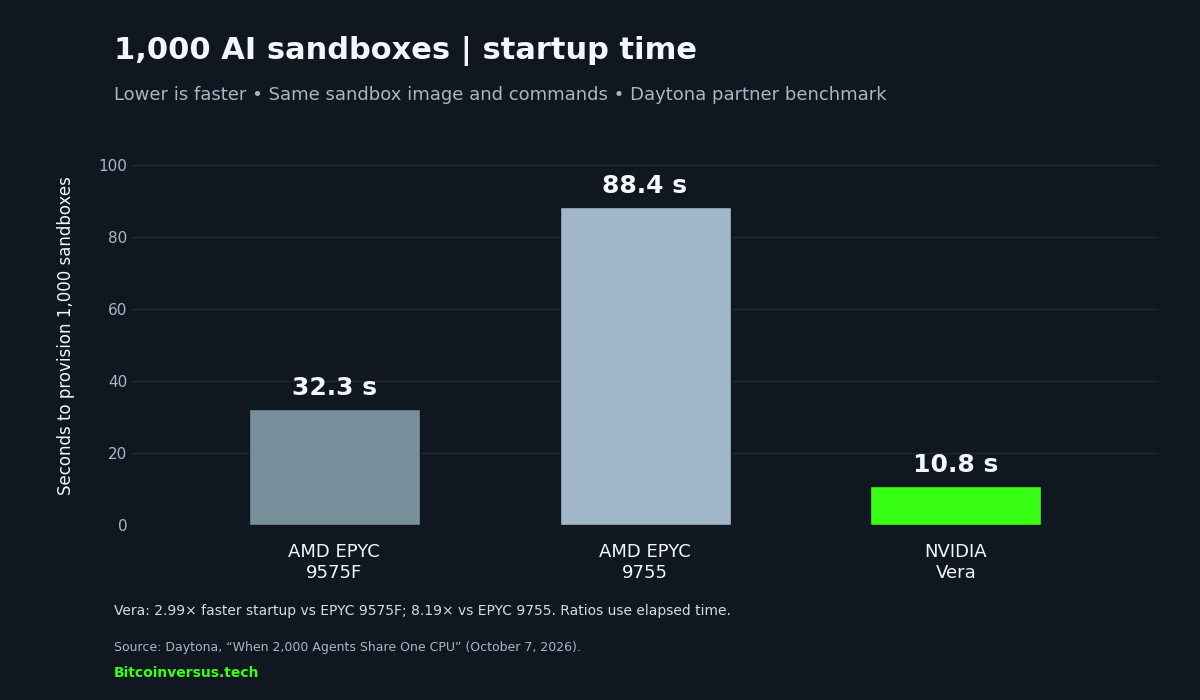
Daytona started the same 1,000 sandbox images and commands on three platforms. NVIDIA Vera finished in 10.8 seconds, AMD’s EPYC 9575F took 32.3 seconds, and AMD’s EPYC 9755 took 88.4 seconds. Dividing the comparator time by Vera’s time gives approximately 2.99× and 8.19× faster startup, respectively. The larger multiplier alone would conceal the much faster EPYC 9575F result. No independent third-party reproduction or statistical confidence intervals were provided.
Daytona also provisioned 2,000 sandboxes in 27.4 seconds on Vera, but did not give a directly matching 2,000-sandbox startup time for both EPYC processors in the published comparison. Such an unmatched number must not be used to claim a 2,000-sandbox speedup. The report is relevant to operating systems and isolation infrastructure; a previous agent sandboxing report covers a different Windows security use case.
Startup time is not completed agent work
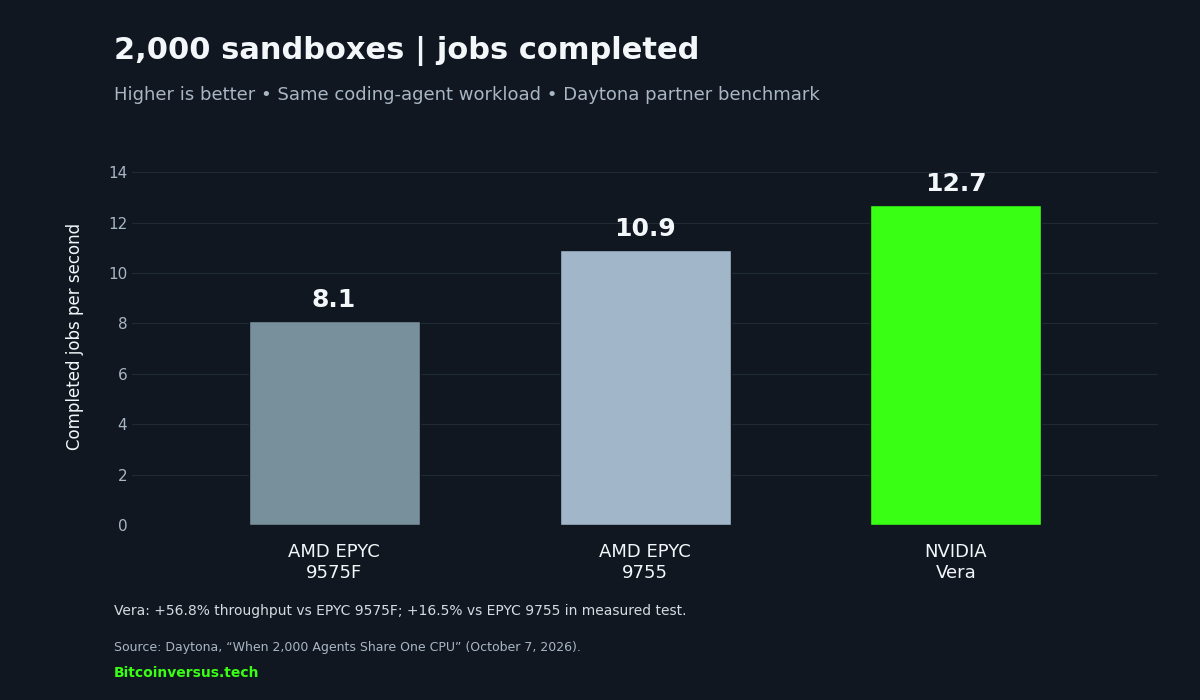
At 2,000 concurrent environments, Daytona measured Vera completing 12.7 agent jobs per second, versus 10.9 for EPYC 9755 and 8.1 for EPYC 9575F. Under the company’s test, Vera delivered 16.5% more completed jobs per second than the 9755 and 56.8% more than the 9575F. Each job involved navigating, repairing and testing a deliberately broken Python package. Those figures are sustained work throughput, not sandbox creation time or inference tokens per second.
Power efficiency needs its own denominator
NVIDIA additionally claims Vera runs 1.6 times as many agents per watt as the fastest x86 processor in a modeled 100-megawatt data-center comparison. Its November 5 post does not name the comparison CPU or publish a full facility-level measurement method. The number therefore cannot be recalculated from Daytona’s seconds or jobs-per-second charts, nor presented as 60% less electricity for an operating facility. AI power-demand analysis explains why efficiency and total consumption can move in different directions.
Vera uses 88 Olympus CPU cores and up to 1.2 TB/s memory bandwidth, according to NVIDIA’s May 31 product announcement. Faster sandbox execution could complement GPU infrastructure, but procurement decisions also require price, power draw, software compatibility, latency distribution and reproducible head-to-head configurations. The DSX OS operations report addresses a separate system-reliability challenge.
The evidence supports a narrow conclusion: Daytona observed substantially faster sandbox startup and higher coding-job throughput on Vera under its chosen test conditions. Whether comparable advantages persist in independent cloud deployments, different languages or customer workloads remains unresolved. NVIDIA’s partner roundups are informative early evidence, not an industrywide performance standard.
Primary sources: Daytona’s October 7 benchmark and methodology; NVIDIA’s November 5 performance roundup; NVIDIA’s May 31 Vera technical and production announcement.
Editor’s Note: Startup and completed-work figures originate with Daytona’s October 7, 2026 company-conducted tests; NVIDIA repeated selected results November 5. Ratios are calculations from the published observations, not external laboratory certifications. The 1.6× agents-per-watt claim comes from a separate NVIDIA 100 MW modeling scenario with an unnamed x86 reference and was not mixed with Daytona’s measurements. The featured image is a conceptual illustration rather than a photograph of the benchmark system. The official NVIDIA video is historical product context; playback and independent cross-device page rendering were not verified at publication.
Support BitcoinVersus.Tech
Support independent research by scanning the original approved QR code below for an optional 5,000-satoshi donation. Mobile readers can display the page on another screen and scan using a compatible Bitcoin wallet, or use the wallet’s supported scan-from-image feature. Verify the recipient address and amount before sending.

We volunteer daily to ensure the information on this platform is Verifiably True. If you would like to support the research, please scan QR code.


Leave a Reply