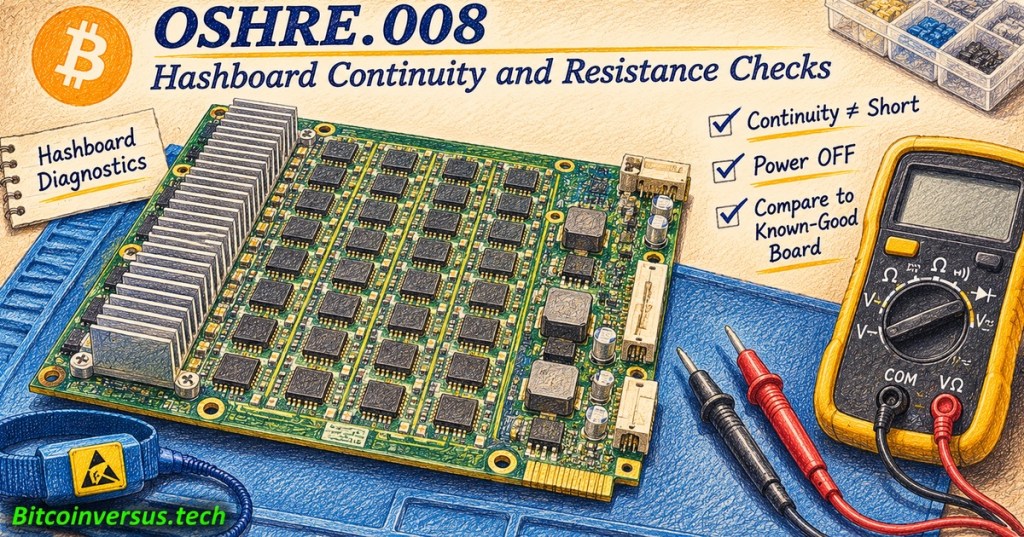
OSHRE.008 examines how a digital multimeter can help characterize an isolated Bitcoin ASIC hashboard without turning a continuity beep into a diagnosis. High-current conductors, parallel chip domains, filtering capacitors and semiconductor junctions can make an intact board look electrically different from a simple wire. Meaningful troubleshooting begins with verified isolation, a documented reference measurement and the precise hardware revision.
Fluke Corporation, “How to use a Multimeter | A comprehensive guide,” April 29, 2025. Official manufacturer training covers resistance at 01:23, continuity at 01:40 and safety at 04:07. Credit: Fluke Corporation / YouTube.
What a continuity beep actually means
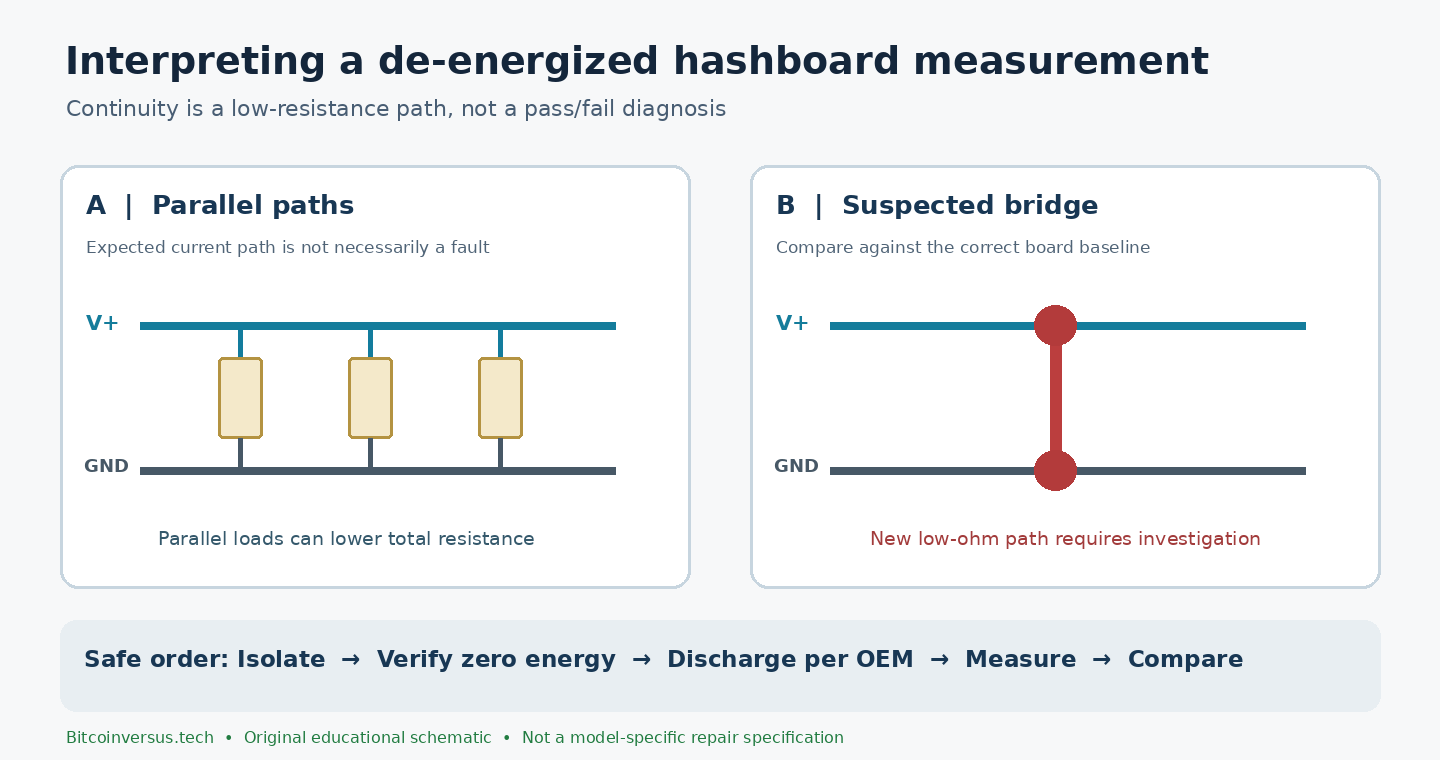
A continuity function injects a small measurement current and signals when the detected path meets the meter’s own low-resistance threshold. Fluke notes that beeper thresholds vary across instruments. Continuity does not establish that two points are accidentally shorted. Ground connections, low-resistance winding paths and multiple components in parallel can produce an audible response without any fault.
Resistance mode reports an ohmic value rather than a yes/no indication. Yet an in-circuit reading includes every available parallel path, not necessarily the resistance of a single capacitor or ASIC. Measurements can also vary as capacitors charge from the meter’s test current, so stable baseline conditions and polarity matter. OSHRE.001 on voltage domains explains why a whole-board interpretation is insufficient.
Safety before meter contact
Only trained, authorized technicians should access a miner’s exposed electronics. Follow the exact manufacturer’s shutdown and lockout requirements, disconnect the equipment from all power sources, and have a qualified person establish absence of hazardous energy with an appropriately rated instrument. Capacitors may retain charge after unplugging. Discharge and verification must follow approved model-specific procedures; do not use continuity mode to verify an equipment-safe state.
An ESD-protected work area also matters, but grounding straps are not substitutes for protection from electric shock. Consult OSHRE.007 on ESD and contamination before exposed-board inspection. Never probe energized hashboard rails in resistance, continuity or diode modes.
How technicians interpret a suspicious reading
A very low resistance may be normal on one design and abnormal on another. Record the multimeter model, lead condition, test mode, probe polarity, environmental state and exact board part number. Compare equivalent reference points on a verified good board of the same revision, using the manufacturer’s approved fixture or service documentation. A difference is evidence for further examination, not definitive proof of a failed ASIC.
Visual inspection may then reveal contamination, damaged traces or solder bridges, subjects developed in OSHRE.006 on solder-joint inspection. Faulty chip enumeration, by contrast, also requires communication-chain analysis. OSHRE.003 on missing ASICs distinguishes reported symptoms from confirmed causes.
ZEUS MINING, “How to Use Antminer ASIC Repair Diagnostic Tester | Asic Test fixture tutorial,” February 3, 2023. Specialist demonstration uses an S17e board to explain fixture-based tests; model-specific procedures must not be transferred to other boards without validation. Credit: ZEUS MINING / YouTube.
Document findings without overclaiming
- Record the miner model, hashboard revision and fault symptoms before maintenance.
- Complete authorized isolation, zero-energy verification and approved capacitor-discharge checks.
- Check meter leads, measuring range and the device’s actual continuity threshold.
- Document readings at approved reference points against a known-good equivalent.
- Escalate inconsistent measurements for manufacturer-approved diagnosis; do not energize a suspected fault or improvise a high-current bench test.
The practical benefit is fewer false diagnoses and fewer unnecessary component replacements. The limitation is equally important: passive continuity and resistance measurements alone cannot certify a repaired board’s safety, communications, temperature control or hashing performance.
Primary references: Fluke, What is Continuity?; Fluke, How to Measure Resistance; Fluke, Continuity Test Guide; Fluke, Multimeter Controls and Jacks. The in-story drawing represents conceptual electrical paths rather than an instrument measurement.
Editor’s Note: OSHRE.008 continues the OSHRE.007 inspection sequence. Safety principles and measurement limitations were checked against original Fluke training and documentation. The original 1200 × 630 colored-pencil cover carries a neon-green Bitcoinversus.tech watermark, and the original in-story diagram is conceptual. The Fluke Corporation and ZEUS MINING videos were identified through public listings. WordPress iframe rendering and real video playback are separate verification steps. No physical hashboard was energized, opened or measured in preparation for the lesson.

BitcoinVersus.Tech is volunteer-run and publishes independent technical education. An optional 5,000-satoshi donation supports research. Scan the original QR from a second screen with a compatible Bitcoin wallet; on the same phone, use a wallet able to import a saved QR image when supported. Independently verify recipient 3C9o19EH5HSiwEPyCTmEKzxhNCbo2X6TTb and amount before payment. Bitcoin transfers are generally irreversible.
We volunteer daily to ensure the information on BitcoinVersus.Tech is Verifiably True. Coverage is educational and informational and does not constitute individual electrical engineering certification, a miner repair authorization, financial advice or investment advice.


Leave a Reply