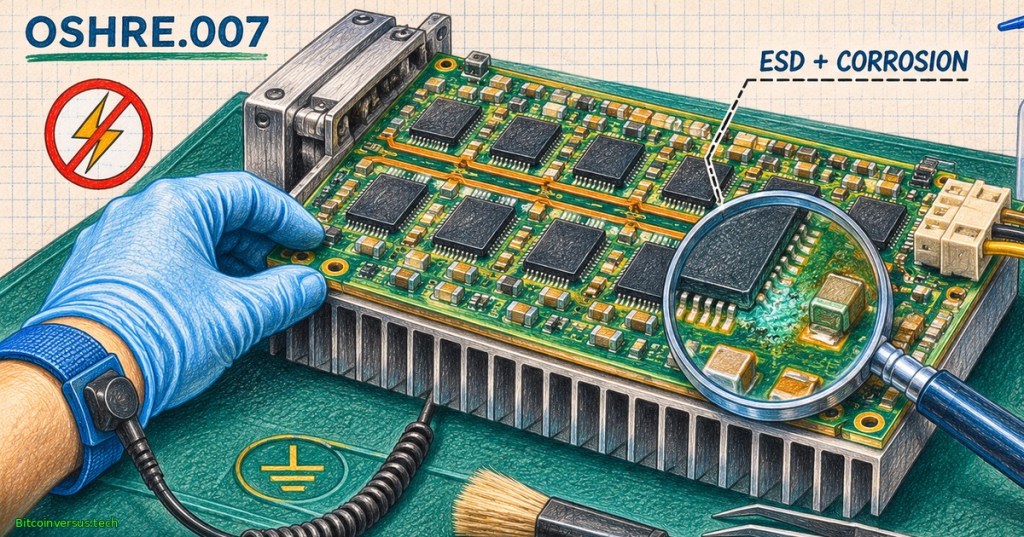
OSHRE.007 examines two preventable threats during Bitcoin miner maintenance: electrostatic discharge (ESD) and contamination. Hashboards contain dense ASICs, high-current connections, control circuitry and fine-pitch components. A board that appears physically intact can still suffer latent ESD damage; moisture and corrosive deposits can also compromise electrical connections. Neither observation establishes a failed chip without supporting evidence.
DigiKey, “What is ESD and How to Prevent it,” March 28, 2023. Official training explains electrostatic discharges and workplace safeguards. Credit: DigiKey / YouTube.
Protect the device before inspecting it
The EOS/ESD Association’s June 2026 grounding guidance describes a protected work area with a controlled common-ground point, suitable personnel grounding and documented verification. A wrist strap and static-dissipative work surface are useful only when connected, maintained and tested correctly. Ordinary gloves or an untested bench mat cannot establish ESD protection.
ESD grounding is not electrical shock protection. Qualified personnel must shut down and isolate all power sources, observe the manufacturer’s discharge requirements and facility lockout/tagout procedures, and verify the miner is safe before handling exposed hardware. Never wear a wrist grounding strap when working on exposed energized hazardous-voltage circuits.
Review the previous OSHRE.006 solder-joint inspection lesson, along with OSHRE.001 power-distribution domains and OSHRE.005 connector diagnostics. Each contributes to safe intake and prevents an unsupported conclusion that every missing ASIC signal represents defective silicon.
Dust, humidity and corrosion are separate problems
Bitmain’s environmental guidance emphasizes non-condensing humidity, appropriate site cleanliness, and avoiding corrosive dust and gases. Operating recommendations vary among miner families, so technicians must apply the documentation for the actual model. Dust obstructs cooling; damp deposits can retain water, foster corrosion and create unintended leakage paths. Bitmain also warns that temperature changes during humid shutdown conditions can cause condensation.
White or green deposits, staining, pitted contacts and residue deserve dated photographs. Yet some visible marks may be process residue or unrelated staining rather than active corrosion. A clean exterior does not rule out contamination beneath chips, shields or heatsinks.
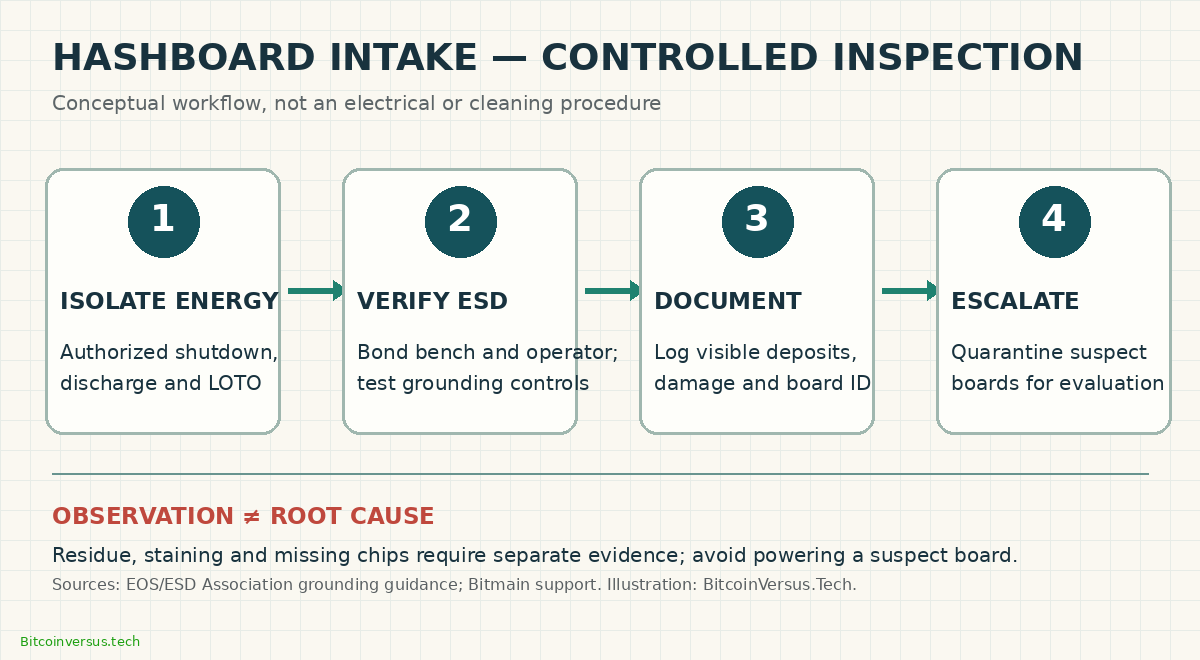
Safe, traceable hashboard intake
- Record asset ID, exact manufacturer, miner and hashboard revision, cooling arrangement, firmware version and previous service history.
- Preserve logs and thermal alarms; photograph accessible regions using diffuse lighting and clear orientation labels.
- After approved electrical isolation, verify the ESD work surface and personnel-grounding controls under the site’s test procedure.
- Inspect de-energized connectors, exposed copper, heat-sink pathways and visible solder regions without scraping, prying or disturbing components.
- Quarantine questionable boards, separate observations from hypotheses and request approved specialist cleaning, diagnosis or replacement.
Gamers Nexus, “Static Electricity Misconceptions: Fake vs. Real ESD Wrist Straps & Proper Grounding Deep-Dive,” July 13, 2021. Independent video explaining grounding, anti-static materials and latent component failure. Credit: Gamers Nexus / YouTube; the channel also markets ESD products.
Why improvised cleaning can create new faults
iFixit’s liquid-damage repair reference discusses residue removal from compatible consumer circuit boards. Its solvent guidance must not be assumed safe for mining hashboards with bonded heat sinks, sensitive coatings, inaccessible thermal interfaces or unknown materials. Avoid spraying cleaning fluids inside assembled miners, uncontrolled compressed air or energizing damp equipment. Cleaning requires compatible materials and the manufacturer’s exact service instructions.
Visual cleanliness cannot certify insulation integrity, correct chip enumeration or stable hashing. An ESD event may leave no visible mark. If a miner remains faulty, use OSHRE.003’s missing-ASIC diagnostic framework to distinguish logged symptoms from confirmed causes. Only authorized bench testing and validated operating checks support a decision to return hardware to service.
Primary sources: EOS/ESD Association, June 1, 2026 grounding article; ESD Association fundamentals; Bitmain environmental requirements; Bitmain dust maintenance; Bitmain condensation warning; iFixit water-damage reference; verified DigiKey and Gamers Nexus videos.
Editor’s Note: OSHRE.007 is technical education rather than a report of a specific new mining-machine failure. The sources separate industry ESD-control principles, model-specific operating conditions and non-transferable consumer-electronics repair guidance. The 1200 × 630 featured cover is original colored-pencil conceptual artwork with a 10-point neon-green Bitcoinversus.tech watermark, and the in-story workflow image is original. No physical hashboard was opened, cleaned, energized or experimentally tested. Video identity and relevance were checked; embedded playback and mobile layout require independent verification.

BitcoinVersus.Tech is volunteer-run and publishes independent technical education. An optional 5,000-satoshi donation supports research. Scan the original QR from a second screen with a compatible Bitcoin wallet; on the same phone, use a wallet able to import a saved QR image when supported. Independently verify recipient 3C9o19EH5HSiwEPyCTmEKzxhNCbo2X6TTb and amount before payment. Bitcoin transfers are generally irreversible.
We volunteer daily to ensure the information on BitcoinVersus.Tech is Verifiably True. Coverage is educational and informational and does not constitute individual electrical engineering certification, a miner repair authorization, financial advice or investment advice.


Leave a Reply