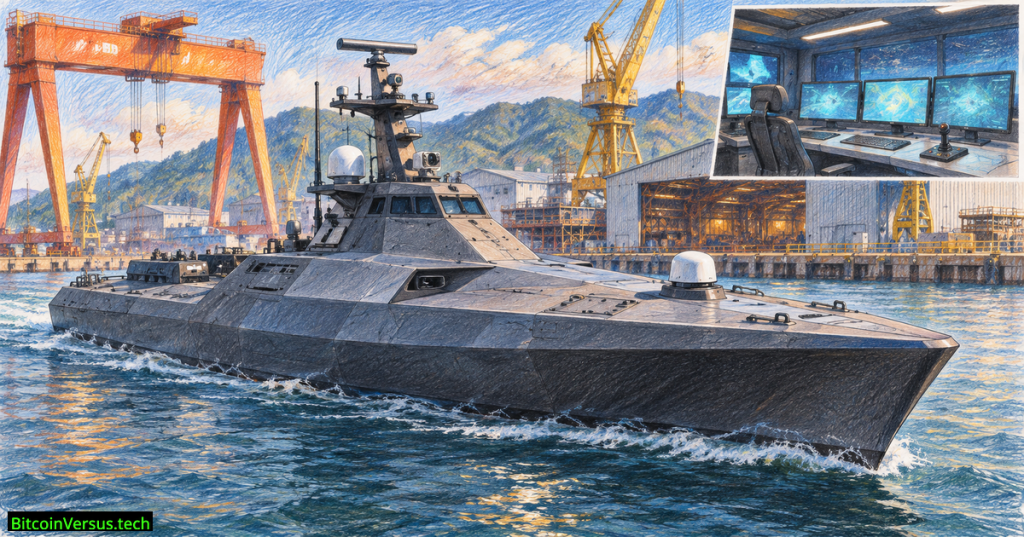
HD Hyundai Heavy Industries and U.S. defense technology company Anduril have launched ASV Alpha, a 600-ton-class autonomous surface vessel designed to operate without an onboard crew. The ship entered the water during a November 12, 2026 ceremony at the South Korean shipbuilder’s Ulsan facility, with HD Hyundai confirming the milestone on November 15. The two companies completed the prototype roughly one year after their November 2025 development agreement.
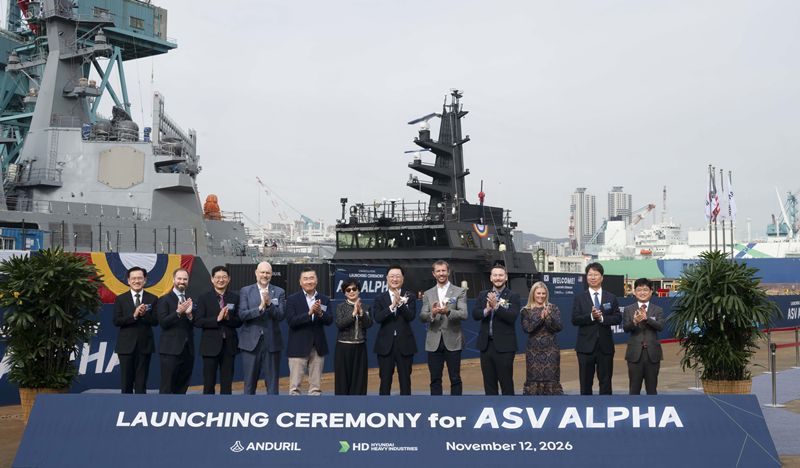
The reported 600 tons refer to light displacement, not the vessel’s full operating weight after fuel, supplies and payloads. ASV Alpha is intended for maritime reconnaissance, surveillance and intelligence gathering. Launching a prototype does not establish that the vessel has completed sea acceptance testing, entered military service or received a production contract from the U.S. Navy.
Official Anduril Industries video: “Lattice for Mission Autonomy.” Archival explanation of the company’s software, not footage of ASV Alpha’s November launch.
Two autonomy systems, one crewless ship
The vessel combines HD Korea Shipbuilding & Offshore Engineering’s VAone software with Anduril’s Lattice mission autonomy platform. VAone is derived from technology developed by HD Hyundai affiliate Avikus. It handles navigation, monitors machinery and is designed to recognize faults and respond to vessel damage. Lattice provides mission planning, coordination and sensor information management across autonomous assets.
The split is operationally important. Keeping a large ship on course, avoiding collisions and monitoring engines are different problems from deciding where to search, processing surveillance data or coordinating missions with other platforms. A functioning prototype must integrate both domains without creating unsafe behavior when sensors disagree, machinery fails or communications degrade. The companies have not disclosed independent reliability statistics for ASV Alpha.
A successful October trial used a different vessel
The partnership previously demonstrated VAone and Lattice during a roughly three-and-a-half-hour test near the Port of Long Beach, California, in October 2026. The test involved autonomous navigation, revised mission instructions, formation movements and simulated machinery failures, with observers watching from a shore-based control station.
A critical detail: the October demonstration used a modified 368-ton former U.S. Navy test vessel, not the newly launched 600-ton ASV Alpha. Results from the smaller craft support the software integration effort, but cannot substitute for testing the new hull, propulsion, sensors and control systems at sea. Naval News published the translated October announcement with the distinction and test scope.
What changes when no sailors are aboard?
A crewless vessel can reserve volume and support systems otherwise needed for accommodation, food and life support. HD Hyundai suggested a comparable crewed vessel could require about 50 sailors, although that comparison is a company estimate rather than a validated personnel saving across an operational fleet. Uncrewed ships still need maintenance teams, command staff, cybersecurity protection and reliable shore support.
Their safety challenges are substantial. Operators need evidence covering collision avoidance in crowded waterways, loss of satellite communications, navigation spoofing, emergency fire response, fault recovery and accountability for high-consequence actions. The launch announcement does not provide endurance, range, speed, collision-avoidance results or independently audited operating costs.
Archival video on Anduril’s Ghost Shark factory. Ghost Shark is an underwater robotic platform, separate from the surface-going ASV Alpha; footage is included only for context on Anduril’s maritime robotics operations.
Next comes proving performance on the water
The partners have indicated plans for U.S. trials in 2027 and are seeking future naval opportunities. Those steps remain planned rather than confirmed procurement awards. The meaningful next evidence will be trials on ASV Alpha itself, including sea-state limits, communications resilience, autonomous fault handling and the ability to complete missions repeatedly without intervention.
Other autonomous platforms illustrate how varied the field has become. BitcoinVersus.Tech previously reported on Saronic’s 180-foot Marauder and its testing claims, a robot boat collecting waste in Singapore, NXP’s robotics software development kit and Agility Robotics’ industrial humanoids. Autonomy spans different environments, operating risks and business models, so headline tonnage alone cannot establish technical leadership.
Sources: Korea.net, November 16; Yonhap News Agency, November 15; Naval News, November 16; HD Hyundai October demonstration statement as translated by Naval News.


Leave a Reply