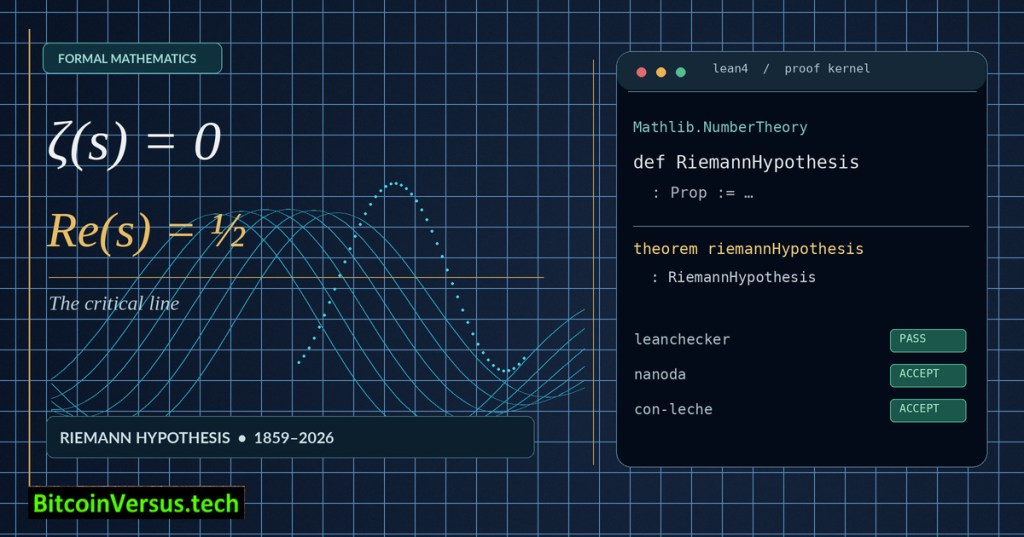
The Lean and Mathlib communities announced November 21, 2026, that they have formally verified Levent Alpöge’s Claude-assisted proof of the Riemann Hypothesis. Their joint statement, endorsed by the Lean Focused Research Organization and Mathlib Initiative, certifies both the mathematical statement and its formal proof. The announcement follows Alpöge’s November 20 release of roughly 17 million lines of Lean code, assembled while working with Anthropic’s Claude.
The result concerns one of mathematics’ most consequential questions, posed by Bernhard Riemann in 1859. The hypothesis asserts that every nontrivial zero of the Riemann zeta function has real part exactly 1/2. Those zeros help describe how prime numbers deviate from their average distribution. Numerical verification of trillions of zeros could never establish the statement for infinitely many possibilities; a proof must cover all cases.
What the Lean community actually checked
The verification was not merely a successful software build. The community required four distinct assurances: the formal statement matches the intended Riemann Hypothesis; the full library compiles; the final theorem is exactly the vetted statement in Mathlib; and independently implemented kernels accept the exported proof. Two comparison tools, comparator and con-leche, confirmed statement equivalence. Multiple proof checkers, including Lean’s kernel and independently developed implementations, accepted the logic.
An MIT verification log maintained by mathematician Andrew Sutherland documents the scale: 175,187 Lean modules compiled, and their kernel replay completed without rejection. The independent nanoda and con-leche checkers accepted the exported proof. An axiom audit identified only Lean’s three standard foundational axioms, rather than hidden assumptions introduced to force the conclusion. Michael Rubinstein of Waterloo reported additional independent checks, including a full module replay and independent kernel tests.
Why the generalized claim matters
Alpöge also announced a proof of the Generalized Riemann Hypothesis for Dirichlet L-functions. MIT’s verification page lists five checked theorems, including the classical hypothesis and statements covering Dirichlet characters. The scope is specific: it does not automatically cover every larger class of L-function, including all automorphic or Hecke L-functions. Formal theorem names and definitions matter because a perfectly checked proof of the wrong statement would not settle the intended problem.
AI can verify a proof before humans understand it
Alpöge’s original four-page note attributes major advances to Claude while describing his own role guiding the mathematics and selecting fruitful approaches. His release initially lacked a conventional human-readable derivation; the formal code was the central deliverable. A machine-checked proof establishes logical validity relative to its specifications and foundations, but understanding its central mathematical insight still requires substantial human exposition. Waterloo’s 164-page working draft began translating parts of the result into traditional language on November 21.
The distinction also applies to the $1 million Millennium Prize. As checked on November 21, the Clay Mathematics Institute still listed the hypothesis as unsolved. Its prize rules require publication in a qualifying outlet, at least two years after publication, and general acceptance by the mathematics community before consideration. Lean’s certification is significant evidence, not an announcement that Clay has awarded the prize.
Why the breakthrough matters beyond mathematics
A proof would sharpen theoretical understanding of prime-number distributions and countless results that use the hypothesis as an assumption. It does not by itself break Bitcoin’s SHA-256 hashing, Schnorr signatures, or modern encryption; no practical cryptographic attack follows from the announcement. BitcoinVersus.Tech previously covered Google’s 1.8-million-line Lean formalization, 6.5 million lines of AI-assisted software proof, AI-model verification technology, and the Navier–Stokes authorship dispute. Together, they show how independent verification and clear attribution are becoming central to AI-generated science.
For now, the central news is precise and historic: the Lean and Mathlib communities certify the Riemann Hypothesis proof’s formal correctness. The work ahead is to explain its mathematics, reproduce the checks more broadly, and follow the separate path toward long-term recognition.
Primary documents: Lean and Mathlib joint statement (November 21, 2026); Andrew Sutherland’s MIT verification record; Alpöge’s original announcement; Clay Mathematics Institute status. Videos provide scientific background, not recordings of the new result. Featured cover is editorial artwork using verified theorem and checker labels.
We volunteer daily to ensure the credibility of the information on this platform is Verifiably True. If you would like to support to help further secure the integrity of our research initiative, please scan the QR code below.


Leave a Reply