
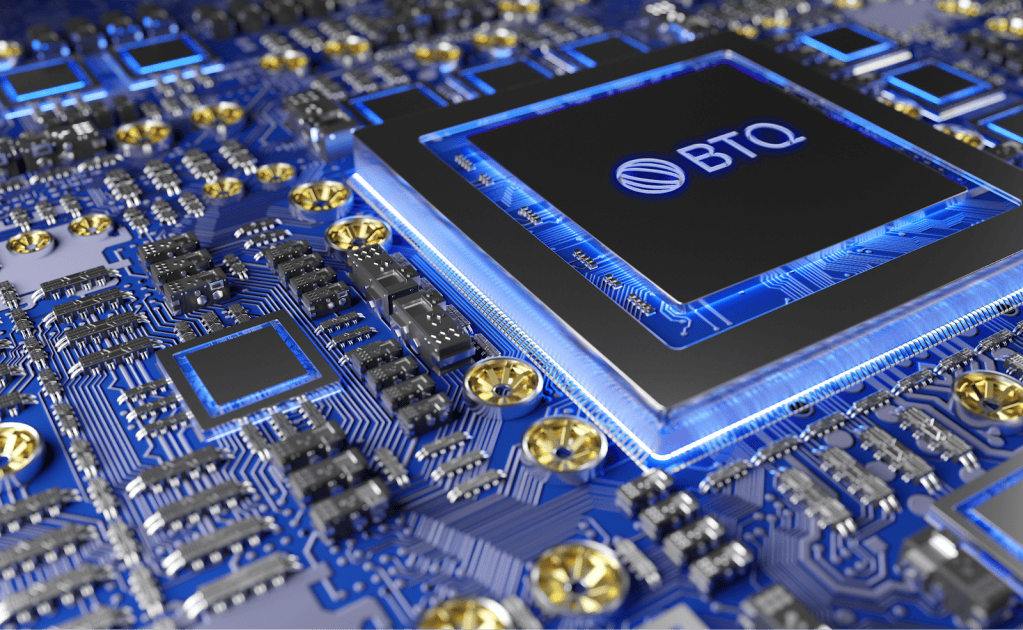
A new post-quantum security-chip design is moving toward physical silicon while a separate Bitcoin-inspired network prepares for its first outside audit. In a November 17, 2026 corporate update, BTQ Technologies said its QCIM cryptographic core had been validated in a TSMC 28-nanometer design environment through Taiwan’s ITRI research institute. BTQ and South Korea’s ICTK completed an integrated security-chip design in July. Neither milestone establishes that commercial chips have been fabricated, certified or shipped.
BTQ’s Chris Tam and chip executive Sean Hackett explain their post-quantum hardware and network roadmap in a June 2026 interview. Background explanation, not evidence of a November chip shipment. Watch on YouTube.
A cryptographic engine built around memory
QCIM stands for Quantum Compute-in-Memory. Its goal is to perform cryptographic operations near or within memory rather than repeatedly moving data between a separate processor and memory. Moving less data can reduce energy and latency, but BTQ has not published an independently reproducible power-efficiency benchmark for the planned commercial chip. The design is intended to support existing algorithms and several post-quantum alternatives, allowing new implementations through programmable cryptographic IP.
The integrated design includes ICTK’s physically unclonable function, or PUF, intended to derive device-unique identity from manufacturing variations in the silicon. Combining programmable cryptography with a hardware-rooted identity could be useful for servers, network devices, custody systems and remote infrastructure. A PUF alone does not prove resistance to every side-channel or physical attack; implementation, laboratory testing and independent certification remain necessary.
Three different hardware milestones
BTQ’s roadmap separates FPGA intellectual property, ASIC design IP and standalone security chips. An FPGA release and ASIC IP beta are targeted for the first quarter of 2027, alongside initial chip samples and silicon validation. The company targets production tape-out in the second quarter and validation in the fourth quarter. Dates are management forecasts, not shipping commitments. The 28 nm figure describes the design-process environment, not the efficiency of a Bitcoin mining ASIC.
That distinction matters because FPGA roots of trust, network cryptographic accelerators and SHA-256 mining hashboards perform different jobs. QCIM is aimed at protecting keys, signatures and authenticated devices; it does not claim to increase Bitcoin hashrate or lower mining joules per terahash.
Bitcoin Quantum is a separate network, not a Bitcoin upgrade
BTQ also develops Bitcoin Quantum, a proposed fork secured with ML-DSA signatures. The company says its testnet has run since January 2026, an internal audit was completed in the second quarter, and a first independent audit remains in progress. Mainnet is targeted for the first half of 2027, with potential exchange and custody integrations later in 2027. No change to Bitcoin’s existing mainnet consensus rules follows automatically from a separate fork’s launch.
Bitcoin 2026 researchers discuss how post-quantum signature sizes, verification cost and wallet design could affect Bitcoin’s own network. An independent technical discussion, not BTQ product validation. Watch on YouTube.
NIST standardized ML-DSA under FIPS 204 in 2024, but adopting a standardized signature scheme does not by itself make a Bitcoin-derived protocol secure or economically practical. Transaction sizes, verification workload, wallet migration and independent peer review still matter. Bitcoin developers are exploring other choices: our reporting on the SHRINCS security study and Blockstream’s post-quantum signature benchmarks explains competing approaches.
The milestone to watch is independent evidence
BTQ is developing hardware security technology and a separate blockchain network, not one completed quantum-proof Bitcoin product. Progress would be established by independently measured chip performance, fabricated samples, published security reviews, successful certification and deployed customer systems. For Bitcoin itself, any eventual signature migration requires its own technical scrutiny and network consensus. Our quantum computing guide explains the underlying threat without assigning a speculative date to a practical Bitcoin-breaking quantum machine.
Primary sources: BTQ November 17 corporate update filed with the SEC; BTQ and ITRI August validation report; BTQ QCIM architecture; NIST FIPS 204.
We volunteer daily to ensure the credibility of the information on this platform is Verifiably True. If you would like to support to help further secure the integrity of our research initiative, please scan the QR code below.



Leave a Reply