
China’s Moore Threads is preparing to show its next consumer graphics processor, code-named Lushan, at the MUSA Developer Conference in Beijing on December 29–30, 2026. A product manager has teased what could be the largest memory capacity on a consumer graphics card. The eye-catching 64 GB figure is a plausible calculation from an earlier roadmap, not an officially confirmed Lushan specification. The company has not announced pricing, retail availability or independently verified gaming performance.
The story accelerated after a November 18 social-media teaser and Moore Threads’ November 19 conference announcement. Its poster shows a concealed graphics card among mountains, a visual reference to the Lushan name. A November 22 X post by @kyzoroX repeats the 64 GB estimate. The embedded post is original-source social commentary; hardware specifications are checked against company disclosures and established reporting.
Original X post shared with BitcoinVersus.Tech discussing Moore Threads’ Lushan announcement and the projected 64 GB memory configuration. The figure remains an estimate pending official specifications.
Official Moore Threads replay of MDC 2025. Archival presentation about the company’s GPU roadmap, not a 2026 Lushan performance test. Open the original YouTube video.
Where 64 GB comes from
Moore Threads previously projected four times the memory capacity of its preceding consumer generation. Its existing MTT S80 carries 16 GB of GDDR6. Multiplying 16 by four gives 64 GB. NVIDIA lists 32 GB of GDDR7 for its GeForce RTX 5090, so the estimated configuration would double its VRAM capacity. The calculation does not establish that a shipping Lushan card will offer 64 GB or twice the RTX 5090’s speed.
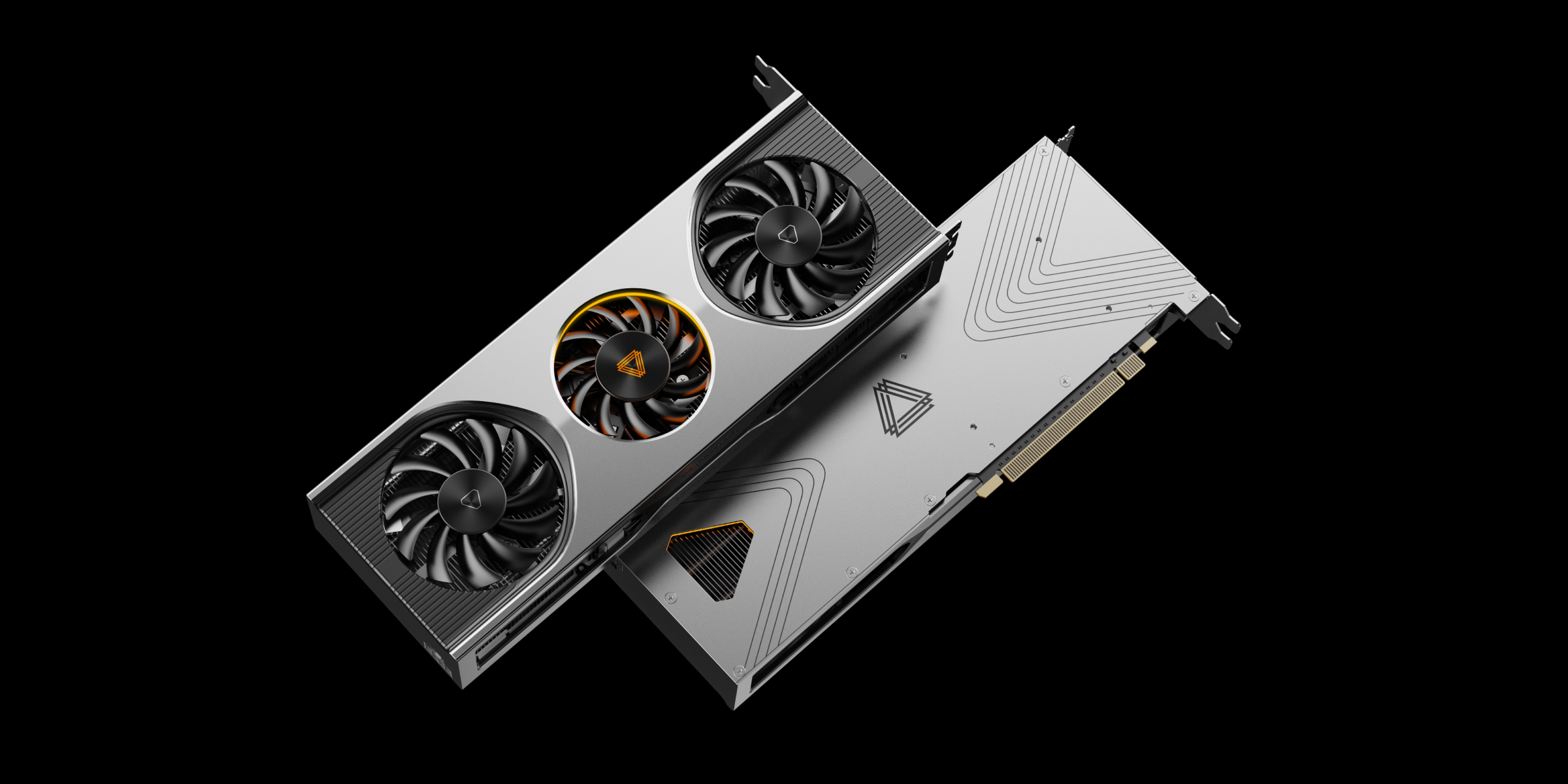
Professional accelerators already exceed 64 GB, including 96 GB NVIDIA RTX PRO models. Any consumer-memory record depends on the product category and the final hardware. Memory capacity, bandwidth and compute throughput are separate measurements. Moore Threads has not disclosed the new card’s memory type, bus width, sustained bandwidth, wattage, or price.
A major performance claim needs independent tests
The earlier Huagang architecture presentation advertised up to 15× AAA gaming performance, 50× ray-tracing performance, and 64× AI compute relative to prior-generation hardware. Those are manufacturer targets, not published, reproducible Lushan benchmarks. The 64× AI claim describes compute, not 64 GB of VRAM. Early independent tests of the MTT S80 also identified software and performance limitations, making game compatibility and graphics-driver maturity crucial.
Gamers Nexus’ July 2023 independent MTT S80 review. Historical baseline for Moore Threads’ driver and power-efficiency challenges; it does not benchmark Lushan. View directly on YouTube.
Why GPU miners and local-AI users should care
A larger VRAM pool can hold more AI-model weights, training data and working buffers without offloading them to slower system memory. BitcoinVersus.Tech recently examined the role of GPU memory in large knowledge stores and an experimental 80 GB mining-GPU modification. Software support and bandwidth can still prevent a memory-rich card from running a useful workload efficiently.
For GPU mining, extra VRAM helps only when an algorithm or workload needs it. Hashrate per watt, supported kernels, pool shares, drivers, electricity cost and reliability determine practical results. Our reports on Suprminer recovery fixes and AI workloads sharing GPU mining rigs address those operating constraints. Bitcoin itself remains SHA-256 ASIC-dominated; Lushan’s VRAM does not make it competitive with purpose-built Bitcoin miners.
What December 29 must answer
Moore Threads’ keynote is scheduled for December 29 in Beijing, but an event announcement is not a product shipment. Key unanswered questions include confirmed memory configurations, memory bandwidth, measured frame rates and compute performance, driver support, energy use, price, and delivery dates. Readers can compare independent gaming results against current high-end desktop GPUs after hardware reaches reviewers.
Sources and disclosure
Moore Threads’ MDC 2026 announcement; official S80 specifications; NVIDIA RTX 5090 specifications; VideoCardz’s November 2026 reporting and roadmap context; Tom’s Hardware’s reporting. Featured artwork is an original conceptual illustration, not a photograph of Lushan. Videos are authentic archival coverage of previous-generation hardware and announcements.
We volunteer daily to ensure the credibility of the information on this platform is Verifiably True. If you would like to support to help further secure the integrity of our research initiative, please scan the QR code below.



Leave a Reply