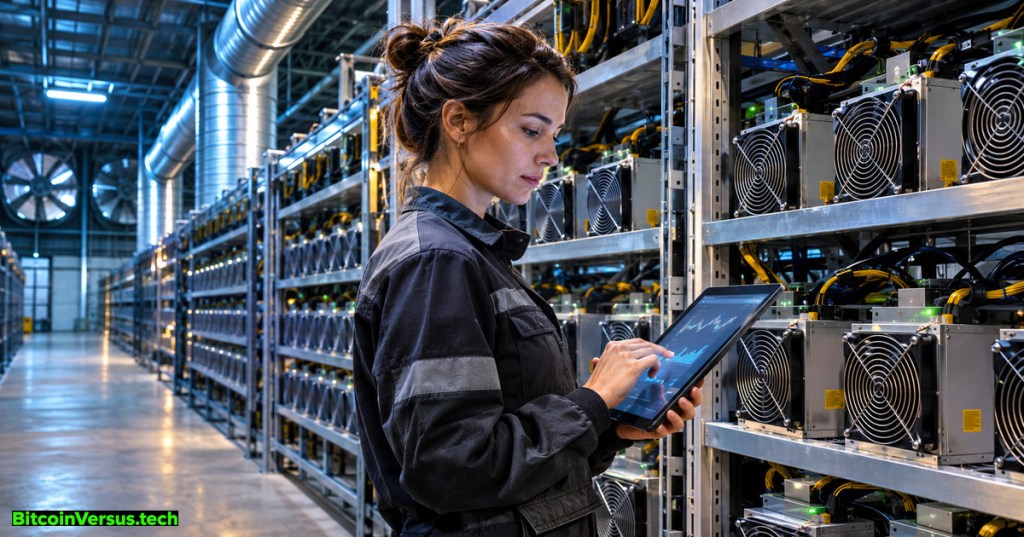
Bitcoin miners can now rent a named amount of SHA-256 computing capacity through NiceHash Virtual Machine Mining, or VMM, without purchasing, powering or servicing an ASIC. NiceHash describes fixed and flexible products, payable in USDT, and lets customers direct rented hashrate toward its own pool or another compatible pool. The operator announced the model in late September, then detailed its mechanics in November 2026. Buying virtual mining capacity does not make Bitcoin mining a software-only activity: actual specialized hardware still performs every hash.
Video context: Luxor Technology explains the Bitcoin hashrate marketplace, hashprice and difficulty. The educational recording predates NiceHash VMM and is not a product demonstration. Watch directly on YouTube if the player is unavailable.
Rent a virtual miner, not a physical ASIC
NiceHash offers three product tiers called Pickaxe, Rig and Farm, representing progressively larger virtual mining setups. The precise amount of computing power is shown before a purchase. Fixed packages commit the selected capacity for a stated duration; Flexible packages can continue while funds remain available, with USDT refills. A customer is purchasing a service delivering mining work, not ownership of the servers, cooling system, power contract or site.
The distinction matters operationally. A conventional mining deployment requires rack space, electrical service, network connectivity and maintenance personnel. A virtual customer delegates those functions to an infrastructure operator but takes on service-counterparty and contractual risks. The operator controls underlying equipment allocation and its real-world uptime; the buyer should look for delivered share data, package terms, charges and payout records rather than infer reliability from a dashboard.
Pool selection changes the economic model
NiceHash says the buyer may route capacity to the NiceHash pool or a compatible external destination. Using the NiceHash pool provides BTC payouts every four hours according to the company, but a payout schedule is not a guarantee of profitable returns. Pool reward methods, rejected shares, fees, minimum withdrawals and potential disconnects can affect net receipts. Customers choosing an external pool should compare hashrate reported by the rental dashboard against accepted shares recorded by the pool.
Our earlier NiceHash rented-hashpower block report concerned an individual miner’s block discoveries, a different product and a luck-sensitive outcome. The 471 TH/s solo-block case also illustrates why occasional windfalls cannot be translated into a reliable return expectation.
A simple break-even calculation
The right unit for comparing a rental with mining output is revenue per petahash per second per day, commonly called hashprice. Suppose a hypothetical 1 PH/s rental costs $35 for one day and earns a gross $30 in BTC at the actual network conditions and pool settlement rate. The operating difference is negative $5 before additional platform, exchange and withdrawal charges. If the same capacity earned $40, the gross margin before extra charges would be positive $5. Neither amount is a live NiceHash price or investment forecast.
The recent ASIC break-even analysis discusses the same principle for owners paying electricity bills. The November difficulty adjustment shows how changing competition affects expected output at constant hashrate. A rental price can exceed achievable mining revenue even if its infrastructure owner runs extremely efficient machines.
What makes VMM consequential
Mining power becomes easier to trial without a multiyear equipment purchase. For operators, short-duration capacity may help test pools and software, but customers still bear price, settlement and delivery risk. Our Texas electricity-curtailment analysis underscores why shifting physical operating risk does not eliminate it from the economic chain.
Primary sources: NiceHash VMM product explanation and NiceHash service fee disclosures. Platform descriptions are vendor claims, not independently audited proof of delivered performance. No rental was purchased or tested for the report.
We volunteer daily to ensure the credibility of the information on this platform is Verifiably True. If you would like to support to help further secure the integrity of our research initiative, please scan the QR code below.



Leave a Reply